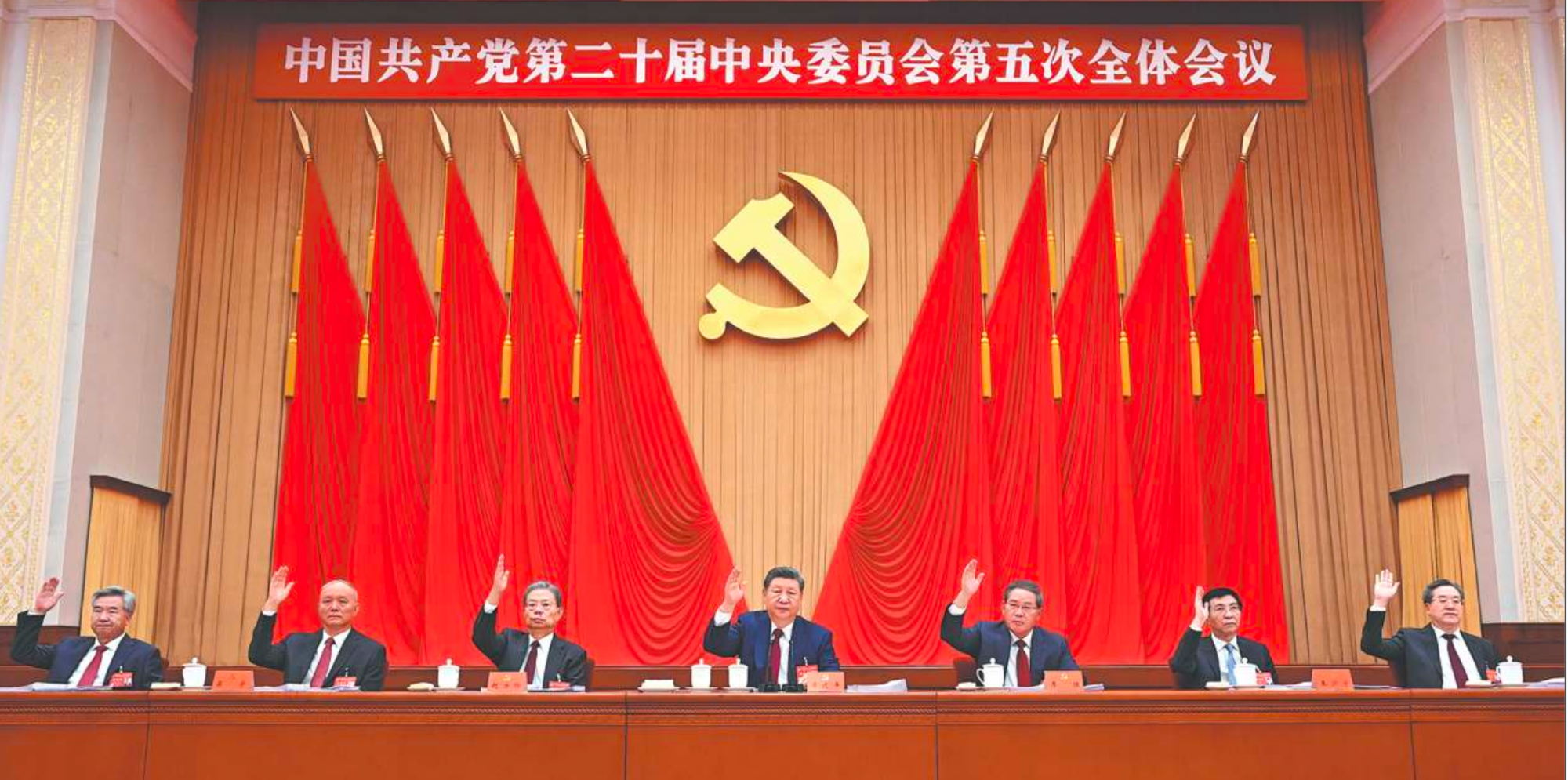
The 20th Central Committee of the Communist Party of China (CPC) held its fifth plenary session last week, focused on the Communist Party’s self-governance, which basically means strengthening discipline and fighting corruption. It is not only important to punish corrupt officials, but also to improve governance to eradicate the root causes of corruption, according to the communique issued after the plenum. The challenges facing the ongoing anti-corruption campaign remain grave and complex. Existing corruption has not yet been fully eradicated, while new cases continue to emerge. While intensifying investigations and prosecutions is important, it is even more important to identify and address institutional weaknesses revealed by individual cases, thereby reducing opportunities for corruption and effectively preventing its spread. Focusing narrowly on individual cases and treating them in isolation will not address corruption at its root. Besides following necessary procedures and examining specific violations of Party discipline and State laws, it is vital to delve deeper into the underlying causes of corruption, according to the communique.
Addressing both symptoms and root causes is essential to eradicating the conditions that breed corruption. Investigations and prosecutions not only deter and punish those involved in corrupt practices but also serve as warnings to potential offenders, prompting officials to stop misconduct before it escalates. Only by tackling the root causes of corruption can this menace be effectively curbed, ensuring that the CPC maintains its essential character, political integrity and fundamental purpose. Investigating cases is not an end in itself. The ultimate goal of the anti-corruption campaign is to improve governance. The fight against corruption depends on investigating individual cases, but it doesn’t stop there. The key is to integrate case investigations with post-investigation rectification and governance, linking problem identification, institutional improvement and tangible results, the China Daily reports.
The South China Morning Post adds that General Zhang Shengmin, the key player in the anti-corruption campaign that has cut deep into the military’s top leadership, has been appointed to the Party’s Politburo. Zhang is also Vice Chairman of the Central Military Commission (CMC), the People’s Liberation Army supreme command. Currently the only other member is CMC Chairman Xi Jinping. It is rare for promotions to the Politburo the happen between Party Congresses. The last time it occurred was in 1994. additionally, Liu Jianchao, a former Director of the CPC’s International Department and Vice Minister of Foreign Affairs was dismissed from the Central Committee and has been placed under investigation.
The Plenum endorsed disciplinary measures against 18 senior civilian and 16 military figures, all full or alternate members of the Central Committee. Only 162 of the 205 full Central Committee members attended the Plenum, representing a turnout of just 79%. A total of 117 alternate members were present at the session, compared with 147 last year. Ten alternate members of the Central Committee have been elevated to full membership, including Shanxi Governor Lu Dongliang, Zhejiang Governor Liu Jie, Inner Mongolia’s government Chairman Bao Gang and Liu Qiang, Party Secretary of Shandong’s capital Jinan. They are seen as rising stars in China’s political system because of their relative youth. The Plenum promoted the 10 officials to full membership of the Central Committee after 24 full members and 11 alternate members had been expelled. It has not been explained why only 10 full seats on the committee were filled when the latest round of expulsions created 24 vacancies.
The Communique singled out “unwritten rules” as a prominent problem to tackle. Unwritten rules refer to the implicit understanding that those with power must be compensated in exchange for jobs, services, promotions, contracts, land leases or even to access social welfare or admission to schools. This can take the form of money, sex or the exchange of favors. These rules have long permeated Chinese society and persist despite the party’s 14-year-long anti-corruption campaign. Measures to stamp out wrongdoing include regulations banning what were formerly commonplace practices, like extravagant business entertainment and gift-giving. “For a period of time, some unwritten rules have existed to varying degrees both inside and outside the party, undermining the authority and enforcement power of party rules and discipline, which has drawn strong reactions from cadres and the public,” said Xie Chuntao, Executive Vice President of the Central Party School. “The decision emphasizes starting by establishing clear rules and puts forward corresponding measures in advancing openness in party and government affairs, strengthening education and guidance, correcting related disorderly phenomena and establishing and improving institutional mechanisms,” Xie said, as reported by the South China Morning Post.