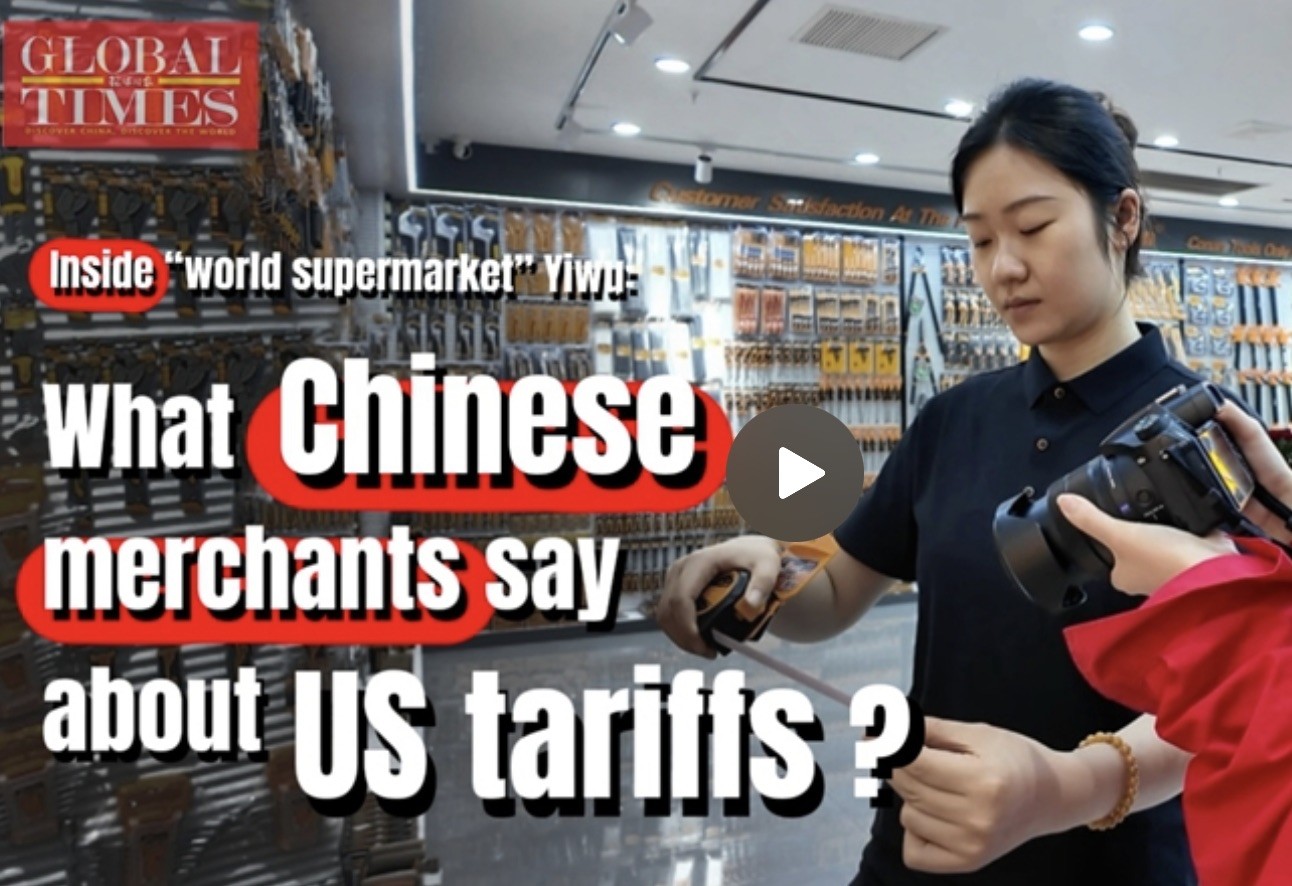
Shortly after the U.S. announced sweeping tariffs against its trading partners and singled out China for even higher duties, many have turned their eyes to Yiwu, known around the world as the global capital of small commodities for signs of impact. Far from being overwhelmed with anxiety, Wu, a manager at a hardware store in Yiwu in Zhejiang province was the picture of serenity. “Honestly, I'm not even worried.” Wu, a veteran hardware merchant whose clients include those from the U.S., appeared unfazed. “We just got a CNY10 million order put on hold by U.S. clients due to tariff concerns,” he said. “U.S. tariffs will certainly affect international trade. In previous years, my shop would be packed wall-to-wall with people at this time, around the Canton Fair,” Wu revealed. “But now, I can sit down and enjoy a cup of tea with you.” Despite this, Wu appears unperturbed, “Honestly speaking, this particular order is insignificant for my business,” as sales to the U.S. market account for less than 7% of Wu's company's annual revenue.
Wu moved from Beijing after the 2008 Olympic Games to Yiwu, after seeing an opportunity to start his own export business, encouraged by China's continued opening-up. From hammers to lawnmowers, his product range has already made inroads into the U.S. market, supplying large retailers such as Home Depot and Costco. Inside his combined office and storefront at the Yiwu International Trade City, the setting is orderly. While the U.S. continues to wield tariffs that have rattled global supply chains and sown uncertainty among businesses – making U.S. companies wary of placing new orders, Global Times reporters observed that many merchants and buyers from around the world still flock to Yiwu, fueling brisk daily transactions. Wu's attitude encapsulates the sentiment of many merchants in Yiwu who are feeling the ripple effects of U.S. tariffs on global trade. For many local companies, the U.S. market is their important export destination. Orders have been put on hold, and American clients are adopting a wait-and-see approach. Yet, the calm demeanor of the trade city's businesspeople and the continuous flow of new orders hardly suggest that this export-centric city is caught up in a swirl of tariffs and a new trade war.
Yiwu's vivid diversity becomes immediately apparent once you walk down the main streets of the city. Signs are printed not just in Chinese, but also in Arabic, Spanish, Portuguese, and Cyrillic among others. Restaurants serving Turkish, Ethiopian, Brazilian, and Argentine cuisine pack the streets. Yiwu is a cosmopolitan hub. According to official data, its permanent population was around 1.9 million at the end of 2023, of which more than 300,000 were foreign nationals, among whom more than 21,000 were long-term residents engaged in business. Yiwu trades with almost every country in the world, with particularly fast growth among Belt and Road Initiative (BRI) partner countries in Africa, the Middle East, and Latin America, according to Wu. “For people in these regions, the fastest route to start a business is to come to Yiwu. Our products are high-quality, diverse, and easily customizable,” Wu said. “If tariffs slow down our U.S. sales, higher demand from other markets could quickly offset any loss.”
According to Yiwu Customs, the city's total imports and exports in 2024 reached CNY668.93 billion, up 18.2% year-on-year. Of that figure, trade with African nations totaled CNY122.09 billion, up 16.4%, and with Latin America the figure stood at CNY111.67 billion, up 24.4%. The city's trade with Saudi Arabia also rose 16.5% to CNY16.46 billion. While interviewing Yiwu-based merchants, Global Times reporters observed a prevailing sense of optimism. Rather than feeling weighed down by the burden of tariffs, most business owners – even those directly hit by canceled orders – expressed confidence.
“We had a U.S. client who recently paused a shipment worth several hundred thousand yuan because of tariffs,” Wang Nan, a hardware merchant who has operated in Yiwu for more than 20 years, told the Global Times. “But that doesn't bother me a lot. Although tariffs did cut the ongoing orders with our U.S. partners, our overall sales remain steady,” Wang said. “In the coming months, we will attend trade fairs in Kenya, Saudi Arabia, and Southeast Asia, to explore new growth opportunities,” she added. Just as Wang was speaking with the Global Times, two traders from Azerbaijan walked into her shop. After briefly inspecting a few product samples, they swiftly decided to place additional orders for grinding wheels and electric screwdrivers. “We don't put all our eggs in one basket; we export to every corner of the globe. If Americans stop buying, we'll simply sell to others. That's the source of our confidence,” Wang told the Global Times.
“If you see a character in a movie that premiered yesterday, you can have that toy produced today – only in Yiwu,” Wu said. In his view, it is precisely because of Yiwu's speedy and flexible production capacity that small businesses from around the globe are drawn there, and these smaller enterprises serve as Yiwu's key shield against the threat of U.S. tariffs. The Yiwu International Commodity Trade City, a sprawling network of 75,000 booths, showcases over 2.1 million kinds of goods, the Global Times reports.