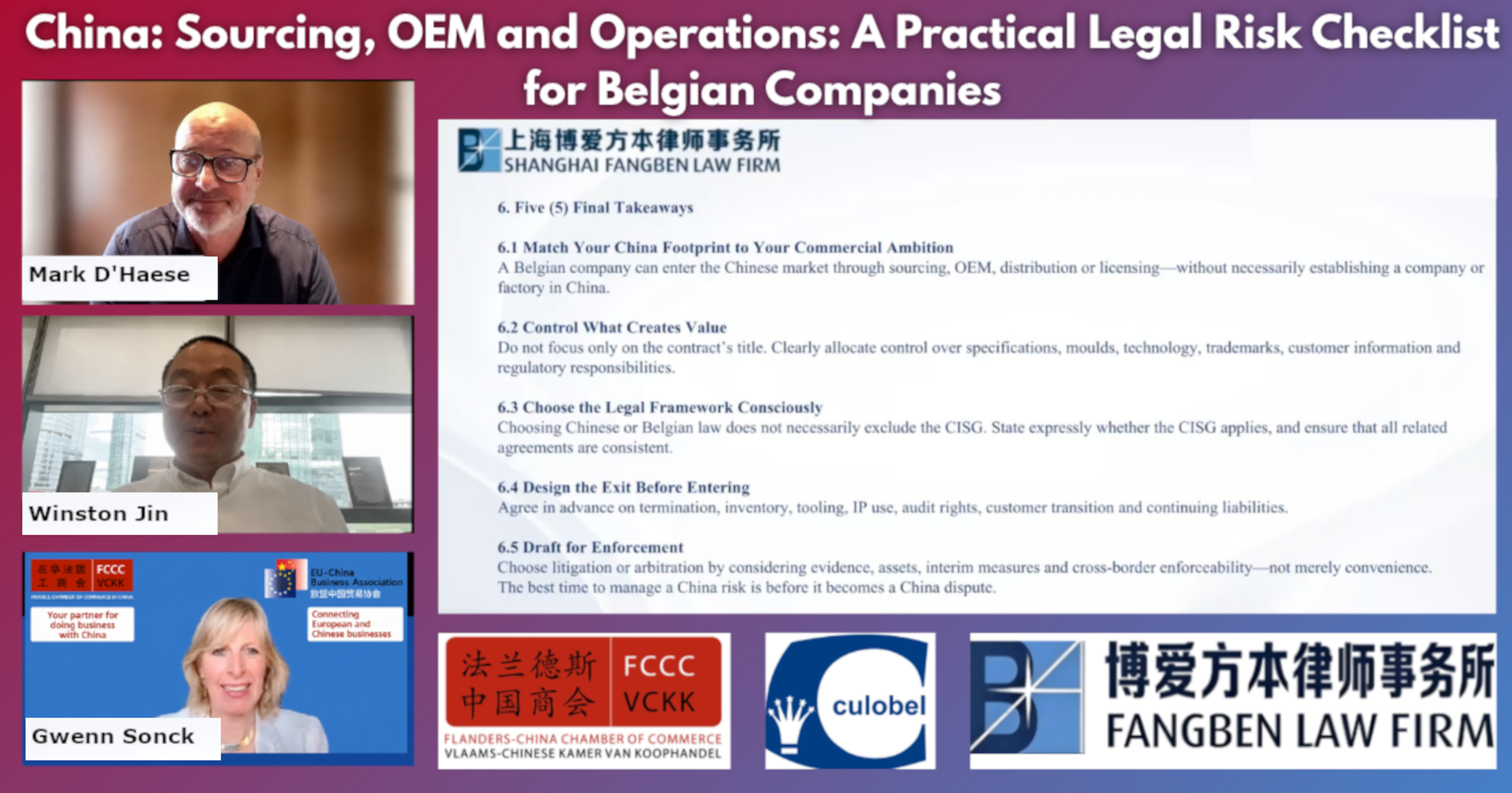
The Flanders-China Chamber of Commerce organized a webinar entitled “China: Sourcing, OEM and Operations: A Practical Legal Risk Checklist for Belgian Companies,” on 20 August 2026. Ms. Gwenn Sonck, Executive Director, Flanders-China Chamber of Commerce, introduced the topic of the webinar and the speakers. The webinar is bringing together two complementary perspectives: expert legal guidance and the practical experience of a Belgian industrial company operating in China. The country remains one of the world's most important manufacturing and sourcing ecosystems. The scale, strength, and efficiency of its industrial clusters have made many global companies reliant on Chinese supply chains to remain competitive. The latest survey of European business in China confirms this continued importance as 94% of respondents of EU businesses in China consider China as an important sourcing destination, while 75% report that their production in China is more efficient than their production in the rest of the world. Companies particularly value China's delivery speed, cost competitiveness, reliability, quality, and global compatibility. At the same time, regulatory compliance receives a lower rating, which underlines the importance of sound legal advice and effective risk management.
Mr. Winston Jin is Co-founder and Attorney-at-Law at Shanghai Fangben Law Firm, a structural partner of the Flanders China Chamber of Commerce. Fangben is a full-service Chinese law firm headquartered in Shanghai with 15 offices across China. In 2026, Fangben was recognized by Corporate INTL Magazine, a UK-based international business publication focused on legal, financial, and corporate advisory sectors as international business law firm of the year in China. Mr. Winston Jin has been engaged in legal education and legal practice since 1986. He advises European and American companies operating in China and has extensive experience in international business law, foreign direct investment, cross-border transactions, technology licensing, and arbitration. He has also served as an arbitrator of CTAC and SHIAC since 2005.
Mr. Winston Jin: The business picture for Belgian and China businesses has changed greatly. Twenty years ago, every three to four weeks some Flemish people knocked on my door, requesting me to identify the best location, purchase land or identify ready-made industrial facilities to create their manufacturing companies. The second wave was that I set up trading companies for them. But now, the situation has changed drastically and also structurally. All of the FDI from Belgium has been contributed by relatively big companies from like Umicore. They are still expanding their capital sites in China. Talented Belgian business people, especially SMEs, have transformed from FDI manufacturing to flexible operations in China by doing sourcing and OEM so that they can buy something or organize some goods flow from China. Even more smartly, some leading Belgian companies have successfully run their operation in China by means of distributors, trademark or patent licenses. Among many other EU members, Belgians are still very successful in China. For freshmen who are just contacting China for business development or who have been dealing with China for years, most important is to know your counterparty. Especially when you are approaching or when you are approached by a Chinese entrepreneur who is telling you that he has multi entities, say five companies in the same city or different cities.
Be careful. You have to be double cautious or a disaster will occur. You should not only look at one of the entities, but also at the business license, the legal representative and the one who signs the contract. Also ensure that the company who signs the contract with you really is manufacturing the products and delivering them to you. Who invoices you or who receives the payment? China is still a country with strict foreign exchange control. If there is something wrong with foreign exchange or cash flow, your business will get stuck. Who really holds the assets? Someone would show you some plant with a very beautiful production line, but be careful when you don't read Chinese characters. You have to ensure that he's showing you his own plant, not somebody else’s.
And last but not least, don’t forget that besides the business license, China has a very complicated and a tough system of production licenses and CCC, China Compulsory Certificates. There are 24 types of industrial products currently covered by production-license requirements under the implementation rules effective from 1 April 2026. Demand to see the production license, otherwise, it's totally illegal and unenforceable for you to proceed with your contract signing. There are also 17 categories of products subject to CCC in China, 106 plus specific product types in total.. You have to verify your counterparty first and then classify the products in terms of production license and CCC. For example, Logitech is producing computer mouses. The manufacturer and the seller in China must have a radio license from the Radio Administrative Committee of each city.
In the future, even after the conclusion of the contract, if there are any changes, they must be subject to your prior approval and written consent. The definition of the products or services must be very carefully defined. What exactly must the supplier deliver and when? We have to link the payment to performance. Ownership and acceptance are not necessarily the same. At delivery in Belgium or other European countries, do not say the quality of the products will be okay. Both Belgium and China are Contracting States to the CISG. Article 39 requires notice within a reasonable time after the buyer discovered, or ought to have discovered, the lack of conformity, while Article 39(2) sets a separate two-year outer limit from actual delivery, subject to any contractual guarantee period. The contract should therefore specify inspection, notice and warranty periods.
Which law applies? CISG is the United Nations Convention on Contracts for the International Sale of Goods, and both Belgium and China are Contracting States. Over my career of nearly four decades, relatively few Belgian clients have preferred to keep the CISG applicable. Where a Belgian company and a Chinese company enter into an international contract for the sale of goods, the CISG will generally apply directly unless the parties exclude it. Simply choosing Belgian law or Chinese law does not necessarily exclude the CISG. Therefore, if you do not want the CISG to apply, the contract should expressly exclude it and specify the governing domestic law. This is also important because certain matters fall outside the scope of the CISG and must be governed by the applicable domestic law.
How a dispute should be resolved, and which law shall be applicable is very simple: it depends on your bargaining power. Which law shall be the governing law and where shall be the forum for dispute resolution, Belgium, Hong Kong, Singapore, or China, will be greatly dependent upon how strong your bargaining power is. There are three scenarios. Both governing law and dispute resolution are on the side of Belgian. If the Chinese party chooses CTAC then normally the governing law should be Belgian. If you are relatively strong, you could still insist upon Belgian law as governing law with third party arbitration in Hong Kong or Singapore.
Five final takeaways:
1. Match Your China Footprint to Your Commercial Ambition.
2. Control What Creates Value.
3. Choose the Legal Framework Consciously.
4. Design the Exit Before Entering.
5. Draft for Enforcement: consider evidence, assets, interim measures and cross-border enforceability—not merely convenience.
Mr. Mark D’Haese, CEO, Culobel Group, presented his company’s experiences in China. Culobel is a rather old company of almost 100 years old, only active in Belgium in 2000. A plant in the Czech Republic was added, and in 2005 some activity in China, where at this moment the company has a sourcing and engineering office with three people. Turnover of the whole group is €40 million. The company produces sheet metal products for which you need strong machines, presses, and on the other hand, the tooling, dies or molds where the know-how lies. As a spinoff of these activities in the mid 90s, we started producing pressure vessels. The real sidekick is Velo-Boxx, a company producing and installing high-end solutions for bike storing. We found out that in Europe our pressure vessels were encountering more and more competition because we bought valves at €7 in Poland, but our competitors could buy them for USD2.5 in China. We went to a trade exhibition in Beijing and built up our contacts, including with the FIT representative and Winston Jin.
We started with a person hired on the payroll of a wholly foreign owned enterprise (WFOE) set up by FIT, but the quality control of our suppliers came basically down to two elderly ladies that sorted the good and the bad parts, and then 20% was thrown out, and 80% were hopefully okay. We drafted some measuring reports that they had to fill out and that they had to deliver together with the parts. In 2009, I got a question from a Belgian customer to copy-paste a production line that we had installed for them to China. We set up a company in Suzhou, but our customer’s end market collapsed the moment we were ready to produce in China, and all of a sudden we had a company in China with not enough jobs so we had to close the company in 2015. During these five years, we learned a lot. We put our suppliers under a lot of price pressure, but you get what you pay for. They modified something or used other materials just to lower their cost and we had all kinds of quality issues.
The quality cascade is something I ran into several times. When you want to order a new product in China, it's extremely amazing how fast they can come up with a first sample, and the sample looks perfect. It's great, it's overnight sometimes, it looks perfect. But what you see then is that basically the owner himself has made the sample or his best people have made the sample, and there's a lot of attention and a lot of care going into the sample. When you then order the first small test series, 5 or 50 parts, it's still okay. But when you start mass production, all of a sudden, you see the quality go down. They hire new workers, but do not instruct them properly. All the agreements that you made with the boss are forgotten, or the standard is somewhere down in a drawer. It also happened that they outsourced to the neighbors if the were cheaper.
We had to close the company, but we still had good people in China and a good network of reliable suppliers. So we created a competitive advantage buying our tools for ourselves and we could sell them in the European market at an attractive price.
We have our tooling Bible, which is basically the standard describing everything. Fifty percent of the payment is only done after the tool is tested in Belgium or Czechia. Fangben drew up a structure to deal with all these worries, also describing the structure of the company. What works for us? Culobel is a small company without big resources. We have three people in China. Build a network, go talk to people, go talk to FIT and go to events. Due diligence is very, very important, legally, are we talking to the right people? Don't hesitate to take the plane quite often. Clear standards are very important. Quality, you get what you pay for. If you push too hard, you will get something, but it will not be what you think you will get. Be reasonable, we are looking for relationships. We are not looking for quick hit and runs. You can draw up very, very strict and severe contracts, but in the end, you must do business, and you have to work with your suppliers. I also am in favor of simple and clean contracts, describing what you need and avoiding all kinds of very harsh clauses that basically nobody can make work.
A Q&A Session concluded the webinar. Q.:Could you explain what China can do that Belgium and the Czech Republic cannot do? Mr. D’Haese: Many things. The speed, flexibility and creativity are enormous. We are good in Europe in maintaining things, and we're always afraid of new things in China, they go fast. You see it now in cars, you see it in everything.