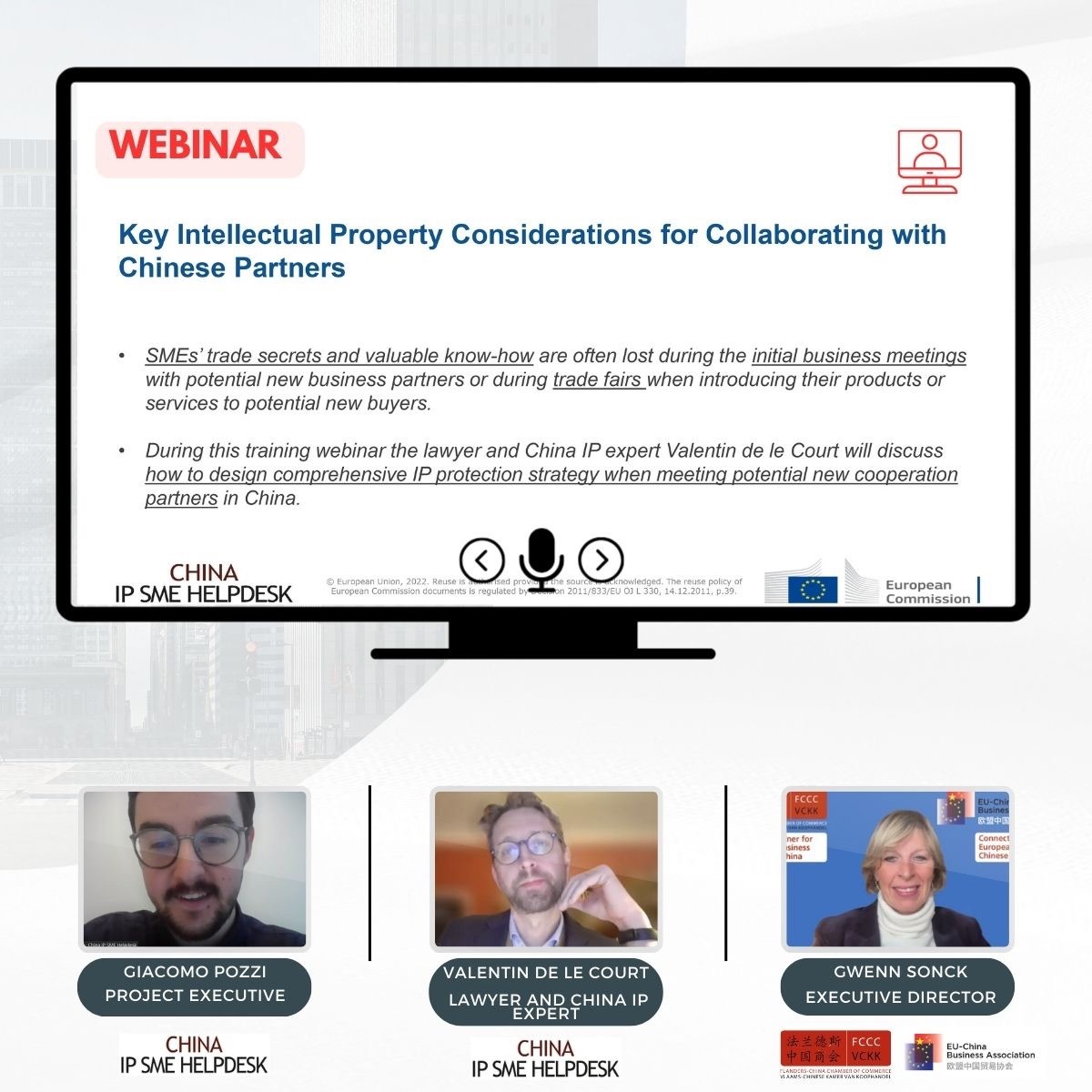
The China IP SME Helpdesk, the Flanders-China Chamber of Commerce and the EU-China Business Association organized a webinar focused on “Key Intellectual Property Considerations for Collaborating with Chinese Partners” on 12 December 2023.
Mr Giacomo Pozzi, Project Executive China IP SME Helpdesk, introduced the Helpdesk, which is funded by the EU and gives free advice to SMEs. The main service is the helpline at question@china-iprhelpdesk.eu giving free advice within three working days. More services are available on the website at https://ec.europa.eu/ip-helpdesk
Ms Gwenn Sonck, Executive Director Flanders-China Chamber of Commerce and EU-China Business Association, introduced the Chamber and the Association, and welcomed the participants to the 11th joint webinar with the China IP SME Helpdesk. It is very important that companies doing business with China also have an IP strategy included in their China business plan. The attractiveness of China as an investment destination varies by sector. Innovation is one of the reasons why European companies want to be in China. It is crucial to do the innovation where the applications are and companies cannot allow not to be close to their customers. If companies want to keep up with the technology of the future they must continue to invest in China. The speed of innovation in China is very fast and keeps our companies sharp. China is the largest producer of AI research in the world and files more than 60% of the world's AI patents with the World Patent Organization. China is No 12 on the global innovation index. Three Chinese science & technology clusters are among the world's top 5.
Mr Valentin De le Court, Lawyer and China IP Expert talked about Key Intellectual Property Considerations for Collaborating with Chinese Partners. Intangible assets have become key in today's economy. In 1975 intangible assets constituted 17% of corporate value, but by 2020 this portion had increased to 90%. What distinguishes you from other companies is often your capacity to innovate and to monetize the results of your innovation. Two legal tools help you protect that innovation: IP rights and trade secrets. IP is extensively used by the largest companies in the world. Intellectual capital is the foundation for market dominance and continuing profitability. Today many partnerships and investments are IP driven because IP is often the most important asset of businesses today.
Why should an EU SME care about IP and invest to protect its intangible assets? IP is there to help you protect your competitive advantage by granting exclusive rights enabling you to have a monopoly and excluding others from exploiting your rights without your authorization. You should also protect your IP to attract investments, which is often an absolute must for Chinese investors, who don't want to invest in a company without a good IP. Freedom to operate (FTO) reduces the risk linked to technology commercialization. When you want to commercialize your technology in a new market you need to pay attention not to infringe the IP rights of third parties. Chinese businesses are massive filers of IP rights and have built important IP portfolios. Having a sound IP strategy gives you increased control and decreased risk when outsourcing and collaborating with manufacturing partners. IP protection is also important for tax purposes and last but not least when you want to enter new markets. Therefore, IP will be at the heart of any internationalization strategy and will be key to succeed on the Chinese market.
In less than four decades, IP in China moved from no man's land in 1978 to top national priority in 2023. Today there is a complete set of Chinese IP laws in place characterized by legislative dynamism. In the period 2017-2021 all the major IP laws were amended. The IP system is constantly adapted to fit the rapidly evolving economy. IP has become a central part of China's development strategy and China has the ambition to become an IPR powerhouse as there is a 15-year plan to develop the IP system in the 2021-2035 period.
China is the No 1 country for patent applications. In 2015 more than a million patent applications were filed, increasing to more than 1.5 million in 2021. Filings by Chinese companies amounted to 90%. There is a clear shift from quantity to quality. Chinese companies rely less on the utility models system and there is a reduction in patent subsidies. China was again the No 1 PCT applicant in 2021. Applicants from China filed almost 70,000 PCT applications in 2021 and it is the country with the most applicants in the top 50 university list. Huawei was the top PCT applicant in 2021. R&D spending in China grew tenfold between 2000 and 2016, while it has stagnated in the U.S. China is set to pass the U.S. on R&D spending by 2025. This is a sign of how important innovation has become.
IP is now essential for Chinese businesses. They are IP aware and IP rich, having understood that IP gives them a competitive advantage and creates value. Chinese businesses have become very strong IP competitors, which has an impact on foreign businesses that want to be active on the Chinese market. More and more Chinese companies are starting IP litigation against their foreign competitors. You need to be aware of that and be prepared.
How to protect your IP when meeting potential new partners or during trade fairs? The first thing is to plan ahead. Protecting your IP requires preparation before meeting partners and before attending the trade fair.
Step 1: Know your IP, perform an IP audit and due diligence and understand what to protect. Intangible assets are non-physical and therefore difficult to identify and often SMEs lack an overview of their IP assets. You need a comprehensive overview of what you have to protect your products and technology. You need to ascertain their legal status, territorial coverage, value, and related risks.
Step 2: Understand how to protect your competitive advantage. There are two types of rights that you can use. An intellectual property right (IP) is an exclusive right granting a monopoly. Different IPRs serve different goals. Trademarks protect indication of origin of goods and services. Patents protect technical features of a product or process. Designs protect the external aspect of products. Copyright protects creative works, a broad notion including software. Trade secrets (TS) do not provide an exclusive right, but provide protection based on the nature of the information and the way it is handled by the holder. They also provide protection against unlawful acts. It is important to create a bundle of rights including different IPRs and trade secrets.
Step 3: Have enforceable IP rights. An IP right is a territorial right: if you are protected in Europe and the U.S. you are not necessarily protected in China. Your IP portfolio needs to cover the Chinese market. Keep in mind that registration is needed. IP rights protection is not automatic. If you do not apply for registration in China, you are giving a free license to your Chinese competitors to use your inventions. Also adapt to the specificities of the Chinese IP system and work together with people that master the system.
Step 4: Use contracts to protect your IP that organize your collaboration on different levels. IP is relevant to numerous contracts, including technology contracts, manufacturing agreements and employment agreements. Execute an enforceable non-disclosure agreement (NDA) before disclosing anything of value and take care that it is enforceable in China.
There are two types of patents in China: invention patents and utility models. There are three conditions for patent protection – similar to Belgium – absolute novelty, inventiveness, and practical use. Patent rights are granted for a limited term: 20 years for invention patents and 10 years for utility patents. The utility model is an interesting feature of the Chinese IP system. They only cover products and smaller technical improvements. The inventiveness level is lower than for an invention patent. There is no substantive examination and it can be registered quickly within 6 to 12 months at a lower cost.
Trade secrets can protect a very broad range of information, provided that three requirements are met: the information must be secret, have commercial value, and you need to pro-actively protect the confidentiality of the information. Signing an NDA is a good start but is not sufficient. Without reasonable steps the information is no trade secret. The Chinese Supreme People's Court has published a non-exhaustive list of confidentiality measures. Keep track of all the information that you share. The main risks come from employees, consultants and business partners. Enforcement is challenging so you should document well.
Don't forget to register your trademarks before meeting with Chinese partners because China is a first to file country and there are many filings in bad faith, known as “trademark highjacking”. Prevention is better than cure.
When meeting with potential partners: execute an NDA; organize what you share and disclose only what is needed; be aware of risks of trade secrets disclosure and misappropriation; perform background checks, and carefully follow up and monitor your trade secrets.
Conclusion: Be proactive and have a tailor-made China IP strategy; sign NDAs; organize what you share; and select your leads and perform background checks.
An Q&A session concluded the webinar.