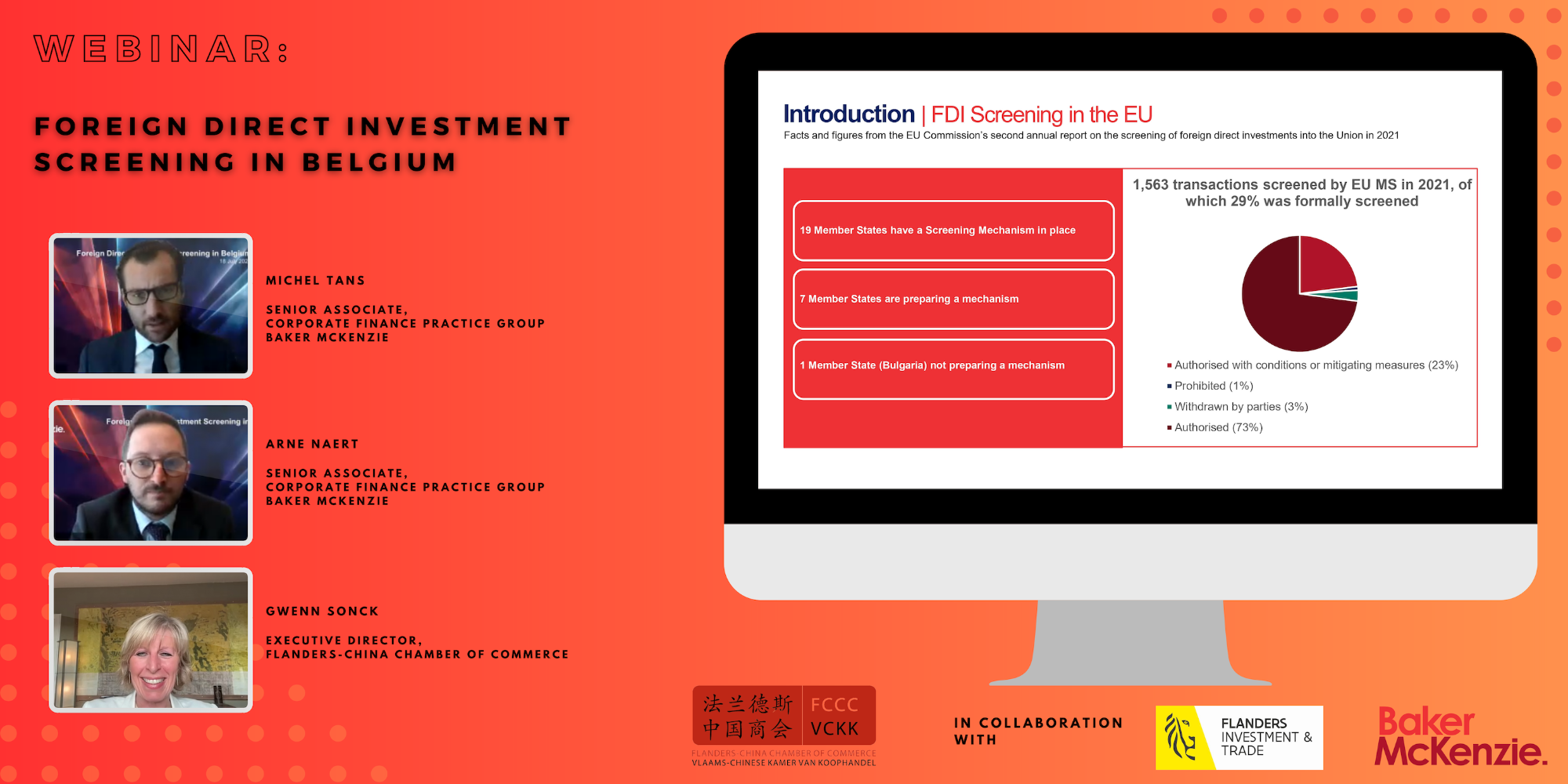
The Flanders-China Chamber of Commerce, with the support of Flanders Investment & Trade, organized a webinar on the new foreign direct investment screening mechanism in Belgium, which entered into force on 1 July 2023. This webinar took place on 18 July 2023.
Gwenn Sonck, Executive Director, Flanders-China Chamber of Commerce, welcomed the speakers and the participants. As in many other countries, an FDI screening mechanism has entered into force in Belgium. Messrs. Arne Naert and Michel Tans, both Senior Associates at the Corporate Finance Practice Group of Baker McKenzie, provided insight in the scope of the regime, the filing process to be followed, and the possible outcomes thereof. The sanctions for non-compliance were also discussed as well as how the new regime impacts M&A deals in Belgium.
According to recent reports by the Rhodium Group, Chinese investments in 2022 in Europe – the EU + the UK – went down by 22% compared to 2021 and reached €7.9 billion. A lack of Chinese M&A activity was the main reason for this decrease. A number of factors from China's zero-Covid policy to rising global risks following Russia's invasion of Ukraine created strong headwinds for Chinese investors to invest in the EU. Greenfield investments overtook M&A for the first time since 2008, driven by electric vehicles and batteries. Chinese greenfield investments in the EU increased by 53%, exceeding M&A flows. Consumer products and automotive remained the top sectors. A strong rebound in 2023 is unlikely, but investments could recover slightly.
Mr. Arne Naert, Senior Associate, Corporate Finance Practice Group, Baker McKenzie, explained that the topic of FDI investment screening was likely to have a material impact on how deals would be done in Belgium. FDI screening is new in Belgium, but has been common for a number of years in the U.S. (CFIUS) and Australia (FIRB). In the EU, FDI regulation was not a priority, but this has been changing about 10 years ago when a bloc of countries was in favor of FDI screening and another bloc opposed it, arguing that more regulation would detract from the power of the single market. In 2019 there was enough consensus among the member states to pass a regulation that encouraged member states to set up FDI regulation. Since then, FDI has become a focal point at the EU level. Recent events such as the Covid pandemic and the Ukraine crisis have provided more fuel to the shift towards more FDI regulation.
We have seen a similar evolution in Belgium. Belgium is an open economy where inbound FDI is very much encouraged and not restricted. This started to change with the notorious Eandis case in 2016, which became an eye opener for some Flemish policy makers. At that time a Chinese state-owned entity attempted to acquire a minority stake in the Flemish electricity distribution grid operator Eandis. Also a letter by the intelligence services was leaked to the press about potential risks associated with that transaction, followed by a lot of debate. The Flemish parliament adopted an ex post screening regime limited to FDI in Flanders' public and semi-public assets in 2018. This was a milestone because it was the first FDI regulation in decades in Belgium, but the scope was very limited and the procedure has never been applied so far. With the recent developments, this has inspired all federated entities of Belgium to agree on a screening regime of broad application and an ex ante screening regime of general application in 2023.
The EU regulation 2019/452 does not impose an EU-wide FDI screening requirement and does not require EU member states to implement national FDI control mechanisms. It does establish a framework for screening of FDI in the EU and minimum requirements that each local regime must adhere to, such as being subject to timetables, being transparent and not discriminating among third countries. The regulation puts in place an elaborate framework of collaboration and information exchange requirements. Member states can give each other advise on prior dealings with certain foreign investors.
Facts and figures from the EU Commission's second annual report on the screening of FDI into the Union in 2021 shows that 19 member states had a screening mechanism in place, seven were at the time preparing a mechanism, and one (Bulgaria) had no intention of doing so. Meanwhile, many of the 19 that have a regime have beefed it up, and most of the seven now have a fully operational mechanism. In 2021, 1,563 transactions were formally notified, of which 29% was formally screened. Of those 500 cases, 73% was authorized, 23% authorized with conditions or mitigating measures, 3% was withdrawn by parties and 1% was prohibited. The prohibition of an FDI transaction is indeed a last resort. We expect those numbers to rise in the coming years.
On several levels in Belgium there was a consensus that some form of FDI regulation would be desirable. The federated entities quickly realized that you can't have nine different procedures, so on November 30, 2022 a cooperation agreement was agreed, which is a treaty among the governments of two or more federated entities. Each of the parliaments has rubber stamped this agreement and the regime entered into force on July 1, 2023. There is now a single point of contact for an investor and a single framework. But the text of the agreement is a compromise, so some of the provisions are a bit vague.
To fall under the scope of the agreement you need a foreign investor doing an FDI transaction that has a potential effect on security, public order or strategic interests. A foreign investor is either a natural person with its main residence outside of the EU, an undertaking constituted or organized under the laws of a non-EU country, or an undertaking which has an ultimate beneficial owner (UBO) with its main residence outside of the EU. There is no exception for members of the European Economic Area or intra-group situations, and there is also no foreign-to-foreign exemption.
The second ingredient to have a notifiable transaction is that the transaction undertaken by the foreign investor must qualify as an FDI transaction, which is defined as “an investment of any kind by a foreign investor aiming to establish or to maintain lasting and direct links between the foreign investor and the entrepreneur to whom or the undertaking to which the capital is made available in order to carry on an economic activity in a member state of the EU, including investments which enable effective participation in the management or control of a company carrying out an economic activity”. This includes investments which enable effective participation in the management of or control over the target. If a transaction by a foreign investor results in a change of control over a target, you may be in scope. Another concept is effective participation in management, such as the power to appoint a board of directors. Based on this broad definition, transactions other than share deals can be caught, such as asset deals, certain commercial contracts, and IP license agreements. Greenfield transactions are not caught.
The third criterion is that the transaction should have a potential effect on security, public order or strategic interests, which is very vague and it will be very difficult to exclude a filing requirement on the basis of this third criterium alone.
Notifiable transactions include the direct or indirect acquisition of a minimum of 25% of voting rights in entities established in Belgium whose activities touch on critical infrastructure, technologies and resources of essential importance for security, national defense or public order, supply of critical inputs, access to sensitive information or personal data, private security, freedom and pluralism of the media, and technologies of strategic importance in the biotech sector with a minimum turnover of €25 million in the preceding year.
A second category is the direct or indirect acquisition of a minimum 10% of the voting rights in entities established in Belgium whose activities touch on the defense sector; energy; cybersecurity; e-communication; and digital infrastructure, provided there was a turnover of more than €100 million in the preceding year.
Michel Tans, also Senior Associate, Corporate Finance Practice Group, Baker McKenzie, talked about the Interfederal Screening Commission (ISC), which consists of 12 representatives, including three of the federal state and one each of the nine federated entities. It is supported by the federal Ministry of Economic Affairs. The Secretary of the Commission is the single point of contact for the foreign investor. The relevant ISC members will carry out the review and formulate an advice to the relevant governments. The ISC takes no decisions itself and will also not provide interpretations of the regulation.
The process includes notification; completion of the file; verification; screening; and finally a combined decision. Notification starts with the submission of the file with the Secretariat of the ISC. There can be no closing of the transaction until completion of the assessment. Notification only applies to agreements entered into as from the entry into force of the screening mechanism. There can be an overlap with FDI regimes of other EU member states. If a transaction is not notifiable in Belgium, it might be in other member states. If there are two foreign investors, two separate filings need to be made. The notification must include: the ownership structure of the foreign investor and the target company; the approximate value of the FDI; the products, services and activities of the foreign investor and target; the countries in which the foreign investor and target have activities; the funding of the investment and its sources; and the anticipated date of completion of the transaction. The provided information remains confidential. Extensive information needs to be included in the notification form, for example market share and main competitors. The deadlines start upon completion of the file and the ISC will determine the competent members.
Notification is followed by the verification phase with a review by the relevant members of the ISC, not the ISC itself. The file will proceed to the screening phase if at least one member identifies specific circumstances that can give rise to a potential impact on security, public order or strategic interests of the regions and communities. Elements that can be considered are ownership or control by the government of a third country; activities involving security and public order of a third country; and risks of illegal or criminal activities. The duration of the verification phase is 30 days from file completion. If there is no answer, the decision is an approval.
If necessary, there is screening phase with advice by the relevant ISC member to the respective ministers of the competent federated entities, which can be positive, negative, or positive subject to mitigating measures. The advice is provided to the foreign investor, who has 15 days to provide his comments. There can be a negotiation on mitigating measures which can last several months.
The last phase is the combined decision. Upon receipt of the advice, the relevant ministers decide each in respect of their own powers and notify their decision to the ISC, which combines the various decisions and notifies the foreign investor. A unanimous decision of all federated entities involved is required in order to prohibit the foreign investment, but the foreign minister acting within its powers can solely decide to prohibit the investment. An appeal with the Market Court is possible, but meanwhile the decision will remain in force. If successful, the file will be sent back to the ISC and the procedure will start anew.
The ISC can conduct ex officio investigations into transactions that it deems to fall under its scope and are not notified. If the foreign investor does not comply with the notification obligation, the ISC can start assessment and screening. Modifications and mitigating measures may be imposed until two years after the acquisition. This applies also retroactively to transactions closed prior to the entry into force of the FDI screening mechanism.
Administrative fines in case of non-compliance amount to between 10% and 30% of the total deal value depending on the severity of the violation. Mr Tans also explained the impact of the regulation on M&A transactions.
A Q&A session concluded the webinar. Q.: How does the Belgian regulation compare to those of other countries? Mr. Tans: It is stricter than in some other countries because it includes the concept of strategic interests and in Belgium there are multiple governments. But it is all new and we'll have to see how it is implemented. Mr. Naert: Belgium's regulation is probably in the middle of the pack, as some countries have lower thresholds.