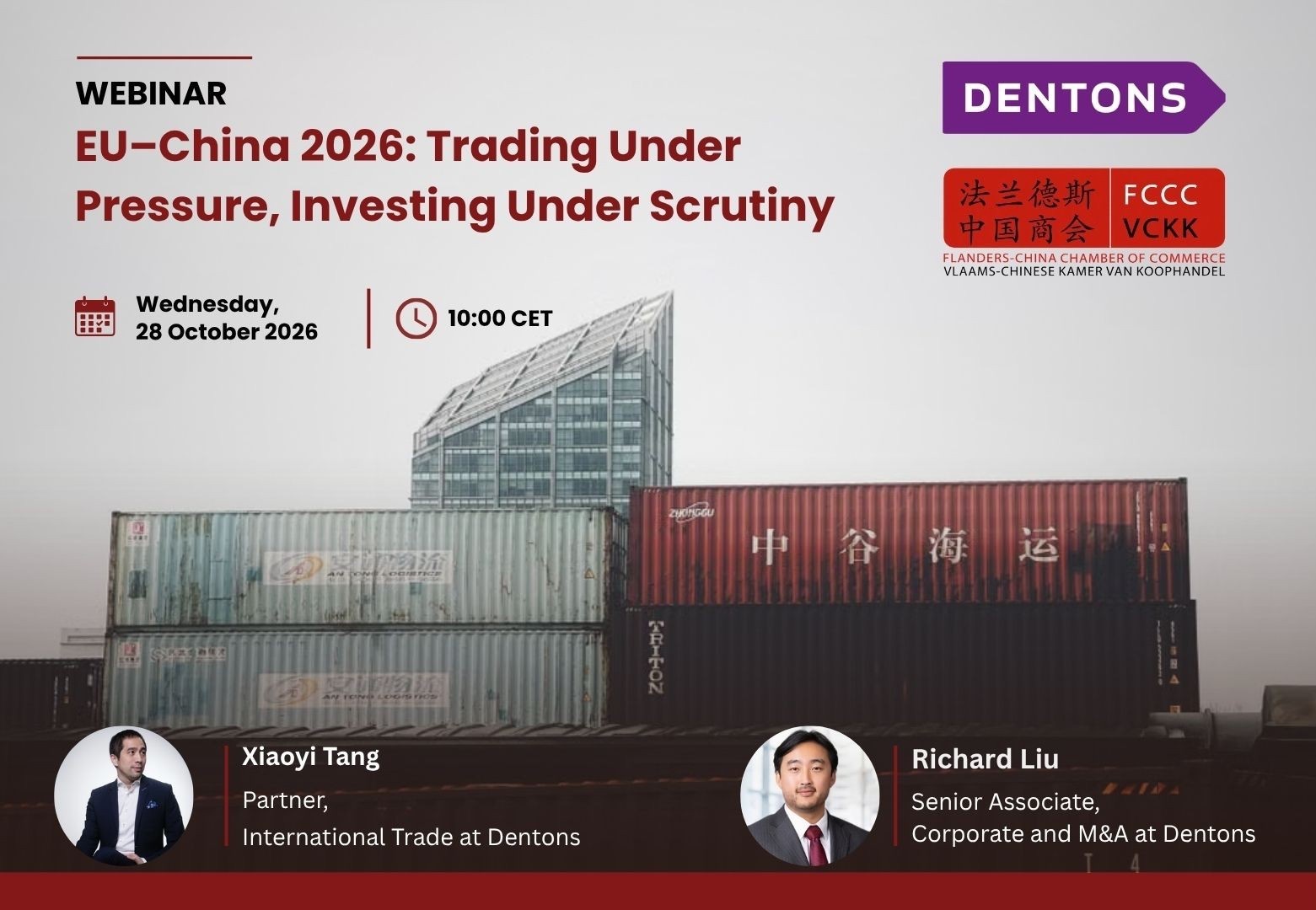
The Flanders-China Chamber of Commerce organized a webinar entitled “EU–China 2026: Trading Under Pressure, Investing Under Scrutiny” on 28 October 2026 with Mr. Xiaoyi Tang, Partner, International Trade and Mr. Richard Liu, Senior Associate, Corporate and M&A at Dentons.
Ms. Gwenn Sonck, Executive Director of the Flanders-China Chamber of Commerce (FCCC) introduced the topic of the webinar and the speakers, and mentioned that the webinar was organized together with the FCCC’s structural partner, Dentons, one of the largest law firms in the world. In 2025, EU–China trade in goods reached around €760 billion. China is the EU's second largest trading partner in goods after the U.S. and our largest source of imports. On the export side, China is our fourth largest market after the United States, the United Kingdom and Switzerland. Last month, the EU and China held several meetings to discuss trade and investment issues. What is changing is why European companies are in China. According to a survey of European companies in China, the market remains important thanks to its size and dynamism. But for many multinationals, China's appeal comes more and more from its world-leading supply chains and industrial clusters. There is really no second China. We are moving from in China for China to in China for the world. More and more companies are also in China for its innovation capacity.
Mr. Xiaoyi Tang, Partner at Dentons Europe, based in Brussels, has been practicing international trade law for 20 years. He talked about EU-China trade relations, including tariffs and the main regulatory challenges. China is the 10th largest country for Belgian exports, reaching €8.1 billion and China is the 4th largest for imports to Belgium, reaching €39.6 billion, so bilateral trade reaches nearly €48 billion. Belgium imports more from China than it exports to China with a deficit of €31 billion. Belgian exports to China in 2025 included chemicals, machinery, plastics, optical and medical instruments. Belgian imports from China included machinery, transport, chemicals, and other products, including plastics. If you compare 2021 and 2025, you will see imports from China started from €23 billion, now it's €39 billion, so imports almost doubled. The result is the trade balance or imbalance. Looking at the EU, EU imports from China were €560 billion and EU exports to China €200 billion, which means there is a deficit of €360 billion. The EU imports machinery, vehicles, telecommunications, audio equipment, and computers, while EU exports to China include machinery, vehicles, vehicle parts, and other manufactured goods, and also including chemicals. There is talk of de-risking or decoupling, but it is difficult to find a second China which can provide goods and logistic convenience in the way China does. However, lots of raw materials supply from one country may create a risk.
Applying the concept of de-risking we see more and more trade investigations. There are many anti-dumping, subsidy and safeguard cases covering all sectors. Recently we saw a surge of cases covering high-tech products. Some imports from China may cause injury to European manufacturers because they are of higher quality and cheaper price, which means some EU products may lose their competitiveness. Starting from 2017 until 2025, trade investigations targeting Chinese imports are increasing, especially in recent years, starting from five cases in 2022, reaching 34 cases in 2024, including electric vehicles, chemicals, and solar panels. Large imports from one country are usually accompanied by an increasing number of trade investigation, usually resulting in the imposition of tariffs or quotas. China is exporting more industrial high-tech products to Europe, which indicates an increasing demand. Over the years, there is a significant change not only in numbers, but also in the categories of goods imported from China. Chemicals are also targeted by the European Commission because there is a big difference in cost. In the EU, the cost of producing chemicals is quite high due to the high energy costs. Chemicals imported from China are more attractive. China is also targeting imports from European companies, not high-tech goods, but household or consumers products like pork, brandy, and dairy products.
European car manufacturers claim there is an overcapacity in China in electric and hybrid vehicles, so duties were imposed creating a barrier for imports from China. The discussion is still going on about reaching an undertaking, a promise to sell no more than a certain number of units at a minimum import price. But since 2024, imports of full electric vehicles decreased and imports of hybrid cars from China significantly increased. In 2026, we expect almost 800,000 cars. We expect that there will be a safeguard investigation to limit quantities with provisional measures expected by the end of the year. Besides imposing tariffs to protect EU manufacturers, there are also foreign subsidy investigations. When a Chinese company acquires a European company or participates in a public tender, the EU Commission may investigate whether the Chinese company received subsidies from the Chinese government. There is also the anti-coercion instrument about forced labor, especially in Hungary.
Mr. Richard Liu, Senior Associate Corporate and M&A at Dentons, focused on investments and the future framework for FDI screening in Belgium. Direct trade is still the larger form of economic cooperation but nevertheless there is also €16.8 billion of investments – the highest since 2018 – and recently there is an increase in M&A activity as well. M&A is now almost half of total investments, next to greenfield investments where businesses come directly to the EU to set up their own business. Belgium is not a top destination but it is still an interesting market. Countries like Hungary are the most popular, but Germany and France are also catching up.
In M&A, the automotive industry is by far the most important with almost half of total investments, almost all related to the electric vehicle supply chain. Aside from buying Chinese products directly, the EU wants Chinese products to be produced here directly as well. China shipped about 922,000 cars to Europe last year and Chinese car plants in the EU will start building about 215,000 cars a year. So if exporting is becoming more complicated with tariffs and more regulations, this is where acquisitions or contract manufacturing could come from. Belgium has assets that fit this context. Zeebrugge port is the first destination worldwide for Chinese EV exports since 2024. We also have the port of Antwerp Bruges and the cargo airport in Liège. There is a Volvo car production plant in Ghent, which is also going to produce more Chinese brand vehicles. Even though Belgium has not been the main investment hub in the EU, there have been landmark Chinese investments in Belgium. You have Volvo cars in Ghent back in 2010 when Geely bought Volvo and indirectly acquired the car plant in Belgium. In terms of greenfield, we have Cainiao at the Liège airport, which is Alibaba's logistics arm. You have the China-Belgium Technology Center in Louvain-la-Neuve and the Windrose electric truck maker with its planned assembly site at the port of Antwerp Bruges. Next to the Cainiao, there are also smaller Chinese logistics companies like 4PX at the Liège airport.
The FDI screening regime in Belgium is existing for three years. It went from 68 to 100 to a total of 191 filings in a year. Most of the filings come from U.S. and UK investors. Chinese investors represent only a small number of the filings. The system is permissive as 96% of all the filings still get cleared in the first phase of the procedure. Only eight files have gone to the second phase where the authority enacts further investigations. In August 2026 there was the first rejection under this Belgian FDI screening regime from NHV, a helicopter operator in Ostend that works for offshore energy and defense and was to be sold to an Irish holding company with the ultimate shareholder being a company controlled from China. No reasons for the rejection were published, so it was all very confidential. It was not a policy change, but just a milestone. Even before the FDI screening system was put in place, there was already review and scrutiny in Belgium since 2016. One example is when State Grid attempted to acquire Eandis, which did not go through after warnings from intelligence services. There are also examples where the Belgian government is actually supporting Chinese-backed investments such as the Volvo car production. Up to €190 million of subsidies has been agreed since July 2026. It's the same for Windrose, R&D at the port of Antwerp and Bruges, and Cainiao in Wallonia.
The screening regime is set out in the Belgian cooperation agreement of 13 November 2022. It makes a distinction between which sectors are considered more sensitive. For the most sensitive sectors, the screening is triggered already when a stake of 10% is acquired, whilst for the other sectors, the trigger only occurs when 25% is acquired. You also have turnover thresholds that apply to the targets. For targets of the 10% category, that would be €100 million turnover against the financial year before. A turnover threshold of €25 million against the financial year before only applies for strategic biotech companies in the 25% category. It is currently very difficult to see if your Belgian target would actually fall within scope of the FDI screening due to the lack of further guidelines and interpretations of the scope of sectors. More importantly, it does not matter if the activity which falls in scope is not the main business of the Belgian target. It is namely sufficient if one of the listed activities of the Belgian target falls within one of these sectors and thus in scope of the FDI screening. The filed cases that come up the most often are in the sensitive information sector, mainly in relation to businesses that process a large amount of personal data. If you have a Belgian target which holds a lot of customer data, this is definitely something to pay attention to.
When do you need to file? When you cross the 10% or 25% threshold depending on the sector, counting direct and indirect stakes together. For listed companies, you notify when you buy and your voting rights are frozen until the decision. With most of the acquisitions, it's never the mother entity buying directly. Usually there's a holding company in between. So some situations can be quite complicated, especially if not 100% in the Belgian target is acquired. How to calculate this? You multiply down the chain: 30% of a holding that owns 60% of the target company means 18%. So it's enough in the most sensitive sectors of the FDI scope, but not sufficient for the second category where a threshold of 25% must be exceeded. Foreign investors targeted by the screening regime entails all parties that are outside of the EU. Asset deals can be caught too if you take over a significant part of the activity of the company.
As from 17 January 2028 at the EU level additional changes will be made that will also affect the FDI screening at the Belgium level. The biggest changes in the Belgian FDI regime would relate to the procedure itself. You will have a longer fixed period that will no longer be paused or extended each time that the committee would ask a question. There's more transparency. You will have a hearing and a recent decision before conditions or a ban are imposed. Screening for now only applies when you buy into an existing company. If you build something new from scratch, you don't need to do a filing. So for many companies, greenfield investments could look like an easier route, but there are specific things to pay attention to within the Belgian legislation. The trade-off is practical. If you buy a company, you don't have to deal with employing staff or obtaining new permits, getting into new contracts with your suppliers and obtaining new customers. But you also potentially incur potent liabilities or other exposure. If you build from scratch, you have to do everything yourself. “We have a guidebook that we created at Dentons to highlight the things to pay attention to when doing business in Belgium.
Please contact xiaoyi.tang@dentons.com or richard.liu@dentons.com in order to receive a copy.”
A Q&A session concluded the webinar.