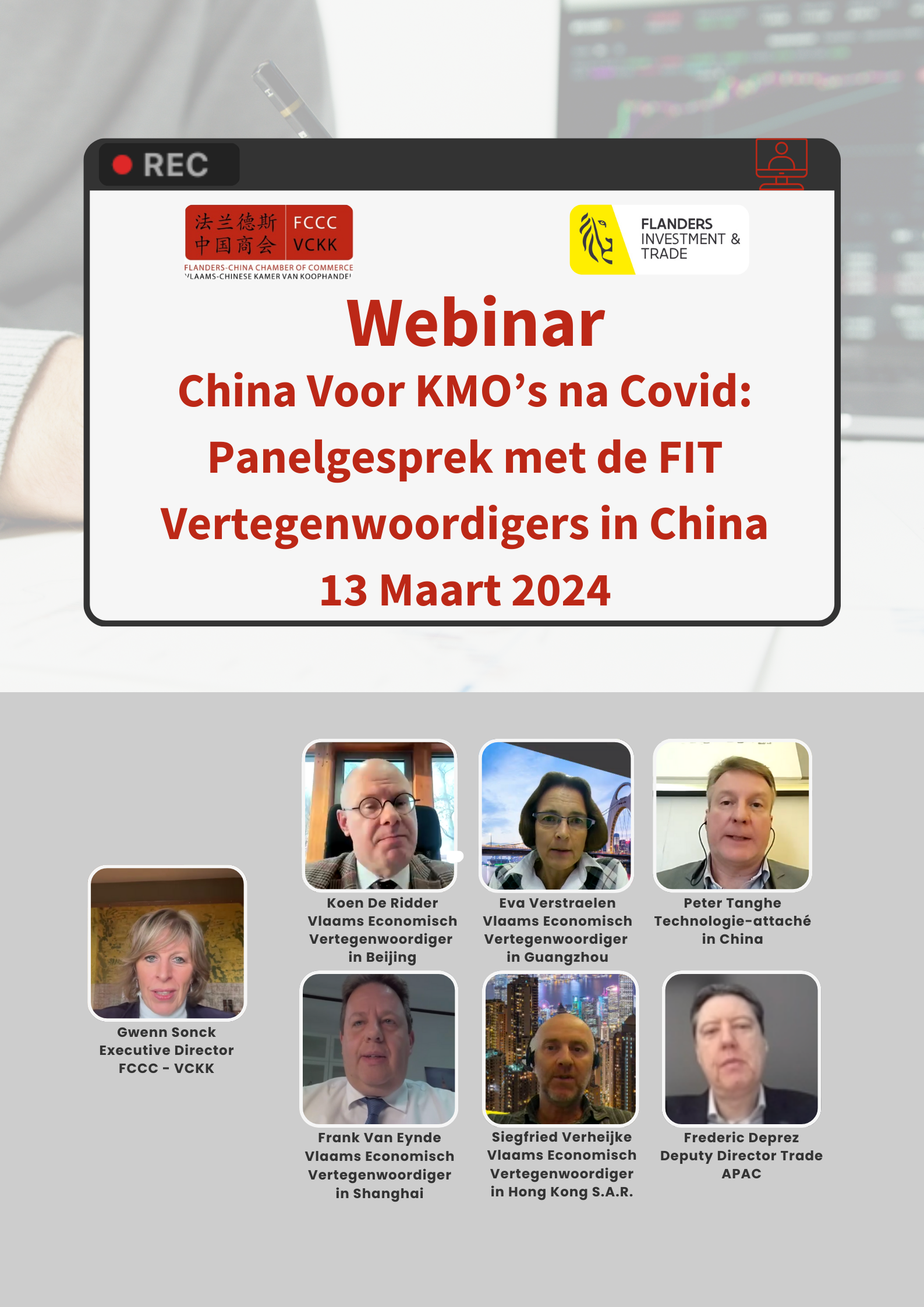
The Flanders-China Chamber of Commerce (FCCC) and Flanders Investment & Trade (FIT) organized a webinar (in the Dutch language) with the FIT Representatives in China on 13 March 2024. The Flemish Economic Representatives Koen De Ridder in Beijing; Frank Van Eynde in Shanghai; Eva Verstraelen in Guangzhou; and Siegfried Verheijke in the Hong Kong S.A.R; as well as Peter Tanghe, Technology Counsellor in China, and Frederic Deprez, Deputy Director Trade APAC, talked about the current business climate and opportunities for SMEs one year after Covid. Ms. Gwenn Sonck, Executive Director of the Flanders-China Chamber of Commerce, welcomed the participants to the webinar and introduced the panelists. She announced the good news that starting on March 14 Belgians can travel to China for a 15-day stay without a visa. This will facilitate trade, but a good preparation remains essential. It is important to be able to react quickly and flexibly to opportunities and challenges. One of the main challenges is currently the slow-down of China's economy, but it remains one of the fastest-growing economies with an expected growth rate of around 5%. Flemish exports to China increased year-on-year by 8.10% to €6.6 billion in the period January-November 2023. Imports from China reached €27.38 billion, down 8.5%.
The main take-aways from the webinar are:
• Mr. Frederic Deprez: Flanders Investment & Trade is putting more emphasis on regional desks to improve coordination. Companies may contact Mr. Frederic Deprez with inquiries about Greater China. He is also responsible for all events related to China. In April there is the China Medical Equipment Fair in Shanghai and the Hybrid Food Fair Shanghai in June. In September there is the China International Logistics Fair in Shenzhen.
• Mr. Frank Van Eynde: Following the lifting of Covid restrictions, there was a period of enthusiasm to visit Belgium, but in Summer, expectations were lowered as some foreign investors maintained a wait-and-see attitude. Currently, the picture is mixed: companies already active in China are adapting to the new reality and are doing well. Expats say Shanghai is much quieter than before and dynamism has declined. China remains an interesting market if you remain prudent and prepare well. First study the opportunities of your product before taking further steps, and remember that FIT can help you. You need a lot of spunk – determination and confidence – to compete in the Chinese market. Fifteen-day visa-free travel to China is limited to certain categories of travelers and is not valid for example for a technician going to China to install equipment or a musician giving a concert in China, so it is advisable to contact the Chinese Embassy before proceeding.
• Mr. Koen De Ridder: Many senior expats have left China and have been replaced by locals. There are more expats from countries of the Belt and Road Initiative (BRI). Covid has caused deep economic and diplomatic injuries. Important trends are the rising number of unicorns and tech companies in Beijing, and the Belt and Road Initiative (BRI). The Beijing-Tianjin-Hebei area is becoming a super cosmopolitan center with a rising demand for intelligent city solutions. In Beijing, there are opportunities in IT, healthcare and green energy. In North China there are niche opportunities in the pigeon and horse hobbies. Winter sports and tourism are also a booming sector in Northern China. Beijing has one of the largest start-up ecosystems in Asia with 1,070 AI companies and 9,000 tech companies. The added value of Flemish Economic Representatives are their networks. We are not lawyers and cannot give you legal advice. Lawyers based in China – including Belgians – can help with local legal problems. When signing a contract with a Chinese partner, don't provide exclusivity and make sure to protect your intellectual property rights. Always communicate well with your partners before going to arbitration or the courts.
• Ms. Eva Verstraelen: The pre-Covid optimism and boom has passed. Flemish as well as Chinese investors are more reluctant. Foreign investors are focusing more on other countries, such as Vietnam, Thailand and South-Korea. In the Chinese consumer market, local and regional competitors, such as Russian and Turkish products, are rising. There are still plenty of opportunities, but it is more difficult to discover them. You can only succeed in China if you adapt to the Chinese business culture and use Chinese marketing channels. Making use of personal contacts is more important than participating in big exhibitions. Image and brand recognition are crucial.
• Mr. Siegfried Verheijke: In Hong Kong, Covid had a big impact on the hospitality sector, which has not yet completely recovered. People are more focused on a healthier lifestyle, providing opportunities for food, wellness and fitness. There are also opportunities in the healthcare, fintech and biotech sectors. Hong Kong has changed significantly in the 2020-23 period in the political and social spheres. Hong Kong is becoming more and more Chinese. Expats who have left, have been replaced by mainland professionals. As for doing business, nothing much has changed, the openness of doing business in Hong Kong has not changed and this will probably not change in the near future. China needs Hong Kong at least as much as the outside world needs Hong Kong. Compared to the mainland, in Hong Kong the medical sector is totally open and it is sometimes possible to participate in tenders of hospitals in Guangdong province. Also remember that if a proposal from a Chinese partner is “too good to be true,” it is most likely too good to be true and an attempt to commit fraud. A difference between Hong Kong and Mainland China is that in Hong Kong cash and credit cards are still used as much as in Europe.
• Mr. Peter Tanghe: The tech rivalry between the U.S. and China also has an impact on our tech companies if they use American software or technology. There are already more than 600 Chinese companies on the U.S. Entity List requiring export licenses and which are no longer available as customers for our companies. The EU is also looking at investment restrictions. China is no longer a priority for companies which are not here yet.
Members of the Flanders-China Chamber of Commerce can obtain the recordings of this panel discussion by sending an e-mail to: info@flanders-china.be