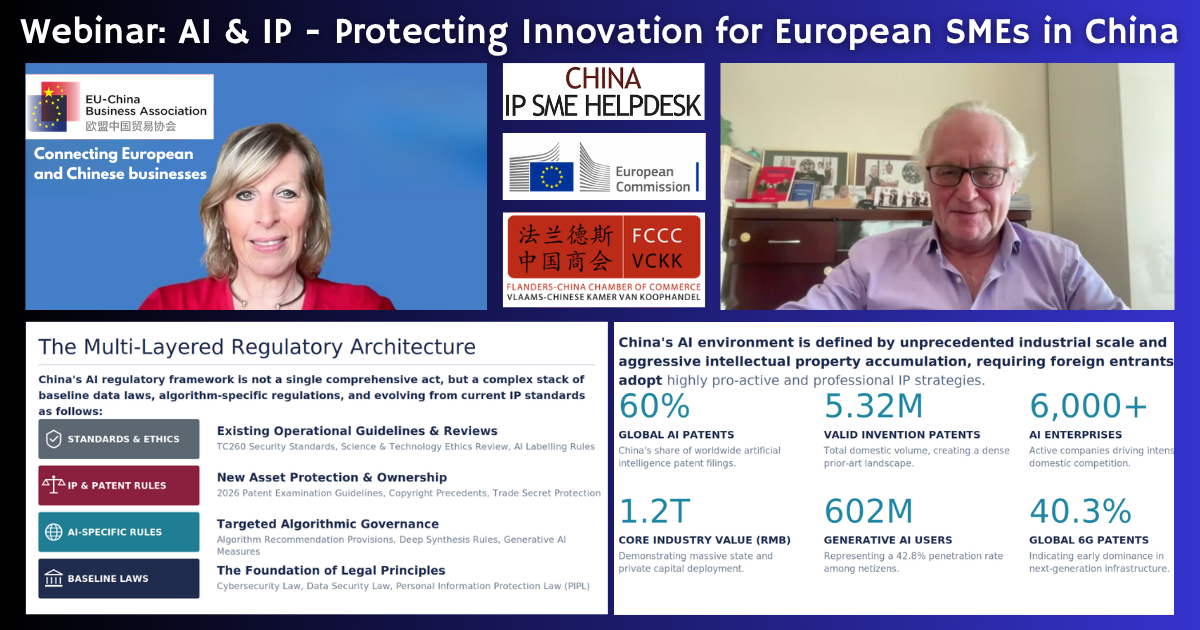
The Flanders-China Chamber of Commerce organized a webinar on AI & IP: Protecting Innovation for European SMEs in China on 27 May 2026. Ms. Gwenn Sonck, Managing Director of the Flanders-China Chamber of Commerce (FCCC) welcomed the participants on behalf of the Chamber and the China IPR SME Helpdesk. The speaker was Mr. Jari Vepsäläinen, Chairman of the Fintrade Mercer Group. He is a China-trained attorney and has been actively involved as a strategic investment advisor and corporate lawyer in the People's Republic of China for more than 36 years and is living in Hong Kong. Partner in organizing this webinar is the China IPR SME Helpdesk, an EU-funded initiative that helps European SMEs protect their IP rights in China, offering free practical advice on patents, trademarks, and copyrights, along with training webinars and one-to-one consultations with IPR help experts. China has emerged as a global leader in AI, both in deployment and in innovation. Recent analyses estimate that China accounts for around 60% to 70% of all AI-related patent applications worldwide, far ahead of any other country. In 2024 alone, Chinese investors filed roughly 300,000 AI patent applications, compared to about 76,000 in the United States, which ranks second. China is now actively implementing a practical and comprehensive regulatory framework for AI that directly affects business operations.
Mr. Vepsäläinen first briefly introduced the China IP SME Helpdesk. Its key office is in Beijing, but it covers the People's Republic of China, Hong Kong, Macao and Taiwan. The team in Beijing can assist with IPR-related issues, all free of charge. Mr. Vepsäläinen was among the first foreign lawyers allowed to work in China in 1985.
China still doesn’t have a united law governing AI issues, so it's really problematic at the moment to come to the China market with AI-related things. There are more than 6,000 active AI enterprises in China with a combined value of CNY1.2 trillion and 602 million generative AI users.
There are six critical operational risks for European SMEs:
1. Confidentiality leakage risks: keep as much as possible to yourself.
2. Patent hallucinations and rejections: filing AI-drafted patent documents.
3. Copyright assumptions are wrong: AI-generated assets or code are not automatically copyrightable. China applies the first-file principle.
4. Uncleared training data.
5. Missing labels and brands or trademarks.
6. Collaboration traps and secrecy agreements.
China’s AI regulatory framework is multi-layered. Filing your IP, you have to follow all technical and security standards, ethics and labeling rules. New patent protection guidelines have been just published. There is a huge law base of different algorithms related to AI. Finally, there are a lot of other laws which you have to follow, such as the cybersecurity law, data security law, personal information law and others. You have to take all these into account once you come to the China market.
At the court, you have to prove human inputs, you cannot just use AI and try to file IP protection. You have to show that it is made by humans, which parameters you have been using, and how AI has been assisting you. You have to document all the generational logs and prove that a creative journey occurred. The final output must reflect the author’s personalized choices.
There are many legal cases in China, and Mr. Vepsäläinen presented three of them to show the basic standards. In the “Butterfly Chair” case the court ruled that there was no human touch. Once you try to register IPRs for your products or copyright, you have to show that there has been a human human touch. In the “Cat pendant” decision, the court reasoned that there was no creative process. The “Shanghai prompts” case was dismissed because there was no originality. You need to prove the identity of the creator, record what tools you have been using, and keep all the input parameters, generation logs, publication details and dates, and all the documentation.
AI IPR rules and strategies include that AI cannot be the inventor, you have to show that a natural person is the father or mother of the product. Applying known AI is not inventive, you have to also explain which kind of AI you used and how it did help you to come up with the design. Disclosure must be complete as black box claims are strictly rejected. Ethics and legality criteria must be observed, and finally, AI-drafted documents are a risk. You cannot let AI make your application.
A new law coming out in the next few days is giving more protection for different trade secrets, but you have to explain to the authorities what you have done and what you need to protect. Training datasets are very important. You show what it is, what happened, and what training and education has been given. You have to make proper secrecy contracts, not NDAs. The major trademark risk is that you did not register. In R&D cooperation with Chinese you have to protect yourself and register all that you have done. Before you come to the China market, you should define what you are going to show, how you are going to do that, and what your target is. Regarding trade secrets, you never need to show everything to partners or to the authorities.
Once you have your patents, you need to be ready for enforcement. If anything happens, you have to go after the persons or companies who have been misusing your IP rights. You have to monitor different platforms and if anything happens, report that to authorities in China. The intellectual property system consists of patents and utility models; copyright and software copyright; trademarks; and trade secrets. Our advise to SMEs is that instead of going for innovation patents, which take time and are rather expensive, you should go for utility models, which are very fast to register and have almost the same protection in China as patents have. Once you file the application for utility models, you get it approved unless it is exactly the same as somebody else has already filed. Moreover, it is cheaper than filing for a patent. For copyrights, there is a China Copyright Center in Beijing for registration. One important thing is software copyrights, which we don't have at all in Europe. If you haven't filed it, you don't have a legal right to take anybody who is infringing it to the court. It is also important to have trademarks registered, as there are already millions registered in China. Remember to also register your Chinese trademarks, because the Chinese might not know your company’s English name. Trademark squatting is normal in China and authorities are very strict. Trade secrets need to be documented.
Once you come to China, the common mistake is to assume there is automatic copyright. It doesn’t exist in China, where there is the first to file principle and traditional patenting might be too complicated and expensive. Evidence is important. You have to show all the time that you are the owner. China now has the multilayered regulatory framework, which is changing for the better, but nobody knows how long it will take.
A Q&A session concluded the webinar.