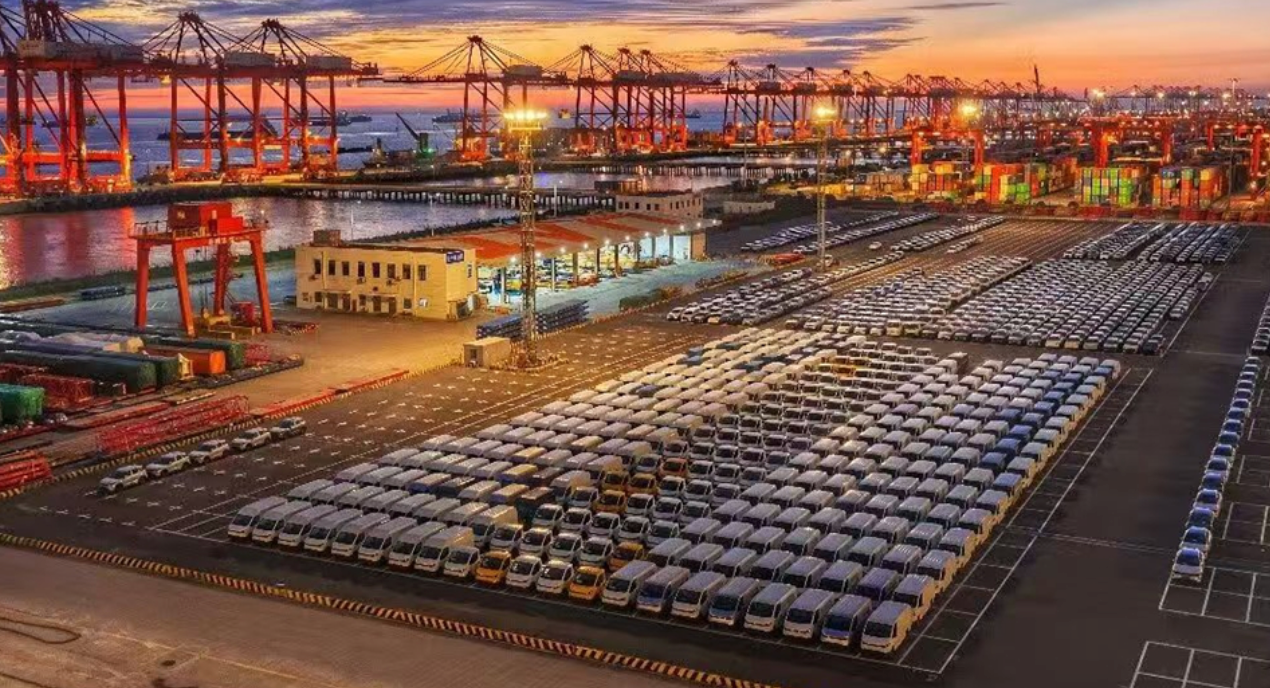
U.S. automakers are increasingly using China as a “global super gym” to exercise in order to remain competitive in the world market. At a deep-water terminal on China's east coast in late September, rows of electric Transit City vans – fresh off Ford's China assembly line – stood in tight formation, waiting to be driven aboard a giant roll-on/roll-off ship. Those electric cargo vans, built by Ford in partnership with Jiangling Motors for modern urban logistics, embarked on a voyage of more than 15,000 kilometers, heading for developed markets such as Europe. Later, the export market for the electric van will expand to 52 countries and regions across five continents. Back in 1997, the first China-built Transit – a Ford design localized with Jiangling Motors – rolled off the production line in Nanchang, Jiangxi province. Today, China-made electric vans from the same Transit family, which are also Ford's first battery-powered commercial vehicles to be exported from China to developed markets, are sailing toward Europe. What began as local assembly three decades ago has evolved into a compelling story of deeper collaboration between the Chinese and U.S. auto industries. The two sides are increasingly intertwined, working hand in hand and growing together – China is playing an irreplaceable, multidimensional role for American brands and suppliers seeking to expand globally.
A growing number of U.S. carmakers, such as Tesla and General Motors (GM), has been pursuing deeper cooperation across the Chinese supply chain. These bilateral ties have strengthened even further with the sweeping wave of intelligent driving and new-energy vehicles (NEVs). In this context, the past years have witnessed a profound change in the country's role – from merely a sales market and a local factory floor to a global production base and a center of innovation that is setting the pace for the industry's transformation. Chinese analysts believe that the imminent arrival of Ford's all-electric Transit City in Europe reflects a broader trend of China's increasing role as a global hub for electric vehicle production – whether in balancing global supply chain cost, securing worldwide deliveries, or developing the latest technologies.
Ford China will begin exporting hybrid new-energy models built in its Chinese factory to North America next year, accelerating its strategy of “based in China, serving the world.” Additionally, the American automaker is jointly developing a range-extended electric model – which the company says is the world's first of its kind – with a Chinese peer, and the model is slated for overseas export starting in 2027, the Global Times learned. The deeper partnership plays to the strengths of both sides. “It draws on Ford's established global sales network and brand, as well as the design, technology, manufacturing, quality and cost advantages of products developed in China, expanding complete-vehicle exports from China so that customers worldwide receive better products – and Ford gains a sharper competitive edge in local markets,” the company told the Global Times.
Another veteran U.S. automaker, GM, is also embracing a similar paradigm shift, which the company describes as moving from “global localization” to “China-based globalization.” The company told the Global Times that in the past, joint ventures (JVs) established by U.S. and Chinese partners primarily served to bring global technology into China and adapt it to local demand. Now, the roles of these JVs are to fully leverage China's strengths in user insight, technological innovation, intelligent manufacturing and industrial-chain efficiency, pushing more products and technologies defined, developed and made in China into global markets.
In August, GM and Chinese automaker SAIC Motor signed an agreement to renew their JV, SAIC-GM, extending the term by 20 years to 2047. In October, the JV's Buick Electra E7 model will formally begin overseas exports, becoming the first high-end new-energy model from SAIC-GM to go abroad. The renewed JV will also continue to expand in the Middle East, Africa, South America, Mexico and the Asia-Pacific in the future. This push is part of a much larger trend. In 2025, China's auto exports rose by 21.1% to nearly 7.1 million units, ranking first in the world for a third consecutive year, data from the China Association of Automobile Manufacturers (CAAM) showed. Among these exports, JV companies performed impressively.
China has been the world's largest auto market for years. The country also has one of the world's largest consumer markets, along with efficient supply chains, a rapid pace of innovation and a large talent pool. “Each of these strengths makes American companies more competitive globally, helping them bring better products to market faster and at lower cost,” Harley Seyedin, President of the American Chamber of Commerce South China, told the Global Times. On the consumer side, the sheer scale of the market allows U.S. firms to spread R&D and production costs across large volumes and test products with demanding, fast-changing buyers. In terms of the supply chain, China's density and efficiency shorten lead times, reduce costs and facilitate easier customization, Seyedin said.