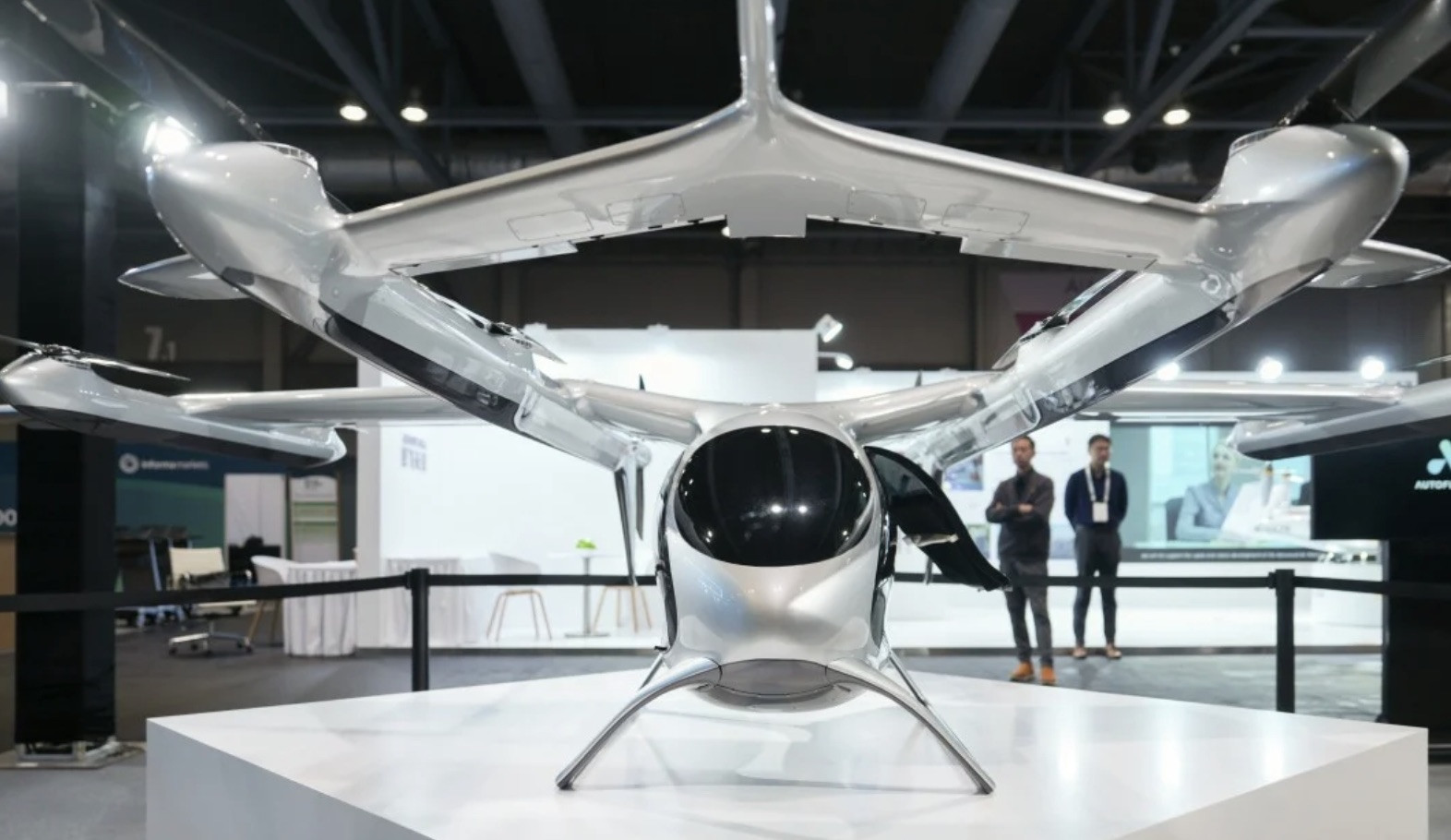
Thousands of passenger and cargo air taxis could be flying across Hong Kong within a decade as the low-altitude economy takes off, according to AutoFlight, one of China’s largest drone makers, which hopes to launch operations in the city. AutoFlight Senior Vice President Kellen Tse told the South China Morning Post the electric vertical take-off and landing (eVTOL) aircraft manufacturer plans to significantly expand in Hong Kong, potentially paving the way to establish its international headquarters in the city. Backed by CATL, the world’s largest electric vehicle battery maker, the Shanghai-based firm aims to extend its presence across the city to support emerging opportunities in Hong Kong’s nascent flying taxi market. Tse called Hong Kong a “very, very important key” to AutoFlight’s international growth. “We are planning to have at least more than a dozen to 20 people, maybe by this year,” Tse said. The team would include sales and marketing, business development and government relations, and would continue to grow in the future, he added.
The expansion plan arose from Tse’s vision that thousands of passenger and cargo eVTOL aircraft could be flying across Hong Kong airspace within a decade. The Hong Kong government is aggressively promoting the low-altitude economy as part of efforts to boost growth and attract foreign investment. Applications to join a sandbox – a controlled pilot environment for testing new software or technology – for unconventional aircraft and cross-boundary routes opened on December 1. The “Regulatory Sandbox X” pilot will enable stakeholders to test unconventional aircraft weighing more than 150 kg, including eVTOLs, with the aim of validating safety standards for future flights between Hong Kong and the mainland. Tse envisions a future in which thousands of eVTOL aircraft operate across the Greater Bay Area.
An eVTOL aircraft is powered entirely by electricity, and can hover, take off and land vertically like a helicopter before transitioning to more efficient flight like an airplane. Unlike a traditional drone, it is designed to carry heavy cargo or passengers. Compared with helicopters, it offers a quieter, greener and more cost-effective operation. AutoFlight’s fleet includes the Prosperity passenger aircraft and the CarryAll cargo model, both powered by electricity.
Prosperity, designed to carry a pilot and five passengers, has a maximum take-off weight of 2,400kg and a commercial range of 200 km. CarryAll is a fully electric, autonomous cargo eVTOL with a maximum take-off weight of 2,000 kg and a payload capacity of 400 kg, capable of flying up to 200 km on a single charge, making it suitable for logistics and emergency transport. Tse said AutoFlight had been working closely with the Hong Kong Civil Aviation Department and Transport and Logistics Bureau. “The Hong Kong government is very friendly and efficient – they’ve helped us quite a lot,” Tse said. “That is exactly the purpose of the sandbox project, to run these sort of trials or experimental flights in a very controlled and safe way,” he said. Tse’s view aligns with Hong Kong’s plan to deploy passenger eVTOL aircraft within the next two to three years as part of its drive to become a regional hub for the low-altitude economy.
Dominic Chow, Deputy Director General of Civil Aviation, in December said eVTOLs had lower operating costs compared with helicopters of similar safety levels thanks to more efficient energy use and simpler maintenance requirements. Chow noted that the current range of such aircraft was around 250 km, but the next generation could reach up to 1,000 km, enabling flights “beyond the Greater Bay Area”. Tse envisioned offering rides at highly competitive rates once the market matures. He said that in the long run, when “perhaps a few thousand units are flying above our heads”, operators on the mainland could be charging “around one dollar per seat per kilometer”. He also highlighted the potential for daily commutes across the Greater Bay Area using such aerial vehicles. “The Greater Bay cities need to be connected by eVTOLs – that is the most ideal way,” he said, as reported by the South China Morning Post.
The China Daily adds that drone operation training is booming in China, offering organizations and individuals new business and job opportunities. Shortly after a new public order ordinance took effect nationwide on January 1, intensifying the crackdown on unlicensed drone flights, China’s largest drone operation training center, Global Hawk UAV, based in Shenzhen, Guangdong province, hosted its first license examination for civil drone pilots, drawing record participation. The monthly test attracted more than 1,600 candidates from over 130 drone training schools in the Guangdong-Hong Kong-Macao Greater Bay Area. The candidates ranged from young people looking to explore emerging drone applications in logistics, surveying, and film, to farmers hoping to use drones to modernize agriculture, and hobbyists seeking to fly drones safely under new regulations. China faces a shortage of drone operators, estimated at up to one million. Yu Jingbing, Founder of Global Hawk UAV, said that between 2014 and 2024, 273,300 drone operator licenses were issued nationwide. In 2025 alone, he estimates 350,000 to 400,000 new licenses were issued.