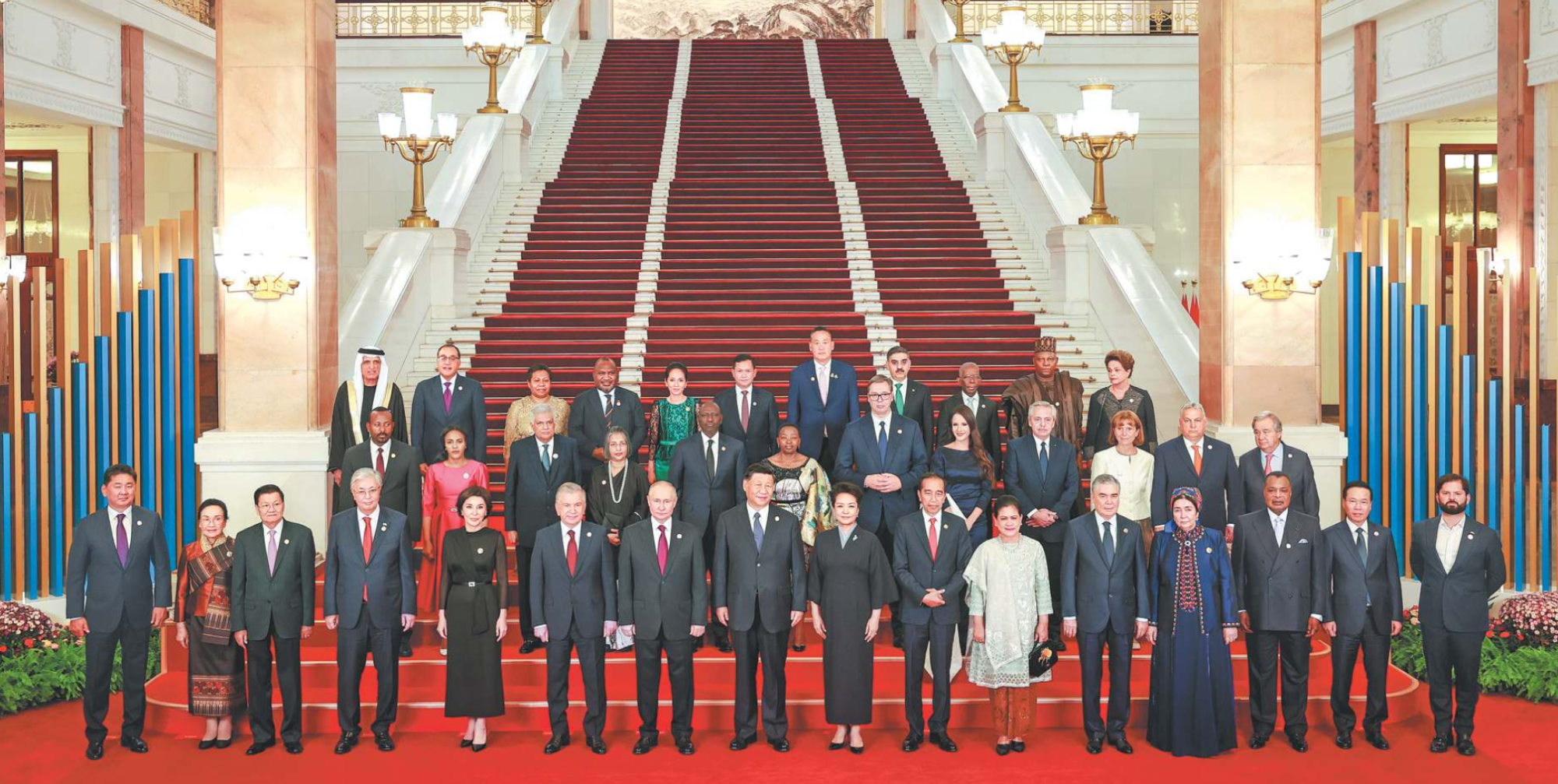
Chinese President Xi Jinping delivered his keynote speech, titled “Building an Open, Inclusive and Interconnected World For Common Development”, at the opening ceremony of the third Belt and Road Forum for International Cooperation in Beijing on October 18. The event was attended by representatives from 140 countries and 30 international organizations. Leaders in attendance included Russian President Vladimir Putin, Hungary’s Prime Minister Viktor Orban, Indonesian President Joko Widodo, Argentina’s President Alberto Fernandez and Thai Prime Minister Srettha Thavisin. Moritz Rudolf, a German expert in Chinese governance at Yale University’s Paul Tsai China Center and a delegate at the Summit, said the absence of many European representatives was palpable. “I attended the two previous forums and then you had a strong European presence – almost every single member state had sent a delegation or delivered a speech,” Rudolf said. “This time, you can really feel the absence of Europe.”
In his speech, President Xi announced eight major steps that China will take to support the joint pursuit of high-quality Belt and Road cooperation, including “building a multidimensional Belt and Road connectivity network”. He also highlighted the concept of “global modernization”, saying that China will work with all parties involved to deepen the Belt and Road partnership of cooperation and “make relentless efforts to achieve modernization for all countries”. United Nations Secretary General Antonio Guterres said that the Belt and Road Initiative provides a crucial and effective way to help developing countries achieve sustainable development, and sets a model for South-South cooperation. The eight major steps announced by Xi fully align with the purposes and principles of the UN and can help developing countries accelerate their development, Guterres told Xi during their meeting. Zhai Kun, Professor at Peking University’s School of International Studies, said “the detailed actions reflect an amazing evolution of themes for cooperation over the course of the past 10 years, from regular cross-border trade to social network-based e-shopping, and from basic digital infrastructure to artificial intelligence governance”. Leaders and observers said Xi’s speech has provided the blueprint for the next decade of the high-quality development of the BRI framework and has highlighted the great achievements and contributions of the BRI in the first decade of its development.
Liu Ying, Director of the Cooperative Research Department at Renmin University of China’s Chongyang Institute for Financial Studies, said that Xi gave a clear definition of the goals of global modernization in his speech, which is “to enhance peaceful development and mutually beneficial cooperation and bring prosperity to all”. “His speech has showed the direction for global economic governance,” Liu said. China’s commitment to greater opening-up and building an open world economy as reaffirmed by Xi’s speech was also noted.
China has matched its previous funding pledge for the Belt and Road Initiative, suggesting there will be little scaling back of its ambitions for the global infrastructure project despite growing questions over the country’s economic prospects. President Xi Jinping committed another CNY780 billion to finance the BRI for the next five years, indicating that the project remains central to his geopolitical vision, and closely ties the country’s development to emerging economies. The latest funding round includes CNY700 billion of loans from two Chinese policy banks – Exim Bank and the China Development Bank – and an CNY80 billion capital injection into the Silk Road Fund, a state-backed investment vehicle. This headline figure of CNY780 billion is the same sum pledged at the first Belt and Road Forum in 2017. However, this time there was a greater emphasis on what Xi described as “small but beautiful” projects and green development, compared with the grand projects of previous years.
Zhao Xijun, Finance Professor at Renmin University in Beijing, said the speech shows the Belt and Road Initiative “remains China’s key enabler of globalization amid the tide of anti-globalization in the West”. China’s Foreign Minister Wang Yi said that the country was willing to work with other development projects, including the Partnership for Global Infrastructure and Investment, but said economic issues should not be “politicized”. “We may as well compete internationally who can build more roads, railways and bridges for developing countries, and who can build more schools, hospitals and gymnasiums for the people in low-income countries,” he told a press conference. “We are confident.” Wang also said “far more” had been delivered at this year’s forum than at the previous one, which was held in 2019, adding that the “most ambitious vision” outlined this year was joining with other countries to modernize the world. He also said the event sent a clear signal of support for openness and cooperation in the face of the “cold war mentality and bloc confrontation”.
This overview is based on reports by the China Daily, Global Times and South China Morning Post.