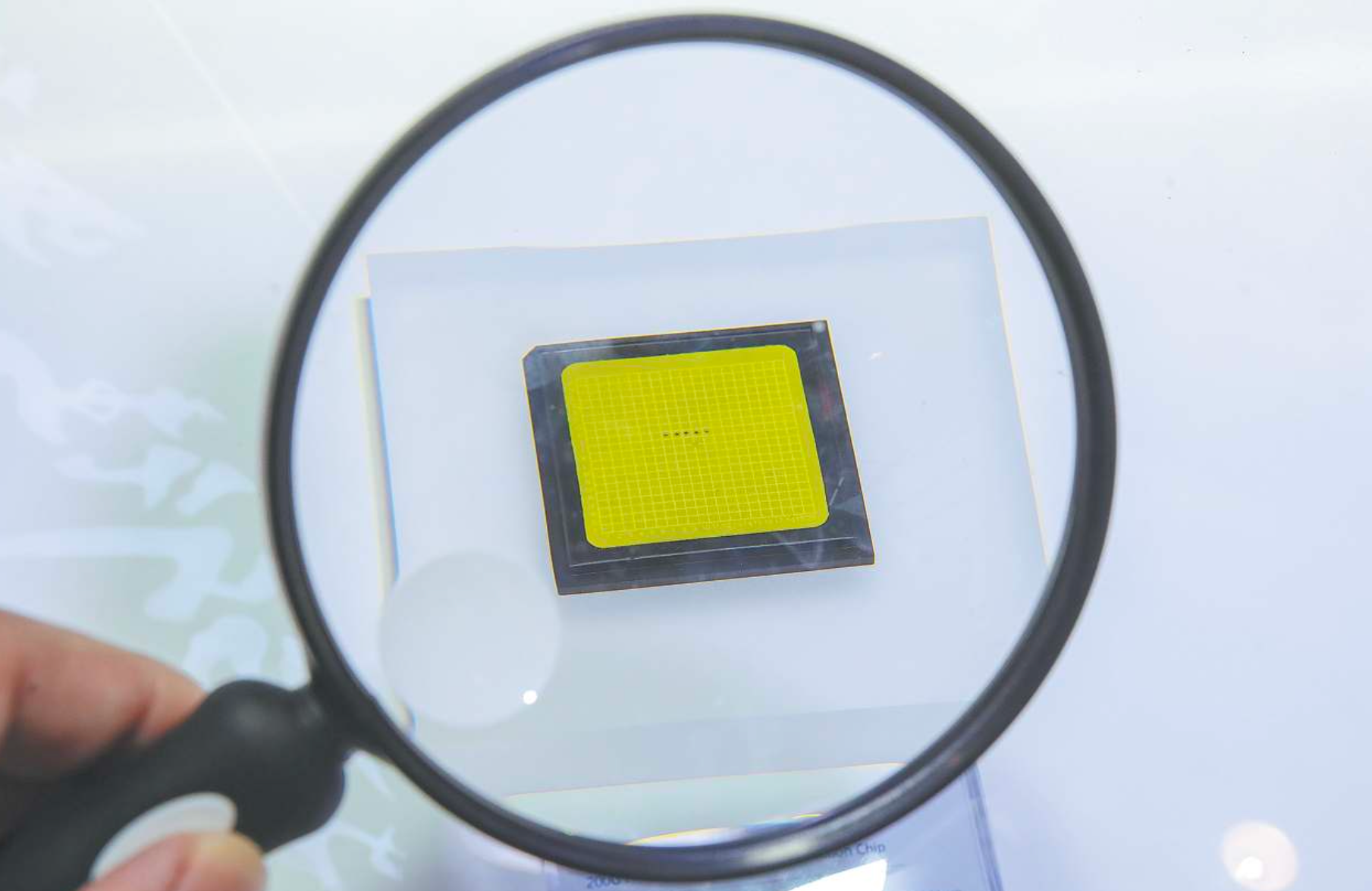
Suzhou is striving to become a powerhouse in photonics, producing tiny optical chips that are increasingly critical to the development of AI. At Suzhou Everbright Photonics Co machines operate around the clock, producing 800G (gigabits per second, or Gbps) and 1.6T (terabits per second, or Tbps) high-speed optical communication chips designed to shuttle enormous volumes of data between servers as companies around the world to build faster and more powerful computing systems. A few kilometers away, Maxphotonics has developed what it calls the world’s first 160-kilowatt ultra-high power fiber laser, powerful enough to cut through exceptionally thick industrial materials. Together, more than 350 photonics and related companies capture a broader transformation underway in Suzhou: a manufacturing powerhouse better known for electronics and industrial production is betting heavily on photonics as a new engine of growth.
As the AI boom sends demand for computing power soaring and manufacturers seek more advanced production tools, the city is building an ecosystem stretching from optical chips and silicon photonics to industrial lasers – part of China’s broader push to move from manufacturing scale to technological strength. AI may be built on algorithms and computing chips, but moving data between those chips is becoming a growing challenge. Training and running advanced AI models requires thousands and sometimes tens of thousands of processors to work together. The more computing power that is packed into a data center, the more information must travel between servers and clusters – quickly and without consuming prohibitive amounts of electricity. That is putting optical communications at the center of the AI infrastructure boom.
At Everbright, 800G and 1.6T optical communication chips are in round-the-clock production, targeting the high-speed connections required by increasingly powerful computing clusters. For Suzhou, that demand has opened a window to move into a segment of the technology supply chain where China once relied heavily on overseas suppliers. A group of Suzhou optical communication companies recently pooled investment to begin construction of what they describe as China’s first 8-inch silicon photonics chip mass-production line. The project is designed specifically for the research, development and manufacturing of next-generation high-speed optical modules. Silicon photonics uses semiconductor manufacturing techniques to integrate optical functions onto silicon, potentially allowing faster data transmission at lower power consumption and greater scale. Turning that promise into mass production, however, is difficult. It requires not only chip design, but manufacturing processes, packaging, testing equipment and customers willing to validate new products. The Suzhou production line aims to close that gap and fill a domestic void in the large-scale manufacturing of high-end silicon photonics integration.
For Everbright Chairman Min Dayong, it marks the latest chapter of a journey that began when China’s photonics industry looked very different. When Everbright arrived in the Suzhou New District, or Suzhou High-tech Development Zone, in 2012, China’s high-power semiconductor laser chip sector was still in its infancy. Overseas companies dominated the market. Chinese manufacturers lagged in yield, output power and other key capabilities, while high-end industrial and medical applications depended heavily on imported components. Everbright faced a daunting combination of obstacles: technological barriers, expensive semiconductor equipment, scarce capital and a shortage of specialized engineers. The company started with a relatively small research and development facility. As it grew, it moved into its industrial park headquarters. In 2026, the ecosystem expanded again with the CNY1.2 billion project and its 8-inch silicon photonics production line. “If there had been no policy support from Suzhou New District, we would not have been able to make the breakthrough from zero to one,” Min said. “This is a place where we can focus on innovation.”
At Maxphotonics, the power of light can be measured on an entirely different scale. Its 160-kW ultra-high power fiber laser, which the company describes as a world first, can handle cutting at the meter scale in some applications and stably process conventional thick plates of more than 500 millimeters. Such systems have potential applications in heavy industries where manufacturers must cut extremely thick materials quickly and precisely. But the headline number – 160 kW – tells only part of the story. Behind the machine is a supply chain of laser chips, optical fibers and other components that Chinese manufacturers once struggled to produce domestically. “Laser chips, which are among the core components, used to rely mainly on imports. Now they can be supplied locally in Suzhou,” said Dang Jiantang, Deputy General Manager of Maxphotonics’ Suzhou subsidiary.
For Maxphotonics, Suzhou offered something that financial incentives alone could not provide: proximity. Suppliers are nearby. Customers are nearby. Engineers and universities are nearby. Beyond Suzhou lies the Yangtze River Delta, one of the world’s densest manufacturing regions. Maxphotonics settled in Suzhou’s Xiangcheng district in 2018. Its local workforce has since grown from around 40 or 50 people to more than 1,900. The company recorded revenue of CNY1.5 billion in 2025 and invested more than CNY50 million in R&D, the China Daily reports.