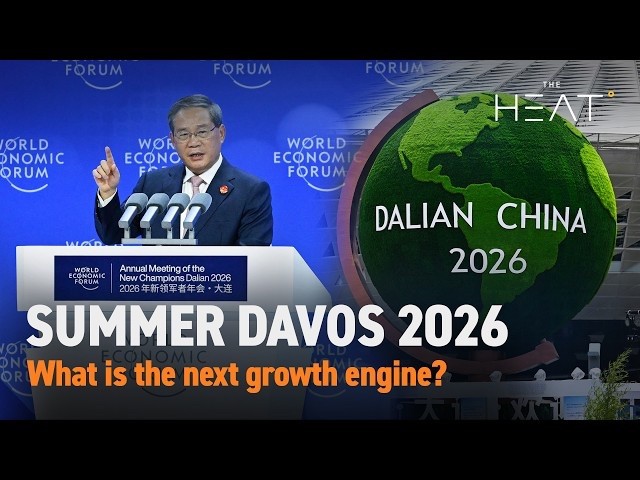
Innovating at scale has overtaken technological breakthroughs as the defining theme at this year’s Summer Davos, with company executives and industry experts pointing to China as a leading example of how artificial intelligence (AI) and other emerging technologies are moving rapidly from laboratories into factories and the wider economy. Innovating at scale means turning breakthrough technologies from laboratory prototypes or pilot projects into products and services that can be deployed widely across industries and society. It is not just about inventing new technologies, but about commercializing, manufacturing and adopting them at a scale that creates lasting economic and social impact, industry experts said.
Chinese Premier Li Qiang delivered the keynote address. The Prime Ministers of Bangladesh, Guinea, Kazakhstan, South Korea, Mongolia and Montenegro and more than 1,700 participants also attended the Forum.
Zhou Yuxiang, CEO of manufacturing software company Black Lake, said: “Last year and the year before, discussions around frontier technologies were still largely at the conceptual or laboratory stage. This year, we’re seeing innovation being deployed at scale and at an accelerating pace.” China’s manufacturing sector is already translating that momentum into business. AI-related products now account for about half of Black Lake’s revenue, a sharp increase from last year, Zhou said.
“Chinese manufacturers are making purchasing decisions on AI agents much faster than before. We expect AI penetration in Chinese factories to rise significantly over the next three to four years.” Henry Wang, Herbalife’s Chief Legal and Public Affairs Officer, said he was particularly pleased to see innovating at scale moving beyond concepts and accelerating from ideas into industrial realities. “Technology is emerging as a critical force to drive the scaled deployment of innovation. Herbalife’s global development path, encompassing its journey in China, closely aligns with this trajectory,” he said.
The industrialization of new technologies is also showing up in China’s trade data. During the first five months of the year, both exports and imports posted double-digit growth, supported by strong demand for products tied to AI and digital infrastructure investment. Zou Jun, Chairman of KPMG China, said: “China has been actively promoting the commercialization of technological achievements.” Wu Chun, Managing Director at Boston Consulting Group China, said the country’s policy support, vast application scenarios, engineering talent and manufacturing capabilities together provide unusually favorable conditions for scaling AI, the China Daily reports.
The Global Times adds that after years of software-first artificial intelligence (AI) development, the technologies with huge impact are moving off screens and into the physical systems that underpin modern economies: energy, medicine, food and materials. The report, titled “Top 10 Emerging Technologies of 2026,” was also unveiled during the 2026 Summer Davos forum. Co-published by the World Economic Forum and research publisher Frontiers, the report identifies key technologies most likely to shape industry, policy and society over the next five years. These technologies range from next-generation clean energy, advanced materials and biotechnology to AI and quantum technologies.
The top ten emerging technologies are:
• Everything-to-grid energy, enabling electric vehicles and buildings to store electricity and feed it back to the grid on demand.
• Direct lithium extraction, replacing slow evaporation ponds with engineered systems that pull battery-grade lithium from salt flats in hours.
• Passive radiative cooling materials, keeping buildings cool without consuming any power.
• PFAS destruction, breaking down “forever chemicals” into harmless, natural substances for clean drinking water.
• Precision fermentation, brewing food ingredients and medicines.
• Exosome drug delivery, using the human body's natural cellular packages to deliver targeted medicines precisely to diseased cells.
• Personalized mRNA cancer vaccines, training a patient's immune system to find and destroy cancer cells.
• Quantum simulation for drug discovery.
• World models, predicting real-world scenarios.
• Lattice-based cryptography, designed to protect sensitive digital data from being hacked by future quantum computers.