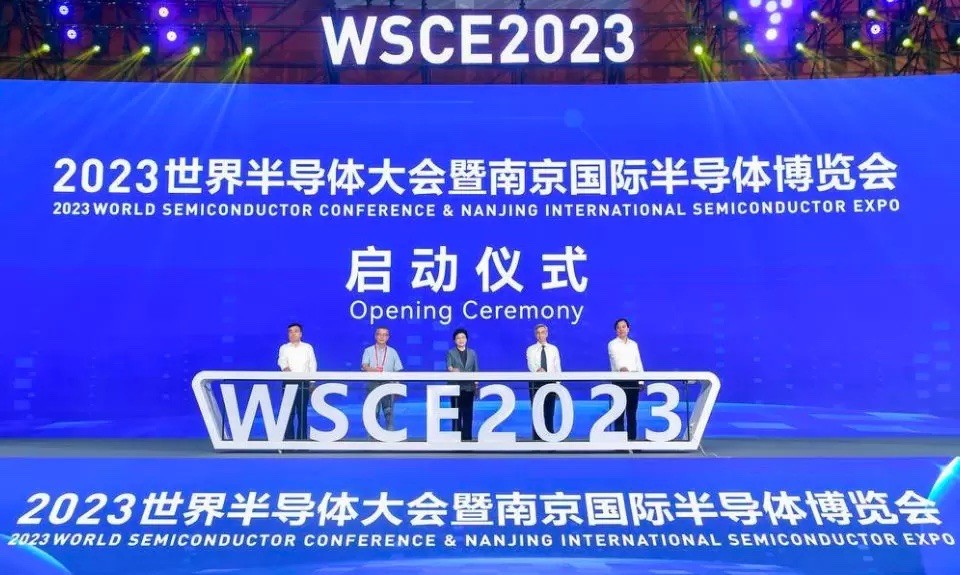
China hosted a semiconductor conference in Nanjing last week, following the imposition of U.S. export restrictions on the country’s chip making industry, where local experts shared their views on how to cope with the challenges. Yu Xiekang, Chairman of the China Semiconductor Industry Association (CSIA), told the World Semiconductor Conference Expo that U.S.-led export controls have disrupted China’s advanced chip making capabilities. He called for “enhanced cooperation”, repeating his Association’s stance that the industry should join hands to oppose Washington’s curbs on China’s chip industry. Wei Shaojun, a prominent Chinese semiconductor expert and former Director of the Institute of Microelectronics at Tsinghua University, said globalization of the industry “is over” amid the geopolitical tensions and that the semiconductor supply chain will “inevitably become more fragmented”. “China bears the brunt of the semiconductor fragmentation and faces serious challenges ahead,” Wei said, adding that the local chip sector has grown over the past decade by tapping into the global supply chain to secure the best available resources. Wei said U.S. sanctions aimed at preventing China’s progress in advanced process nodes bodes ill for the country as the current emphasis on legacy nodes is vulnerable in the long run.
Ni Guangnan, Chip Expert at the Institute of Computing Technology under the Chinese Academy of Sciences (CAS), said the country should take advantage of the size of its domestic market to spur growth of local players such as U.S. sanctions-hit Yangtze Memory Technologies Corp (YMTC). Ni said China was able to produce advanced NAND flash memory chips even without access to extreme ultraviolet lithography tools, which are barred under Washington’s export controls. The concerns flagged at the conference come as Washington is reportedly set to further tighten trade restrictions, impacting the ability of Intel and Nvidia to ship advanced artificial intelligence (AI) chips to China-based customers. This has prompted lobbying efforts by the U.S. Semiconductor Industry Association (SIA) and some top American chip makers, including Intel, to try and convince the Biden administration to show restraint.
The impact of the restrictions was visible at the three-day event, as few U.S. executives were present. Under new rules introduced last October, U.S. citizens are restricted from contributing to advanced semiconductor development in China. Washington has imposed tighter restrictions on the type of technology China-based foundries can use. It also convinced Japan and the Netherlands, two of the world’s leading suppliers of chip making tools, to align with its goals of curbing China’s ability to develop advanced semiconductors.
As China becomes marginalized from the global chip supply chain, cooperation has increased among the U.S., EU, Japan, South Korea and Taiwan. Taiwan Semiconductor Manufacturing Co (TSMC) and Samsung Electronics both committed to investing billions of dollars to build advanced wafer fabs in the U.S., while Intel will invest an initial €17 billion in a leading-edge mega-fab in Germany. Nanjing, home to more than 500 semiconductor companies, has emerged as a stronghold in Jiangsu province for China’s chip industry, along with the neighboring tech manufacturing hubs of Wuxi and Suzhou. In 2016, TSMC, the world’s largest contract chip maker, opened a foundry in Nanjing, which is currently capable of manufacturing 16-nanometer and 28-nm process nodes, with a capacity of 350,000 wafers a month, the South China Morning Post reports.
AI development in China could be challenging in the short term, as U.S. restrictions on the export of advanced graphics processing units (GPUs) have “scared some people away”, Jui Tan, Managing Partner at BRV China, told the South China Morning Post. “You’re worried that after you invest in the application scenario and talent, then maybe halfway you realize that you don’t have enough computational power and can’t get enough GPUs,” said Tan. “I think that’s created some kind of fear for entrepreneurs and investors.” The U.S. Department of Commerce last August imposed a ban on American companies Nvidia and Advanced Micro Devices (AMD) from selling some of their most advanced chips to China, leaving the Chinese AI industry scrambling for limited supplies of GPUs made by Nvidia, which has a near monopoly on processors used to train Ai systems. Xia Zuoquan, a Chinese billionaire investor who made his fortune co-founding electric vehicle giant BYD told the South China Morning Post that he is skeptical that a ChatGPT-level product will be born in China soon. However, Tan said BRV is committed to investing in China’s AI sector. The venture capital firm is set to allocate over 50% of its new CNY5.5 billion fund, raised in May last year, to AI start-ups, he said.
Meanwhile, Micron President and CEO Sanjay Mehrotra has visited China and met with the Ministry of Commerce, two months after the Cyberspace Administration of China (CAC) banned sales of its products to China’s critical information infrastructure operators (CIIOs), including a wide range of entities from telecoms operators to banks and water utilities. Analysts said this proved that American chip companies are reluctant to give up on the Chinese market, despite rising U.S.-China geopolitical tensions. Intel’s CEO Patrick Gelsinger also concluded a low-key trip to China as his company pushes its latest processor for AI deep-learning applications, the Gaudi2, a device that is not currently covered by U.S. export restrictions. According to memory chip maker Micron, a quarter of its revenue comes from Hong Kong and companies headquartered in mainland China. After Beijing’s sudden ban, Micron said it would maintain communications with the Chinese authorities. The following month, it announced plans to invest CNY4.3 billion to upgrade its chip packaging plant in Xian, Shaanxi province. While Micron’s spending in Xian is modest compared to plans to invest USD3.6 billion in Japan, and even the USD825 million it is spending on a new test facility in India over the next few years, CEO Mehrotra said the move showed its commitment to its China operations and the local team.
“Allowing the industry to have continued access to the China market, the world’s largest commercial market for commodity semiconductors, is important to avoid undermining the positive impact of the Chips and Science Act”, the Semiconductor Industry Association (SIA) said in a statement. The executives of three SIA members, Intel, Qualcomm and Nvidia, lobbied against the new restrictions in Washington last week. SIA warned that any steps to further impose “overly broad, ambiguous, and at times unilateral” restrictions would risk “diminishing the U.S. semiconductor industry’s competitiveness, disrupting supply chains, causing significant market uncertainty, and prompting continued escalatory retaliation by China.” Last year, China’s semiconductor purchases totaled USD180 billion, accounting for around a third of the worldwide total of USD555.9 billion, consolidating the country’s status as the largest single market for semiconductors.