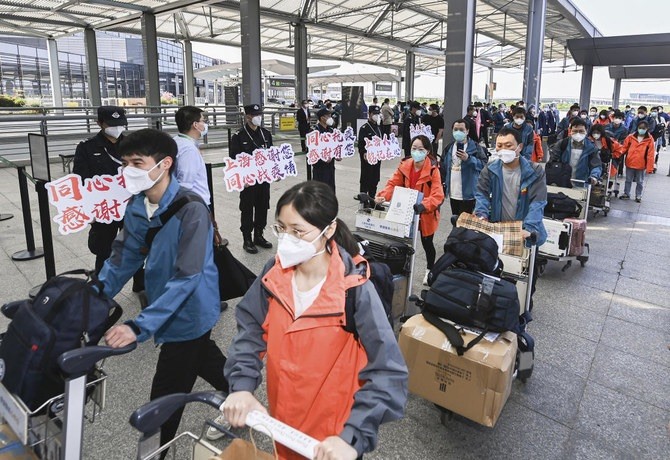
Return to normal in Beijing and Shanghai was marred by new Covid-19 outbreaks in Anhui province, and three new cases in Shanghai. Authorities dismissed allegations that this was linked to adjustments in policy with a reduction in quarantine for international arrivals and close contacts, and easier domestic travel.
The worst hit province is Anhui, which reported 61 confirmed and 231 asymptomatic cases on July 2. Sixian county is under lockdown and conducting several mass testings. At least three cities – Nanjing, Xuzhou and Wuji in Jiangsu – have identified cases believed to be linked to Anhui's Sixian county. Outside of Anhui, Shandong, Jiangsu, Zhejiang, Shaanxi and Liaoning provinces, as well as Shanghai reported new infections.
Restaurants in Shanghai reopened their doors to diners on June 29 after dining-in service was suspended for about three months due to the Omicron outbreak. On its first day of resuming dining-in service, onsite turnover at restaurants increased by 293% compared with the previous week, according to Meituan. Large-scale restaurants must limit seating at 70% of capacity, while smaller restaurants are ordered to operate at 50% capacity. Shanghai restarted travel group tours on July 1 after a three-month suspension. Sanya, Zhoushan and Beijing are the top three destinations for Shanghai tourists. In Beijing, Universal Studios' Resort reopened its doors. Nearly 500 scenic spots across China have announced free tickets or discounts for special tourists including students and medical workers.
Early last week China reduced mandatory quarantine for international arrivals to 7+3, meaning seven days in centralized hotel quarantine and three days of self-monitoring at home. The rule also applies to close contacts of confirmed Covid-19 patients. But Lei Zhenglong, Deputy Director of the National Health Commission’s Bureau of Disease Prevention and Control said that “the adjustment by no means suggests a loosening of novel coronavirus control measures. Rather, we are aiming for higher standards and more targeted and faster response in dealing with outbreaks, while adhering to the dynamic zero Covid-19 strategy”. The measures are outlined in the Joint Prevention and Control Mechanism's ninth prevention and control guideline for Covid-19, released more than a year after the previous version was published.
The nationwide travel tracking system – the Big Data Itinerary Card – will no longer mark cities having areas of Covid-19 infection risks with an asterisk to better balance epidemic prevention and economic and social development, it was announced. Inter-city and inter-provincial travelers were usually asked to present tracking information upon arrival. Travelers from marked areas – until recently including Beijing, Shanghai and Nanjing – usually faced a mandatory quarantine after arrival in Covid-free areas.
During an inspection tour in Wuhan, President Xi Jinping reaffirmed the dynamic zero-Covid policy. “Even if there are some temporary impacts on the economy, we will not put people's lives and health in harm's way, and we must protect the elderly and the children in particular. If we make an overall evaluation, our Covid-19 response measures are the most economical and effective,” he said.
A mysterious jump in influenza cases of the H3N2 type in some southern provinces prompted experts to call for expanding flu vaccinations, while exploring their integration with Covid-19 shots. Flu vaccination coverage has been low in China at only 3.34% in the last flu season. From April 4 to June 19, the country’s southern areas registered 503 influenza outbreaks, up from 136 during the same period last year, mostly in Guangdong, Fujian and Guangxi. China’s northern areas recorded a mere four outbreaks, down from 86 a year ago.
China has also begun screening inbound international travelers for potential monkeypox infections as human-to-human transmission is being reported in a number of countries.
This overview is based on reports by the China Daily, Shanghai Daily, Global Times and South China Morning Post.