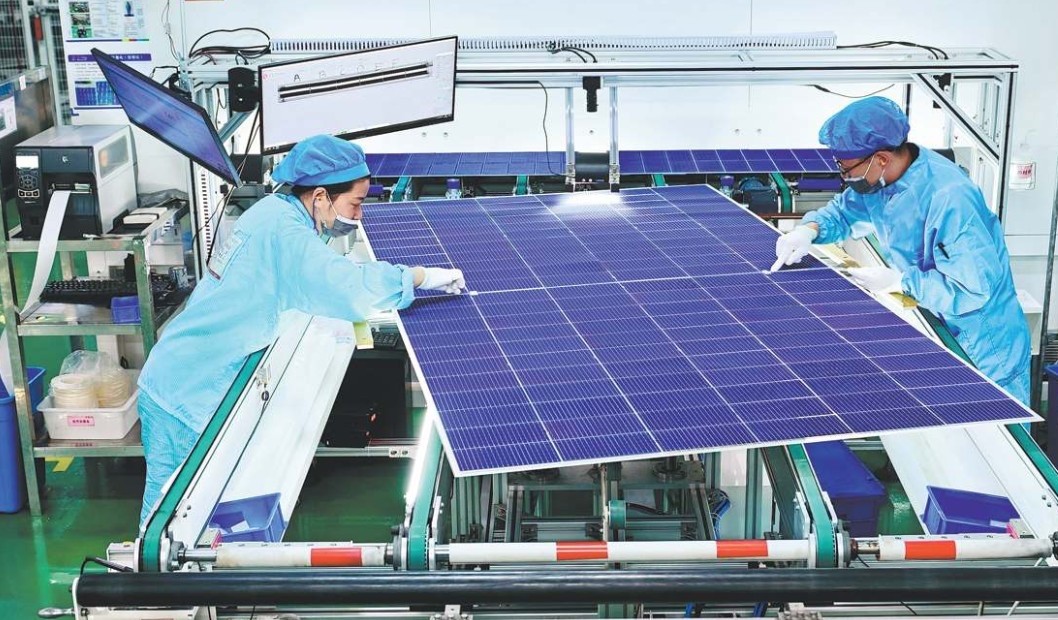
China’s solar power industry is entering a mature phase of stable pricing and high-quality manufacturing, following the removal in April of a key export tax rebate, which ends a prolonged era of volume-driven price wars. The policy shift is acting as a powerful catalyst, forcing weaker, subsidy-reliant manufacturers out of the market while accelerating a much needed return to long-term value. “This policy marks a critical turning point for the entire industry,” noted Chen Jiahui, Senior Solar Market Analyst from Shanghai Metals Market, a metal information provider in China. “Top-tier Chinese manufacturers are pivoting from simply exporting basic components to delivering localized, high-efficiency power systems. This will fundamentally shift the core logic of the market from pure supply-and-demand volume to long-term cost efficiency, technological upgrades, and comprehensive service,” he said.
Designed to rein in irrational price competition and eliminate outdated production capacity, the policy completely eliminated the 9% VAT export tax rebate for photovoltaic products, including silicon wafers, solar cells, and modules, effective April 1. In addition, to encourage domestic enterprises to focus on core technological breakthroughs rather than rely on export subsidies, the export tax rebate rate for battery products was reduced from 9% to 6% starting April 1 and will be entirely phased out from Jan 1, 2027. This definitive cancellation of the export rebate marks the second major recalibration of China’s solar fiscal policy in over a year, following an initial reduction of the rebate rate from 13% to 9% in December 2024, said Lin Boqiang, Dean of the China Institute for Studies in Energy Policy at Xiamen University. Lin described this environment as a “survival of the fittest” landscape.
“For top-tier manufacturers equipped with vertically integrated supply chains, advanced technology, and strong brand pricing power, the policy shift is a golden opportunity to consolidate their dominance,” he said. “These firms can absorb cost fluctuations through internal optimization and expand their overseas asset-light production bases.” Conversely, for smaller manufacturers lacking technical advantages and heavily reliant on low-price dumping to survive, the removal of the tax rebate poses an existential threat, Lin added.
The era of “involution” – relentless, margin-crushing internal competition – is yielding to a healthy environment where price competition gives way to value competition, Lin said. According to Chen, anticipating potential cost variations, overseas buyers have proactively secured extensive orders to ensure steady supply chains. Solar panel exports reached a record high this March, rising 125% month-on-month and 67% year-on-year in value terms to USD3.61 billion. According to research firm TrendForce, total first quarter module exports reached between 80 and 100 gigawatts, effectively covering more than a third of the anticipated global demand for the entire year. Consequently, the second quarter is projected to be a period of rational recalibration. Export volumes are expected to stabilize as international channels digest their massive first quarter inventories, paving the way for a steady, healthy market recovery in the third and fourth quarters.
Amy Fang, Senior Analyst at PV consultancy InfoLink Consulting, noted that the robust performance across both module and cell segments in March was a direct result of manufacturers rushing to ship products before the April policy adjustment took effect. She highlighted that while Europe and the Asia-Pacific region remained the primary drivers of this export wave, Africa stood out as a significant emerging growth engine. Echoing this sentiment, S&P Global Analyst Jessica Jin attributed the export boom to both the impending rebate elimination and enhanced profit margins driven by cheaper silver. However, she cautioned that these massive export figures do not strictly mirror actual downstream consumption. Instead of reaching end-users immediately, a portion of these shipments was likely stockpiled at overseas production facilities or intermediate transit hubs.
“Countries are importing solar panels at record levels and building up their own domestic assembly and manufacturing capabilities to address surging global demand,” said Euan Graham, Senior Analyst at energy think tank Ember. Beyond the sheer volume of shipments, China is also moving up the global value chain by exporting more advanced, high-tech solar components. Chen from SMM points out that while fully assembled modules remain the primary export, accounting for 67% of the total, shipments of higher-value solar cells have become the fastest-growing segment, and now comprise 18% of solar energy exports. Wafers and polysilicon account for 9% and 4%, respectively. Exports to the Association of Southeast Asian Nations (ASEAN) have grown by 29.4%, while shipments to Africa have surged by nearly 50%, illustrating a rapidly expanding global market share in the Global South.
Starting on August 1, the government will implement binding targets for renewable energy consumption. This marks a strategic shift in China’s energy transition, moving away from the massive capacity expansion seen in recent years toward ensuring clean electricity is actually utilized, the China Daily reports.