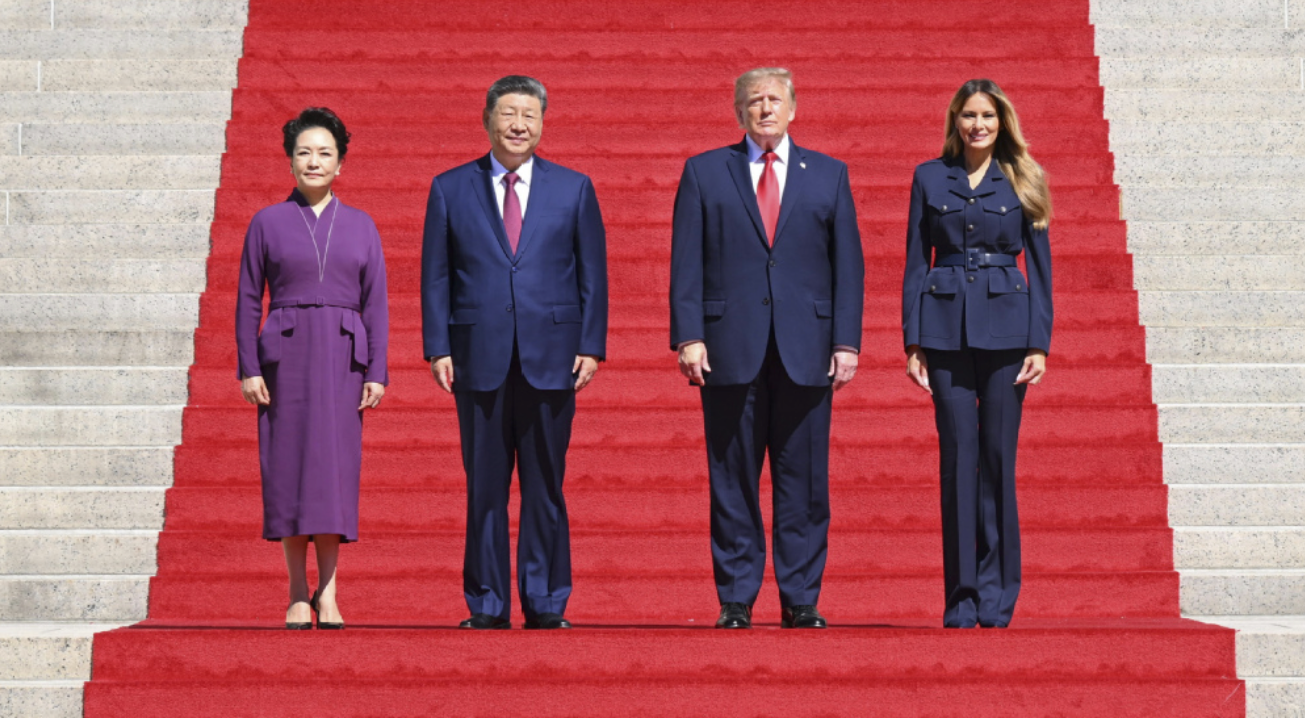
Chinese President Xi Jinping, accompanied by his wife Peng Liyuan and a large official delegation, paid a three-day visit to Washington. U.S. President Donald Trump and his wife Melania went to Joint Base Andrews in Maryland to welcome their Chinese guests. An official welcoming ceremony was held the next day at the White House before both Presidents started their meeting. While they cemented their friendship, few agreements were signed. The visit was called “heavy on pageantry but light on concrete deliverables”.
Following separate economic talks between U.S. Treasury Secretary Scott Bessent and Chinese Vice Premier He Lifeng, it was announced that both countries have agreed to extend the Busan trade agreement for two months until January 10. The Chinese government preferred an extension through the end of Trump’s presidency in January 2029, while Washington sought a shorter-term deal. Both sides also agreed to operationalize the Board of Trade where both sides select non-sensitive sectors and products capped at USD30 billion each to implement lower tariffs.
They also agreed to open an AI or – as Trump calls it – a ‘super intelligence’ communications channel. A meeting of the newly formed U.S.-China Super Intelligence (SI) Dialogue would take place by November. President Xi said that both China and the U.S. are leading nations in artificial intelligence and have the capability and responsibility to develop and manage AI for good, and to ensure that the development of AI is always under human control and serves the well-being of the people. Xi reiterated that China and the U.S., as two major countries, stand to gain from cooperation and will both lose in confrontation.
The Guardian reported that President Xi called for extensive cooperation with the U.S. to avoid the “Thucydides trap” that could put both countries on a military collision course amid rising tensions over artificial intelligence (AI), trade and Taiwan. At the start of his summit meeting with Donald Trump in the White House, the Chinese President laid out terms for a mutual understanding that he said could steer the two competing powers away from future military conflict and on to a road of mutual gain. We should coexist in peace and build a constructive China-U.S. relationship of strategic stability, Xi added.
Describing relations as being at a “new historical juncture”, the Chinese leader said Trump’s “Make America Great Again” was complementary with Beijing’s commitment to realizing the great rejuvenation of the Chinese nation. Xi, meanwhile, noted that George Washington, the first U.S. president, personally acquired a large collection of Chinese porcelain as a symbol of that long commercial relationship. “Over 200 years ago, soon after its independence, the United States turned its eyes to China,” Xi said. “Our two countries started trading with each other, exchanging goods to meet each other’s needs and draw on our complementary strengths.” Xi urged Washington to treat Chinese firms fairly, while vowing to keep China’s door “always wide open” to American companies. The two sides could lengthen the list of cooperation and shorten the list of problems, he added.
At the formal White House dinner, sitting at the main table with Xi and Trump were Chairmen and CEOs of major U.S. tech companies, including Tesla CEO Elon Musk, Nvidia CEO Jensen Huang, Advanced Micro Devices CEO Lisa Su, and Apple Board Chairman Tim Cook. Also attending the dinner were OpenAI CEO Sam Altman, Amazon Chairman Jeff Bezos, Google CEO Sundar Pichai; the CEO of Micron Technology Sanjay Mehrotra, JPMorgan Chase CEO Jamie Dimon, Citigroup CEO Jane Fraser, Lockheed Martin CEO James Taiclet, and Pfizer Chairman Albert Bourla. Chinese business executives were not included in Xi’s delegation aboard his special plane. Some traveled independently to Washington, but none were invited to attend the White House dinner.
President Xi also invited 100,000 young Americans to visit China for exchanges and studies in the coming five years, and said two pandas will come to their new home in Zoo Atlanta.
Xi and Trump are expected to meet each other again twice before the end of the year, in November at the Asia-Pacific Economic Cooperation (APEC) Summit in Shenzhen and the following month at the G20 Summit in Miami.
This overview is based on reports by the China Daily, Global Times, South China Morning Post and The Guardian.