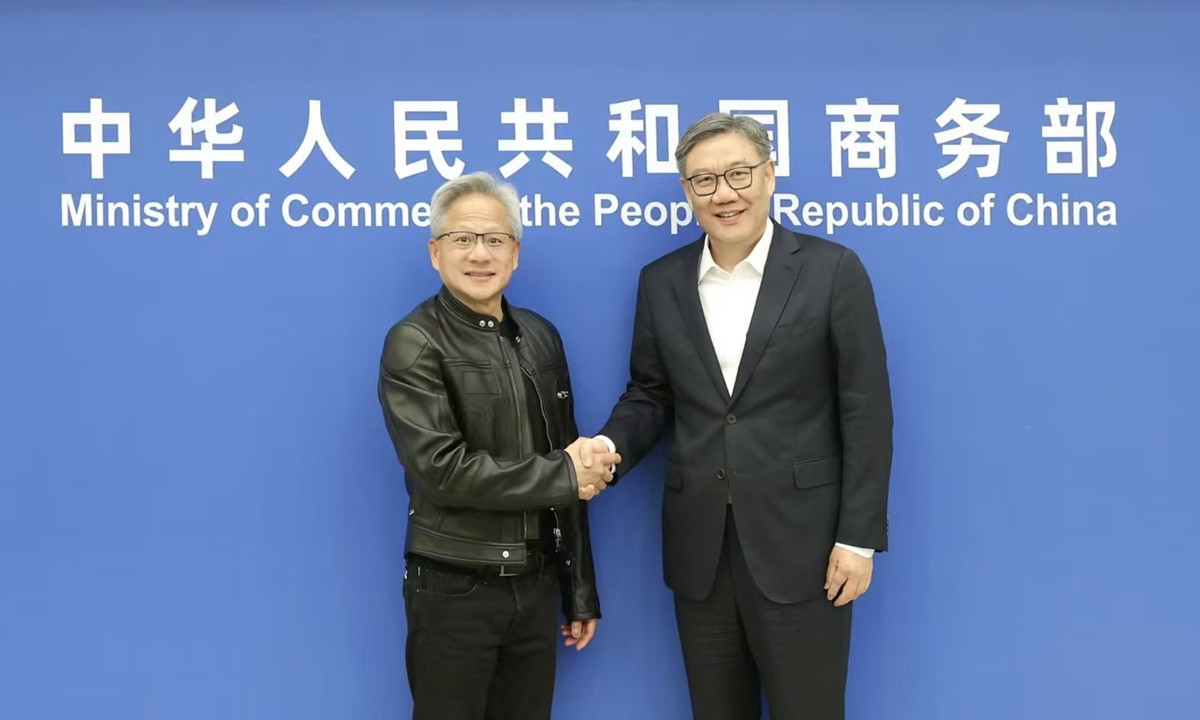
(Top Left: Nvidia CEO Jensen Huang, left, and China's Minister of Commerce Wang Wentao, right)
On his third trip to China in a year, Nvidia CEO Jensen Huang – head of the world’s most valuable company – was on a full-blown charm offensive. As a guest of honor at the China International Supply Chain Expo (CISCE), Huang’s visit underscored the recent thaw in Sino-U.S. relations. Upon arrival, he announced that U.S. authorities had cleared the way for Nvidia to export the H20 – a made-for-China AI chip less powerful than its gold-standard acceleration model, which was banned for export to the country in April. At the opening ceremony for the Expo’s third edition, Huang even swapped his signature leather jacket for a traditional Chinese tang suit, delivering part of his speech in Mandarin. Offstage, he took endless media interviews, praised Chinese technology companies and AI models, and posed for selfie requests. His charisma and optimism were on display after China and the U.S. agreed on a framework in trade negotiations and pushed ahead with approvals for certain technology and rare earth exports.
As a sign of the importance China attaches to his visit, Huang had a meeting with China's Minister of Commerce Wang Wentao. China's policy of attracting foreign investment remains unchanged and will further open its doors, the Ministry of Commerce said. With its vast market, rich application scenarios, and vibrant innovation ecosystem, China hopes that multinational companies, including Nvidia, will provide high-quality and reliable products and services to Chinese customers, Minister Wang said. Huang said that the Chinese market is highly attractive, and Nvidia is willing to deepen cooperation with Chinese partners in the field of artificial intelligence (AI).
Led by Nvidia, U.S. firms were the largest overseas contingent at the Expo – with participation up 15% compared to the previous edition. But beneath the surface of the buoyant atmosphere, the threat of supply chain disruptions – and a broader decoupling – had not dissipated. At the U.S. Grains Council booth, a Chinese importer said he faced a 10% tariff, split between the Chinese importer and his U.S. supplier, who agreed to share the costs. But where the importer could have made CNY2 million a year, he may now lose CNY2 million. Despite recent progress in U.S.-China trade talks, the Chinese importer remains cautious about placing large-volume orders or committing to major contracts.
A representative from a U.S. state office in China expressed similar concerns. Many such offices, which promote trade and investment, have decided to withdraw from China since last year – most of them Republican-led or swing states. Today, only about 10 Democrat-led states maintain a presence, down from about 20 offices previously, according to the representative. There was a surge in interest from Chinese firms to build warehouses or factories in the U.S. during the second half of last year, she said – especially when the possibility of U.S. President Donald Trump returning to the White House became clearer. But following Washington’s unprecedented trade war, launched in April, consultation requests declined sharply.
One of her clients – a Chinese manufacturer in the raw materials industry – recently decided to cancel plans to build warehouses in her state. “The plan was to quickly stock some goods in the U.S. as a contingency against potential trade barriers. But after they selected a place, the approval process became a bottleneck – the property agents required extensive documentation because the company is Chinese – and nothing was completed when the tariff war began. Then the plan became pointless.” After the U.S.-China trade talks in Geneva in May, most tariffs were removed or suspended for 90 days – but the company’s anxiety was not at all alleviated, she said. “Their management began questioning the entire U.S. investment strategy. Consequently, the warehouse initiative has been shelved indefinitely.”
This overview is based on reports by the South China Morning Post and the Global Times.