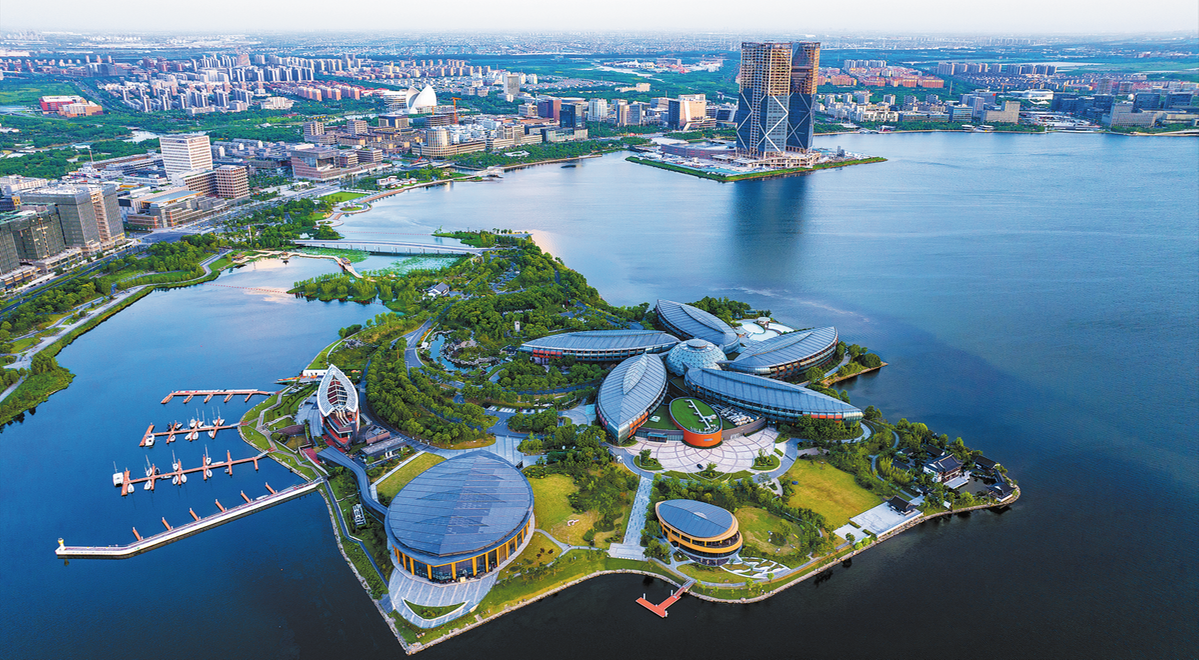
The Lingang New Area of the China (Shanghai) Pilot Free Trade Zone (FTZ) marked its fifth anniversary on August 20. A milestone in its development, the area is now home to numerous advanced manufacturers including Tesla's first overseas gigafactory and the production base for China's first self-developed large passenger aircraft C919. As the area's actually used foreign direct investment (FDI) increased by 45.3%, it negated Western countries' "decoupling" and "de-risking" push against China. The figure also showed that global multinationals are increasingly counting on the Chinese market, and that China has become an irreplaceable and pivotal part of the global supply chain, especially in high-tech manufacturing, observers said. The second final assembly plant for the C919 aircraft will be built in the Lingang New Area, with a total construction area of 330,000 square meters and a total investment of CNY11.95 billion. It is expected that the factory's annual production capacity will reach 150 units by 2027, when the production line will run at full capacity.
“This would mark another milestone for the development of high-end manufacturing in Lingang, taking advantage of the area's pioneering role across a number of sectors ranging from the financial services and leasing industries, to systemic opening-up. It also aligns with China's ongoing drives to upgrade industries and make innovation a key engine of the national economy,” Cong Yi, Professor at the Tianjin School of Administration, told the Global Times.
This is only one of the latest success stories since the Lingang New Area was inaugurated on August 20, 2019. In June, the Boeing Shanghai Aviation Services Co announced groundbreaking for its new facility in the area, which the company said aims to “leverage the unique regional and policy advantages” of the area. With a total investment of CNY850 million, the facility is anticipated to be completed by the end of 2025. “It is not an exaggeration to say that those developments in the area offer a vivid example of how China's continued deepening reform and opening-up will build an efficient institutional system that aligns with international standards and leads the country on a path of high-quality development,” Cong said. The Lingang New Area is also a demonstration zone, where its practical experience of innovation in systems and opening-up would be gradually applied in other Chinese cities.
In May, U.S. carmaker Tesla broke ground on a mega factory in Shanghai to manufacture its energy-storage batteries, Megapacks, making it the first energy storage megaproject outside the U.S. The plant is expected to start mass production in the first quarter of 2025. The gigafactory of Tesla, the first solely foreign-invested car manufacturing project in China, was put into operation in 2018.
Over the past five years, the Lingang New Area's regional GDP rose at an annual average rate of 19.8%. The region has blazed trails in opening-up, including trade liberalization, free flows of resources and foreign exchange management. In a latest move, an executive meeting of the State Council, presided over by Premier Li Qiang, reviewed and approved four documents, including the 2024 edition of the negative list for foreign investment access. China will relax restrictions on foreign investment further by completely abolishing entry barriers in the manufacturing sector, while accelerating the opening up of sectors such as telecommunications, education and health care services.
The China Daily mentions the example of IAT Auto. In late June, China’s first independent car design company signed an investment framework agreement with the Lingang Special Area to conduct its automotive research and development, manufacturing and export operations. Xuan Qiwu, Chairman of IAT Auto, which has worked with over 80 industry leaders including Honda, SAIC Motor and Li Auto for the past 17 years, said there were major reasons the company was setting up in the Lingang area of the Shanghai Pilot Free Trade Zone. Apart from an extensive transportation network linking Lingang to the rest of the country and the world, various opening-up policies introduced to improve global competitiveness were good incentives for the company to expand its footprint there, he said. IAT’s new facility will be located in Lingang’s Yangshan Special Comprehensive Bonded Zone. The bonded zone has already attracted a large number of well-established overseas carmakers such as BMW and Fiat Chrysler Automobiles to build design hubs, and international centralized procurement and distribution centers for auto parts. Establishing itself in the zone is expected to accelerate IAT’s internationalization, as Chinese automotive companies become more outward looking, Xuan said.
Apart from overseas companies, Lin-gang is also home to a large number of domestic companies in the auto industry chain. The possibility of working with more companies is another major reason IAT was attracted to the area, Xuan said. In 2023, more than 1.1 million intelligent connected cars were manufactured in Lingang, with the industry’s annual output exceeding CNY300 billion, 10 times the size in 2019. U.S. electric vehicle maker Tesla can take a big part of the credit for progress made by the industry in Ligang. By launching a gigafactory in Lingang in 2018, Tesla helped build a full industry chain for intelligent connected car manufacturing in the special area. More than 180 companies have been providing auto parts or services to Tesla’s gigafactory. Of those, 105 are based in 24 cities in the wider Yangtze River Delta region. Tesla’s 40 gigawatt-hour energy storage project, also located in Ligang, is scheduled to be operational by the end of this year. With CNY50 billion in investment, Tesla’s gigafactory is the largest foreign-invested manufacturing project in Shanghai. Tesla’s Vice President Tao Lin said the multiple institutional innovations introduced in Lingang were another major reason Tesla’s operations were galloping ahead there. Over the past five years, Lingang has realized 138 institutional innovations covering free trade, investment, cross-border finance and high-end shipping. Just as importantly, 70 of these innovations were the first of their kind in China. Boeing Shanghai Aviation Services’ modification and maintenance businesses in Lingang is one of the latest, and best, examples of institutional innovation, the China Daily reports.
The four frontier industries in Lingang are the civil aviation industry, integrated circuits, artificial intelligence and biomedicine. The expansion of industries and new businesses, coupled with economic dynamism, has propelled Lingang’s population from 440,000 in 2019 – when it was upgraded to become part of the Shanghai FTZ – to over 600,000 today. The government’s efforts to attract fresh talent to the area have also played a big role. Over the past five years, Lingang has issued 1,110 work permits for expatriates and approved permanent residency for another 79 foreigners. Overseas returnees have set up 270 companies in the special area.