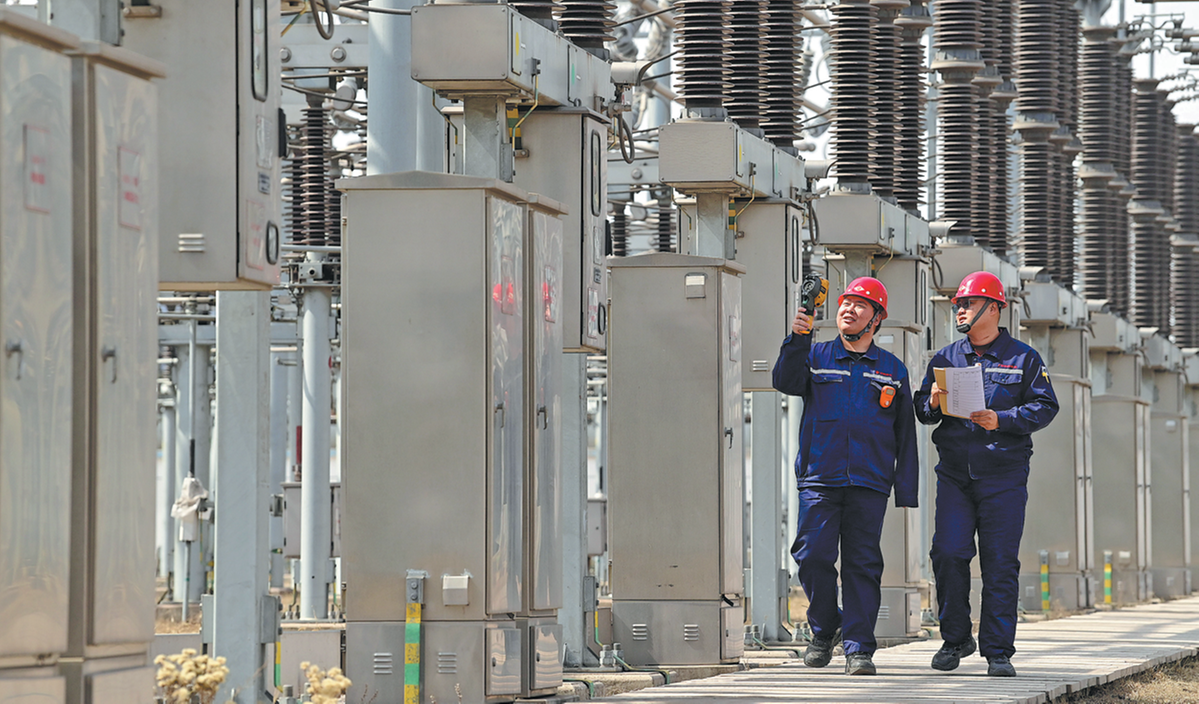
For a long time, electricity has been a unique energy commodity, with production and consumption happening almost simultaneously. You use it the moment it is generated. But today, as solar and wind power have become China’s largest sources of installed capacity, energy companies are building “warehouses” for the power grid. These massive facilities store surplus green electricity during the day and deliver it to factories, shopping malls and millions of households at night. This time-shifting has found its grandest stage in North China’s Inner Mongolia autonomous region. Driven by the massive deployment of new-type battery facilities designed to support its vast wind and solar power bases, Inner Mongolia has overtaken California to become the world’s largest energy storage region.
As of the end of 2025, the region’s cumulative installed capacity of new-type energy storage exceeded 25 million kilowatts, ranking first in China. Under the blueprint of the 15th Five Year Plan (2026-30), this figure is projected to break the 50 million kW mark, cementing the region’s role as the most critical power “reservoir” for the country’s renewable mega-bases in the Gobi desert and other arid areas. The sheer scale of this deployment has triggered a profound industrial metamorphosis. In the past, Inner Mongolia’s vast Gobi Desert served merely used equipment purchased from manufacturing clusters in China’s eastern provinces. Today, Hohhot, Baotou and Ordos are forming a differentiated energy storage equipment manufacturing cluster. Each city has its unique strength, but the regional capital Hohhot stands out for its focus on system integration and custom solutions for extreme environments. Hohhot’s produces energy storage equipment uniquely designed to withstand the severe cold and punishing sandstorms characteristic of the northern frontiers.
While Baotou boasts the most comprehensive industrial chain and Ordos combines equipment manufacturing with ultra-large applications at sites like Envision’s zero-carbon industrial park, Hohhot’s tailored approach to hostile climate operations ensures these massive systems remain reliable year-round. “Deploying gigawatt-scale battery facilities in the Gobi desert is fundamentally different from installing systems in temperate coastal plains,” said Lin Boqiang, Dean of the China Institute for Studies in Energy Policy at Xiamen University.
“Extreme sub-zero winters can degrade battery performance and lower efficiency by double digits, while seasonal sandstorms pose severe risks to thermal management and air filtration systems.” Hohhot’s focus on hostile-climate customization addresses the industry’s biggest operational bottleneck: ensuring that massive desert storage parks don’t just get built, but actually run safely and reliably 365 days a year, he said. Inner Mongolia’s regional achievement mirrors a broader national strategy. In 2026 the strategic importance of new-type energy storage has reached unprecedented levels. For the first time, it has been listed among the nation’s six emerging pillar industries in the 15th Five Year Plan.
The China New Energy Storage Development Report 2026, released recently by the National Energy Administration (NEA), said China’s cumulative installed capacity of new-type storage had reached 136 million kW/351 million kilowatt-hours by the end of 2025, representing a year-on-year surge of 84.3%. Accounting for roughly 50% of the global total, new-type energy storage has surpassed pumped-hydro storage to become China’s largest regulating resource, it said.
The years of rapid expansion have ended and “the industry has formally entered a new phase characterized by market oriented selection, value priority and a focus on quality,” said Dai Hongcai, Director of the New Energy Institute at the State Grid Energy Research Institute. While the “forced pairing” of storage with renewable projects drove early growth, future expansion will rely on sustainable business models. The market is also demanding longer duration capabilities. While the average storage duration was around 2.5 hours at the end of 2025, four-hour storage has now become the mainstream, and eight-hour long-duration storage is moving from demonstration to commercial application. This shift ensures that “giant power banks” don’t just respond quickly, but can actually sustain the grid through the entire evening peak.
As the technology matures, the application boundaries of energy storage are expanding far beyond the traditional power grid. A new and highly lucrative frontier has emerged: the intersection of energy storage and artificial intelligence computing power. In the era of AI large models, a massive global “compute-power race” has sparked acute anxiety over electricity consumption. A single 10,000-GPU computing cluster can consume roughly 100 million kWh of electricity annually. While technology companies in the West are resorting to isolated gas turbines or small nuclear plants to power their AI ambitions, China is leveraging its robust wind, solar and storage eco-systems to pioneer a “compute-power and electricity synergy” model. Inner Mongolia is at the absolute forefront of this revolution. Ulaanqab, a city once known primarily for its grasslands and potatoes, is rapidly transforming into one of the Asia-Pacific’s largest and fastest-growing AI computing clusters. In under two years, the region’s computing power has nearly quadrupled.