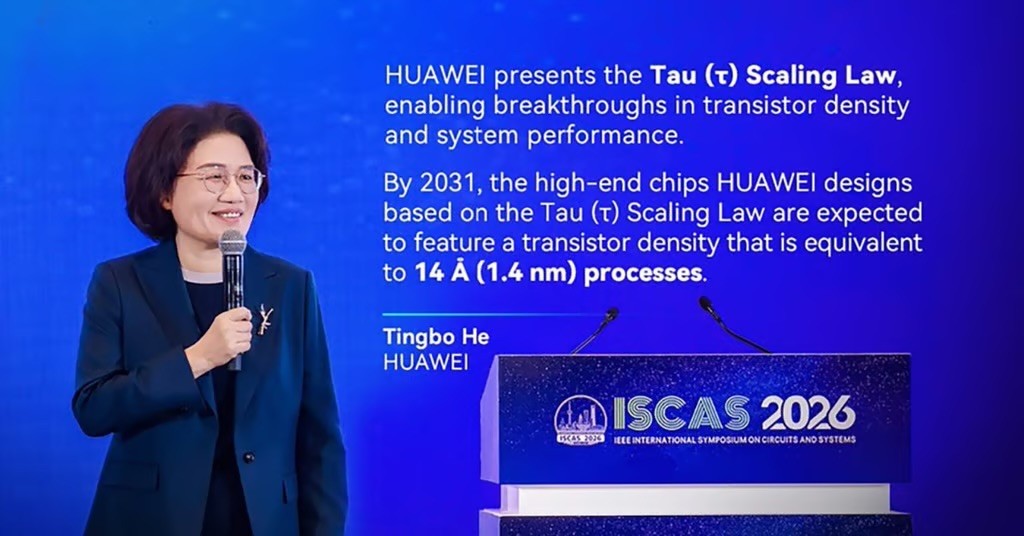
Huawei Technologies expects its premium chips to achieve transistor density equivalent to 1.4-nanometer processes by 2031 under a new semiconductor development framework, the company announced at a conference in Shanghai. He Tingbo, Huawei Board Member and President of its Semiconductor Business, formally introduced the “Tau Scaling Law” in a keynote speech titled “New Semiconductor Path in Practice”. Unlike traditional approaches that rely on miniaturizing transistors, the new methodology prioritizes reducing signal propagation time across devices, circuits, chips and systems, He said, adding that Huawei has already designed and mass-produced 381 chips based on the Tau Scaling Law over the past six years.
This autumn, the company will launch a new Kirin smartphone chip that adopts a multilayer circuit architecture which shortens critical path wiring and improves transistor density and energy efficiency. The announcement underscores China’s push to circumvent U.S. export restrictions that have limited domestic access to advanced lithography tools and cutting-edge semiconductor manufacturing.
China is widely seen as unlikely to reach 1.4 nm capabilities through conventional fabrication alone, but a successful application of the Tau Scaling Law could offer a way to improve performance and chip density despite equipment constraints, experts said. Huawei’s projection places it on a competitive timeline with TSMC, the world’s largest advanced chip foundry. TSMC currently produces chips on 2 nm technology and plans to begin mass production of its A14 (1.4 nm) process in 2028.
Beyond Huawei’s internal roadmap, Chinese AI developers are increasingly turning to domestic chips. In its DeepSeek-V4 technical report, DeepSeek listed Huawei’s Ascend NPU alongside Nvidia GPUs within the same hardware validation framework, the first time the company has positioned a Chinese AI chip on equal footing with Nvidia in an official document. The model has already completed inference adaptation on Huawei’s Ascend platform. As overseas advanced computing procurement tightens, the shift toward domestic AI chips is accelerating. He from Huawei said the semiconductor industry’s future depends on open collaboration, adding that no single company can independently find all the answers.
Huawei’s progress comes as a string of Chinese semiconductor companies are making inroads into chip supply chains, including chip materials, packaging, manufacturing processes and chipmaking equipment. Xing Ziqiang, Chief China Economist at Morgan Stanley, said that China is making breakthroughs in technological innovation, driven by three core advantages – industrial clusters, a demographic dividend of science and engineering talent, and an ultra-large market – that are difficult for other economies to replicate. “My colleagues estimate that by 2027 or 2028, China is expected to achieve a 50% localization rate in GPUs, marking a significant leap forward,” Xing said, as reported by the China Daily.
Huawei Technologies has engineered a workaround to one of China’s most crippling chipmaking bottlenecks, but analysts warn that the nation’s path to semiconductor independence is still constrained by manufacturing challenges. Huawei has been cut off from procuring leading lithography machines from Dutch supplier ASML, and cutting-edge electronic design automation (EDA) tools since 2019. The company’s new Tau (τ) Scaling Law proposes a major shift in how chips are built. For decades, the industry advanced by physically shrinking transistors to pack more onto a silicon wafer. Huawei is betting instead on a concept called “time scaling”. Rather than trying to make the hardware components smaller, the firm aims to boost performance by compressing the effective time constant (τ) – essentially speeding up how fast signals travel across devices, circuits and systems. Under this new path, improvements in lithography tooling are “not necessary.
However, Arisa Liu, Chief Director and Research Fellow at Taiwan Industry Economics Services, cautioned that Huawei’s new law provided “architectural optimization gains” within physical limits, but was not a total replacement for hardware. The question remains: can Huawei find a domestic foundry capable of manufacturing its sophisticated designs amid strict U.S. export controls? While Huawei’s 2031 timeline indicates it still lags behind global rivals by a few years, Liu noted that achieving this level of innovation while “totally isolated and unable to access top-tier Western equipment” demonstrated “exceptional resilience” and gave Huawei significant bargaining power in the smartphone and AI sectors. Beyond lithography, industry observers expect advanced chip packaging to become more important in the supply chain. Huawei’s LogicFolding architecture boosts performance by reducing the electrical resistance that slows down signals, allowing different parts of a chip to connect and communicate much more quickly.
The South China Morning Post adds that researchers at Peking University have claimed a breakthrough in microchip design software, offering critical support to Huawei Technologies. The innovation comes in the form of a prototype tool for electronic design automation (EDA), a market dominated by Western players such as Synopsys and Cadence Design Systems.