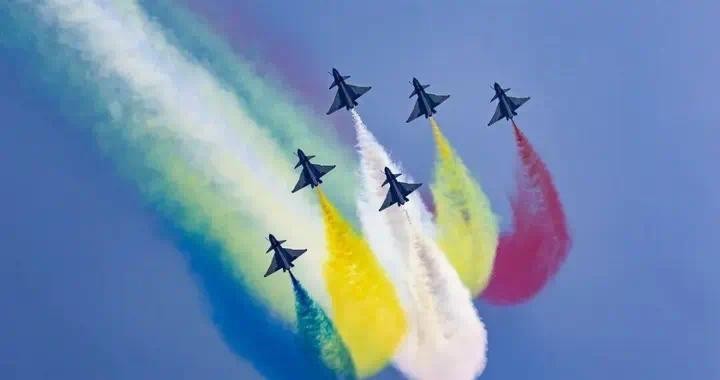
When Zhuhai hosted its inaugural air show in November 1996, the event showcased the J-8IIM fighter, a second-generation fighter equipped with Russian radar and weapons, alongside a limited line-up of home-made aircraft. Imported planes were the focus and Chinese audiences curiously studied the much more advanced foreign designs. They crowded around two Russian fourth-generation Su-27 fighters and were wowed as the jets performed their famous cobra maneuver, sharply braking in mid-air. At the time, China had yet to build its own fourth-generation fighter. But over the next three decades, China went from being heavily reliant on Russian technology to becoming the only country other than the United States to have flight-tested sixth-generation fighters.
The Zhuhai air show – officially the China International Aviation and Aerospace Exhibition – has charted this journey year by year, becoming a major global event and a showcase for the nation’s growing military might. This year’s edition has drawn extra attention, not only because it marks the event’s 30th anniversary but also because it comes ahead of the People’s Liberation Army’s centenary on August 1 next year, described as a key milestone for the military’s modernization. International participation has doubled since 1996, with nearly 50 countries taking part this year. More than 1,100 exhibitors are expected for the December 7 to 13 event, up from around 400 at its debut. The scale of the exhibition has also grown – from 8,000 square meters 30 years ago to 135,000 sq m this year. More than 3,000 pieces of equipment will be on display, including 170 aircraft. There will also be a dedicated naval section for the first time. The event mirrors China’s growing aviation confidence, showcasing advanced systems earlier than in the past. For example, the show did not feature China’s J-10 until 2008, 10 years after the fourth-generation fighter jet conducted its initial flight. The J-20, China’s most advanced stealth fighter in service, was first displayed five years after its 2011 maiden flight. Now, China is not only exhibiting its most advanced operational aircraft but also offering static displays of platforms still in development. In 2024, an airborne drone mother ship called Jiutian debuted at the air show, a year ahead of its maiden flight.
In July 2009, then U.S. Defense Secretary Robert Gates said in a speech that the U.S. should cap its production of fifth-generation stealth fighters because China would not have a fifth-generation jet by 2020. At the time, the Chinese military’s most cutting-edge planes were the fourth-generation J-10A and J-11. But less than two years later, in January 2011, while Gates was meeting with then Chinese President Hu Jintao in Beijing, the J-20 fifth-generation stealth fighter performed its maiden flight. On his flight back, Gates admitted that U.S. intelligence had underestimated how quickly China was developing stealth technology. Today, the U.S. and China are the only countries flight-testing 6th generation fighters. There is no concrete sign of who is ahead, the U.S. F-47 or China’s J-36 and J-50, which have been observed undergoing test flights since December 2024.
Military expert Fu Qianshao said the competitiveness of China’s military aviation had undergone “earth-shaking” changes in the last 30 years, citing engines as an example. “Compared to the U.S., it’s basically a tie. Even though the U.S. is still ahead of China because it started engine installation much earlier, it has been moving quite slowly in the past few decades.” He said China held the leading position in terms of radar, avionics and air-to-air missiles. China’s fleet of advanced fighter jets has expanded rapidly in recent years. According to a January report by the London-based Royal United Services Institute, the PLA Air Force operated an estimated 320 to 350 J-20 fifth-generation stealth fighters by late 2025, up from around 50 in 2020. Its fleet of J-16 advanced fourth-generation multi-role fighters grew from around 90 to 100 to around 450 over the same period. Xu Anxiang, then Deputy Commander of the PLA Air Force, said at the 2018 Zhuhai air show that China aimed to build a world-class strategic air force by the middle of the century, the South China Morning Post reports.