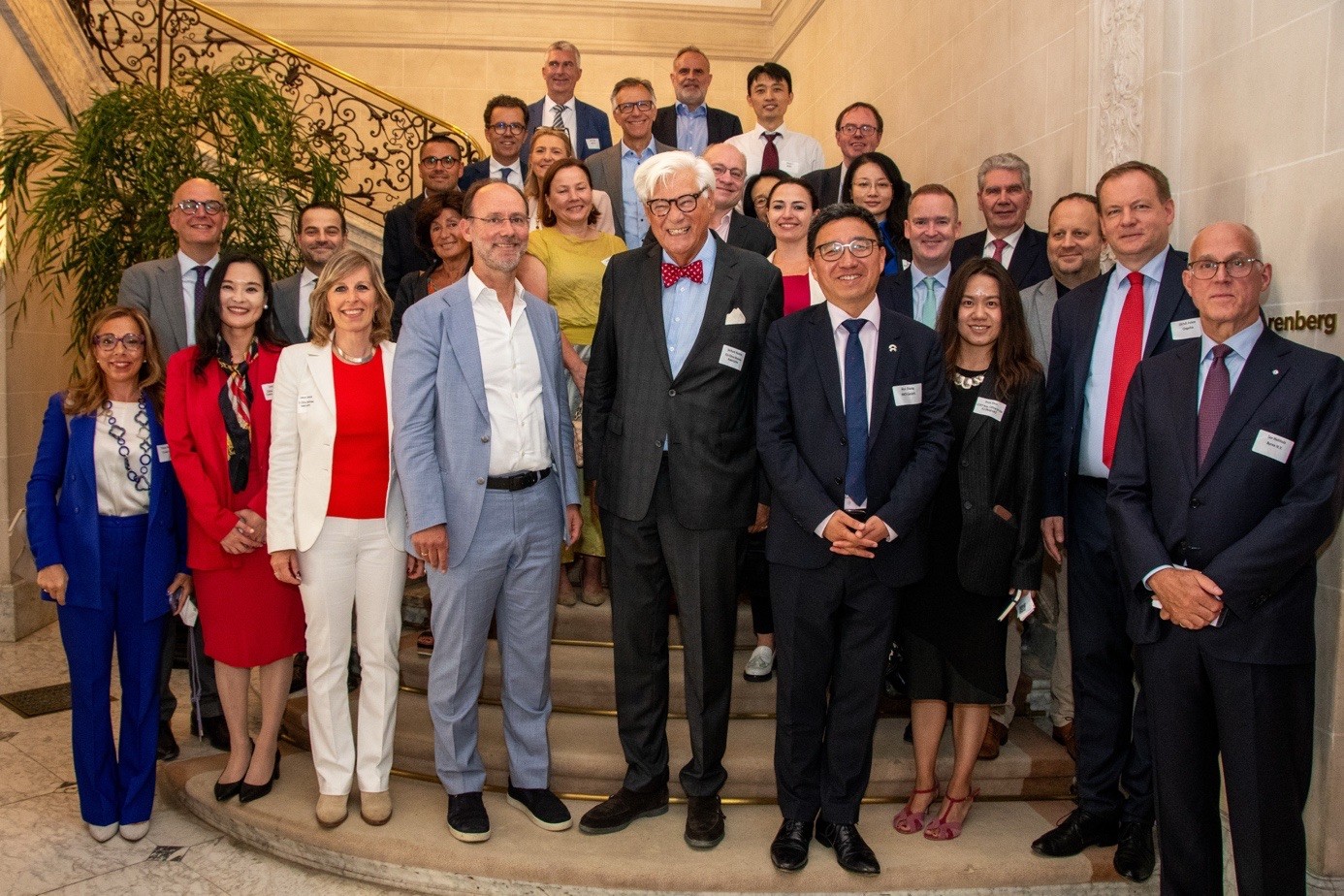
On 7 July, the EU-China Business Association organised an exclusive dialogue with Mr Bernd Biervert-Luth, Chief of Cabinet of EU Commissioner for Trade and Economic Security Maroš Šefčovič, at De Warande in Brussels. The luncheon brought together business leaders for a timely exchange on the current challenges and future direction of EU-China trade and investment.
Mr Jochum Haakma, Chairman of the EU-China Business Association, introduced the discussion and underlined that recent feedback from the European business community in China suggests that confidence is starting to recover after several difficult years. In a world of instability, many European companies still see China as a large, dynamic and, in some respects, more predictable market.
In his remarks, Mr Biervert-Luth stated that the European Commission attaches great importance to its relationship with China, describing it as a relationship of mutual interest and one of the largest and most important economic partnerships. He noted that bilateral trade exceeds €700 billion, reflecting the strong interdependence between both sides.
Mr Biervert-Luth also highlighted that China remains an important market for the EU, while noting that it is currently the EU’s fourth-largest export market, after the United States, the United Kingdom and Switzerland. At the same time, he stressed the need to address current challenges, including the EU’s trade deficit with China, which he referred to as reaching around €1 billion per day, as well as market access, industrial subsidies, export controls and dependencies.
He also referred to the EU-China Trade and Investment Consultations (TIC), launched on 29 June by EU Commissioner Maroš Šefčovič and China’s Minister of Commerce Wang Wentao, as an important platform to address these priorities, including trade and investment imbalances, export controls, intellectual property rights and cooperation within the WTO. He underlined that the EU’s preference remains dialogue, cooperation and practical solutions, with the aim of building a more balanced, predictable and mutually beneficial economic relationship.
We were pleased to bring together business leaders for this timely exchange of views on the future of EU-China trade and investment. As Europe and China navigate a more complex period, conversations like this are essential for building understanding, encouraging constructive engagement and supporting practical solutions. We sincerely thank Mr Biervert-Luth for his open and insightful exchange, and all participants for their valuable contributions to the discussion.