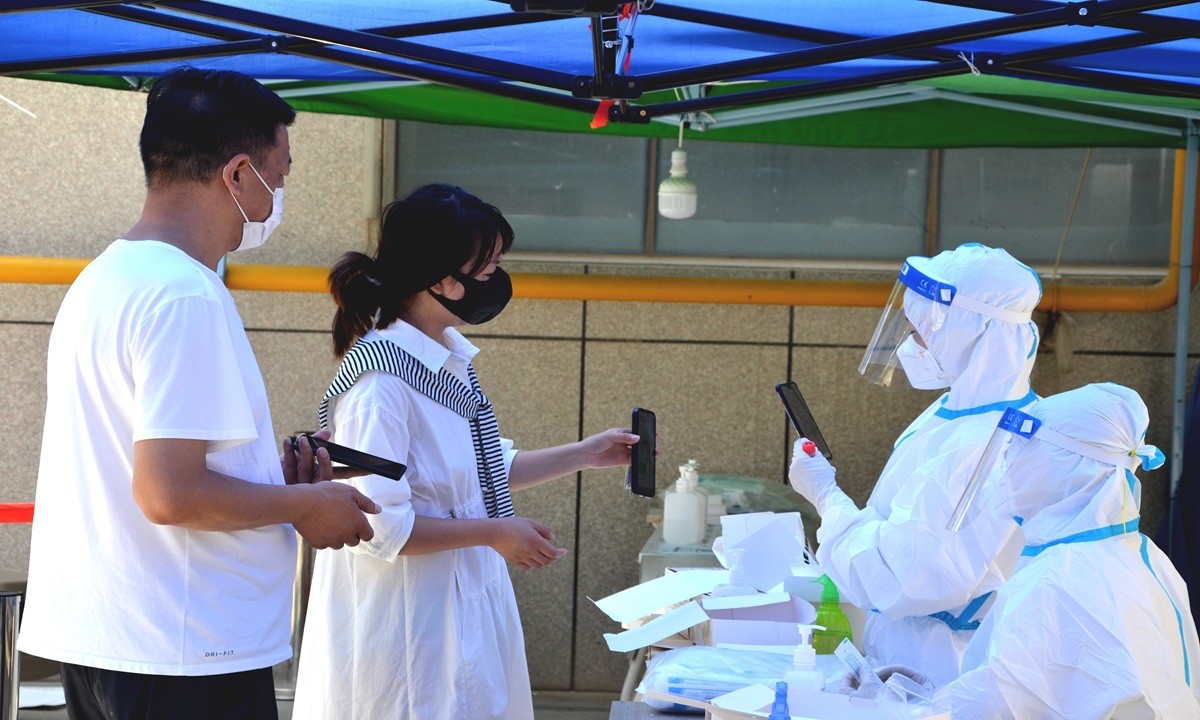
Most Covid-19 cases last week were reported in Gansu and Anhui provinces and in the Guangxi Autonomous Region. The city of Beihai in Guangxi, with a population of 1.9 million, already reported over 1,000 infections. Mass testing campaigns were launched and some parts of the city were locked down. Over 2,000 tourists who went to the city on holiday were stranded as they were not allowed to leave. The change from previous weeks is that most cases are now reported in smaller cities in inland provinces as opposed to the major metropolises of Beijing and Shanghai in the east of the country. Shenzhen vowed to “mobilize all resources” to curb a slowly spreading Covid-19 outbreak, ordering strict implementation of testing and temperature checks, and lockdowns for Covid-affected buildings. On the mainland, 21 provincial-level regions reported new locally transmitted infections in the past week, some being caused by BA.4 or BA.5.
In Shanghai, the mandatory weekly nucleic acid tests are to be extended till the end of August. After reporting no cases for seven days, a crew member of Air China returning from abroad and his wife tested positive in Beijing last week. Imported cases are the biggest risk facing the fight against the epidemic, Xu Hejian, Spokesperson of the Beijing Municipal government, said. Beijing has announced a citywide ban on hotels hosting weddings, as well as other events such as group banquets, as a few new infections in the community were reported. Hotels in the city are also required to restrict activities such as meetings, conferences and training sessions, while those in the “core area” are banned from holding them altogether.
The new subvariant Omicron BA.2.12.1 was found in Chengdu. So far 10 Omicron subvariants have been identified in China. Dong Xiaoping, Chief Virology Expert at the CDC, said compared with previous subvariants, BA.4 and BA.5 are more transmissible, but they result in roughly the same symptoms as others.
Vice Premier Sun Chunlan, the Chinese official leading the country’s Covid-19 response, has said the authorities are not relaxing controls and urged cities to take decisive measures to contain outbreaks quickly. “All departments should overcome weariness and fatigue and the emergency response command mechanism must maintain an efficient state of operation to take practical action to ensure the successful opening of the 20th Communist Party Congress,” Sun said.
Zeng Yixin, Deputy Director of the National Health Commission has confirmed that China's top party and state leaders have all been given Chinese-made Covid-19 vaccines. Zheng said the vaccinations show the high trust the party and state leaders have in Chinese vaccines. He added that foreign state leaders from over 30 countries, including Cambodia, Indonesia and Turkey, had also received vaccines made by China. The two most popular vaccines in China are those developed by Sinopharm and Sinovac. The authorities are trying to increase vaccine take-up rates as new, highly transmissible variants of Covid-19 emerge. The country is still holding on to its strict zero-Covid policy, but analysts have warned that it is becoming increasingly unsustainable. So far 71% of the mainland population have received boosters, but only 67% of the over-60s, Zeng said. Only 61% of those above 80 have received two jabs and 38.4% have received three shots.
The number of epidemic-related criminal cases rose rapidly in the first half of this year, the Supreme People’s Procuratorate (SPP) said, as 1,316 people were prosecuted in 708 cases related to the epidemic. Many were charged with smuggling goods banned from import or export, illegally crossing the border, hindering the prevention and control of infectious diseases, fraud and transporting others illegally across the border, according to the SPP. Some sold unqualified medical protection suits. Some nucleic acid testing institutions have also been found violating epidemic prevention regulations.
This overview is based on reports by the China Daily, Shanghai Daily, Global Times and South China Morning Post.