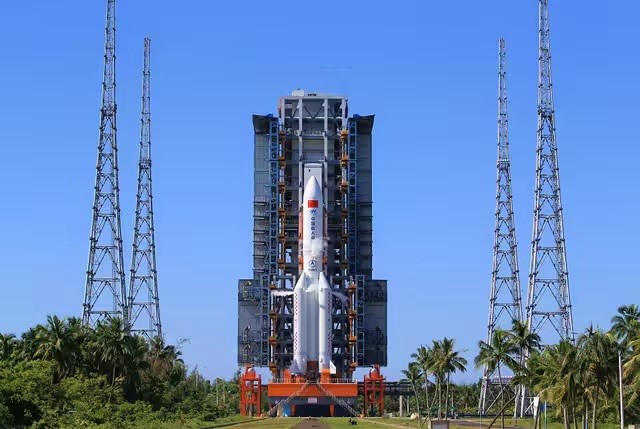
Hainan is betting on its growing aerospace cluster to expand its economy beyond tourism. On Hainan’s northeastern coast, launch towers rise abruptly from a flat landscape of coconut palms and open sky. At Pad 1 of the commercial spaceport in Wenchang, an 83-meter service tower stands surrounded by four slender, steel lattice towers, designed to protect the launch site from lightning during the island’s frequent tropical storms. No mission is scheduled, but an orange flame flickers from a gas vent at one facility. Long known for its coconuts, its namesake chicken and generations of emigrants who left for Southeast Asia in search of a living, Wenchang has been thrust onto the frontier of national development. Beijing’s space ambitions have turned the city into a showcase for rocket launches – and given Hainan an unexpected catalyst to reshape an economy long reliant on tourism and consumer services.
Today, the island province is working to build a more diversified and sustainable growth model and, together with its ambition to host a premier free-trade port, is embracing a hi-tech future increasingly centered on the space economy. “Commercial space flight could give Hainan a clearer manufacturing focus while complementing its traditional strengths in tourism and consumer services,” said Peng Peng, Executive Chairman of the Guangdong Society of Reform.
Home to more than 10 million people and comparable in size to Belgium, Hainan now boasts a growing industrial cluster known as Wenchang International Aerospace City. At its center are two state-owned rocket launch facilities: one serving national programs and another handling commercial missions. The Wenchang Space Launch Site staged its first launch in 2016 and focuses mainly on lunar exploration and human space flight. Just a few miles away sits the Hainan Commercial Space Launch Site, China’s first dedicated commercial launch site. Since its inaugural mission in November 2024, the commercial site has completed 21 launches and has sent 221 satellites into orbit, according to Xu Xikai, Deputy Director of the Development Department at Hainan International Commercial Aerospace Launch, the site’s operator.
Two more general-purpose liquid-fuel launch pads are also under construction and could host their maiden missions by the end of this year, Xu noted. Longer-term plans envision as many as eight large coastal launch pads, together with tracking facilities and systems for recovering rockets at sea. Massive rockets can be delivered directly by sea, bypassing the road, tunnel and bridge constraints faced by inland facilities. At about 19 degrees north latitude, rockets gain an extra boost from the Earth’s rotation, reducing fuel or allowing heavier payloads, Xu explained. Geography, however, also points to one of Hainan’s economic weaknesses. The island has historically lacked a heavy industrial base, meaning much of the specialized hardware and construction materials required for space manufacturing must be shipped in from the Chinese mainland.
The challenge for Hainan is transforming launch sites into the nucleus of a wider industrial ecosystem – and early signs are encouraging. Wenchang International Aerospace City recorded a surge in revenue amid an unprecedented pace of rocket launches. The aerospace park’s revenue jumped 85% in 2025 to CNY23.53 billion, while manufacturing output from its rocket supply chain more than doubled to over CNY8 billion. Under a provincial action plan from 2025 to 2027, Hainan also aims to raise annual operating revenue at Wenchang’s aerospace cluster to CNY10 billion by 2027, while building an integrated supply chain spanning rockets, satellites and data services.
The expansion comes as Beijing presses ahead with reforms to open the island further and develop new sources of growth – though competition is intensifying. Two other commercial launch sites have already begun operating in Gansu and Shandong provinces while at least four more are under development nationwide. To stay ahead, Hainan’s strategy is to push further up the industrial chain. Its action plan prioritizes a “super factory” next to the launch pads, designed to produce up to 1,000 satellites annually. The location would allow freshly assembled satellites to move straight from production line to launch pad with very little transit time.
Described by local authorities as Asia’s largest satellite-manufacturing facility, the industrial complex is also expected to support China’s Qianfan low-Earth-orbit constellation. A planned special bonded zone for satellite data would further leverage Hainan’s free-trade policies to attract data from overseas. The Hainan Commercial Space Launch Site handled more than 30% of China’s commercial satellite launches in 2025 and successfully carried out the country’s first offshore rocket booster recovery. Putting a rocket into orbit, however, is only one part of the emerging space economy. Hainan must capture a larger share of the value generated after a rocket launches, the South China Morning Post reports.