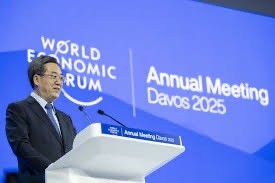
Vice Premier Ding Xuexiang has warned of “unimaginable” consequences if the world becomes divided, and he emphasized the need for the international community to work together to oppose a Cold War mentality and zero-sum game, and build a more equitable international order. “If the world becomes divided, it will be difficult for humanity to address common challenges together, and the world could relapse into confrontation and even wars, and no country could remain unaffected,” Ding said during a speech at the World Economic Forum Annual Meeting 2025 in Davos, Switzerland. Ding’s appearance at the Davos event made him the first senior leader from China to address global concerns about the country’s economic prospects and foreign policy priorities since U.S. President Donald Trump assumed office for his non-consecutive second term. Ding told the attendees at the event that global governance is undergoing profound adjustments, with imminent tariff and trade wars, an ongoing tug-of-war between the forces for and against economic globalization, and intense rivalry between multilateralism and unilateralism.
He underlined the need for the international community to jointly promote universally beneficial and inclusive economic globalization, saying that “protectionism leads nowhere” and that a trade war “has no winners”. “In terms of foreign trade, we don’t seek a trade surplus; we want to import more competitive quality products and services to promote balanced trade,” he said. Ding called for upholding and practicing true multilateralism, pursuing the vision of global governance featuring extensive consultation and joint contribution for shared benefit, and ensuring equal rights, opportunities and rules for all countries in international affairs.
This year’s WEF annual meeting is taking place under the theme “Collaboration for the Intelligent Age”. While highlighting the importance of leveraging artificial intelligence (AI) and emerging technologies to bridge global divides and drive inclusive, sustainable economic growth, Ding called for improving global governance on AI development to ensure that AI becomes an “Ali Baba’s cave” filled with treasure, rather than a “Pandora’s box” of uncontrollable risk. He urged global cooperation under the United Nations to create strong governance frameworks to ensure that AI benefits humanity while avoiding risks. The benefits of technology should be shared, he said. “We aim to bridge the tech gap and avoid allowing innovation to become a game for the rich countries alone.” China will collaborate with countries from around the world in AI development, especially when it comes to sharing new technologies with countries in the Global South, he added
Regarding the Chinese economy, Vice Premier Ding underscored China’s high-quality development, noting its 5% GDP growth last year despite external and structural challenges. He said that the difficulties faced by the Chinese economy stem not only from the impact of the external environment, but also from the growing pains associated with its own economic structural adjustments. China will adopt more proactive policies to boost consumption and investment, and will promote scientific, technological and industrial innovation, he said. China will further intensify macro policies, and adopt a more proactive fiscal policy and an appropriately accommodative monetary policy, Ding said, adding that the country will promote the sound and stable development of the capital market, stabilize the real estate market, and effectively prevent and defuse local government debt risks to effectively pursue higher-quality economic growth. He also said that the country welcomes more foreign companies to invest and do business in China and share in its opportunities. “China’s door of opening-up will not be closed and will only open even wider, and our business environment will only get better.” Ding reaffirmed China’s unwavering commitment to peak its carbon emissions before 2030 and achieve carbon neutrality before 2060.
Simon Lacey, Director of Digital Trade and Geopolitics at the World Economic Forum, said he believes China’s emphasis on shifting to new quality productive forces will inject strong tailwinds into the economy and create rising growth opportunities for foreign investors, the China Daily reports.
U.S. President Donald Trump in a video address to the Forum voiced optimism about Sino-American relations while warning of tariffs on companies that do not manufacture stateside. Trump described a “very good” relationship with Chinese President Xi Jinping, saying their countries needed only to make the trade relationship “fair”. He criticized Washington’s “massive” trade deficits with Beijing – America’s second-largest trading partner after Mexico – and blamed his predecessor Joe Biden for letting the situation “get out of hand”. “It’s just an unfair relationship and we have to make it just fair,” Trump said of China. “We don’t have to make it phenomenal. We have to make it a fair relationship. Right now, it’s not a fair relationship. We look forward to doing very well with China and getting along with China,” he added. The U.S. trade deficit with China fell from USD308 billion in 2020 to USD279 billion in 2023, the last year for which full-year data is available, the South China Morning Post adds.