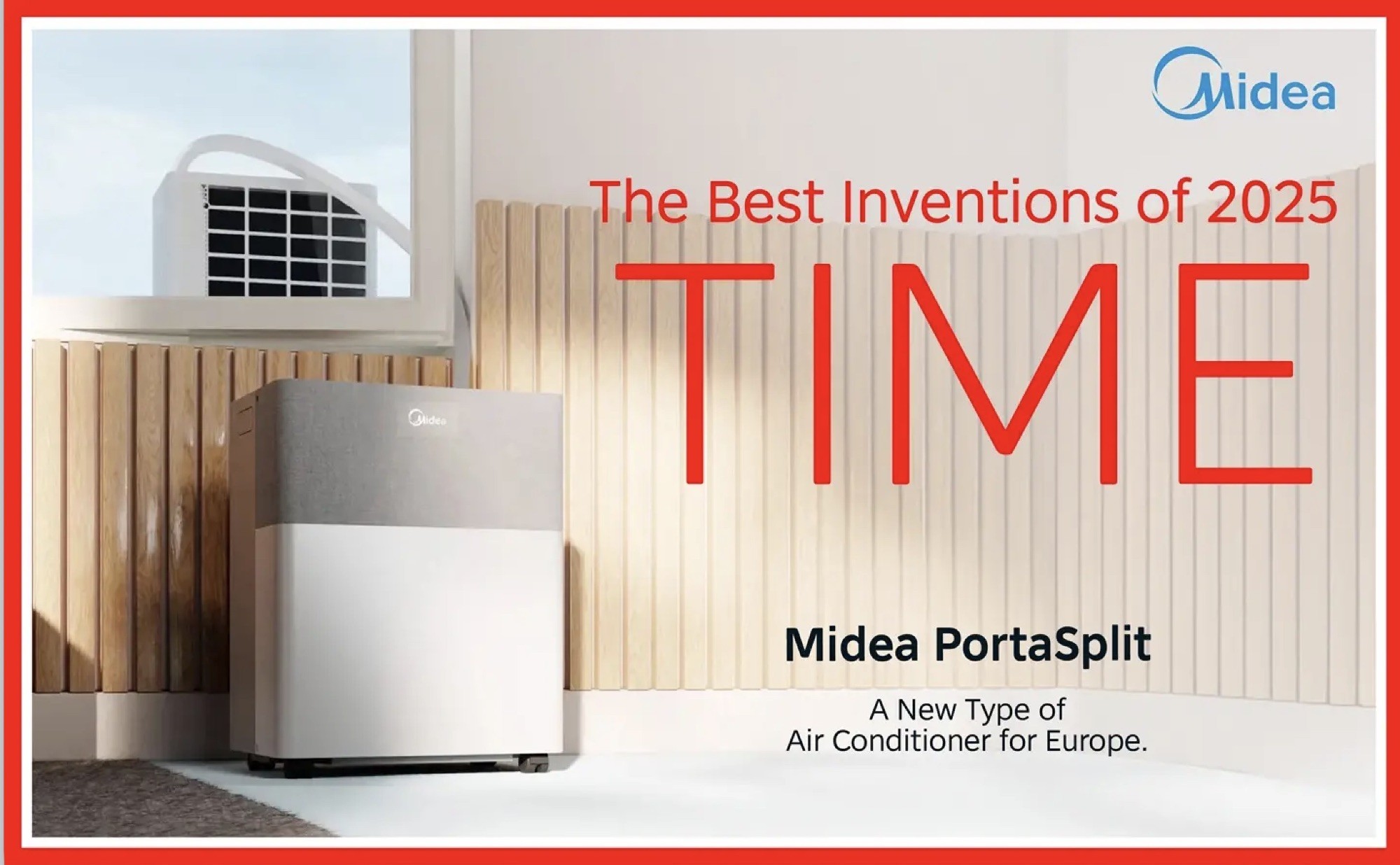
Some Chinese brands are becoming more popular in Europe. One of them is Midea, which sells the PortaSplit portable air conditioner. Weighing 10 kilograms, its outdoor unit can be mounted on a bracket outside a window without drilling. The entire process can be completed without professional installation. The product’s first edition was launched in the summer of 2024, with the aim of solving the hassle of installing air conditioners in Germany and many other European countries, where summer temperatures were once milder and many homes are not equipped with air conditioning.
As extreme heat continues to spread and break records due to climate change – with Paris and London hitting record-high temperatures last month – more Europeans are looking for cooling solutions. This year, Midea launched an even smaller version called PortaSplit Cool. After the product launched, searches for ‘Midea’ on Google increased 20-fold in Germany. Midea’s strategy in Europe now is to make breakthroughs through innovation, instead of low prices.
The portable air conditioning unit was just one of many home appliances from Chinese brands that have been gaining popularity across Europe, appreciated not only for their value but for their quality and innovation. A clear sign of this trend was visible at the 2025 Internationale Funkausstellung Berlin (IFA), Europe’s largest consumer electronics exhibition. Major Chinese brands displayed prominent advertisements, booked some of the largest exhibit spaces, and showcased a range of innovative products, including AI-powered smart home appliances, new-generation displays and robotics. Some 700 Chinese companies participated, accounting for more than 30% of all exhibitors. Observers noted that the IFA has become a key platform for Chinese companies looking to strengthen their presence in Europe and expand international cooperation.
“In the past, most Chinese consumer electronics companies entered international markets as original equipment manufacturers (OEMs) or by offering cost-effective products,” said Zhu Keli, Director of the China Institute of New Economy. “But now they mainly focus on innovation.” At the trade show’s highly anticipated Global Product Technology Innovation Awards, Chinese brands, including Midea, Hisense and TCL, received gold awards alongside companies such as Bosch and Siemens. Oliver Pearce, the London-based Executive Director of iMpact, a consultancy dedicated to helping Chinese enterprises explore overseas markets, described this latest wave of Chinese companies going global as a continuation of a trend that began in the 1990s. Pearce recalled that when he moved to China in 2009, his Chinese friends liked to show off their Samsung or Siemens appliances. “The average middle-class family in Beijing and Shanghai back then still preferred to buy foreign brands because they believed they were better,” Pearce said.
Chinese brands have evolved over the past decade. While still exporting functional, low-cost products in the 2010s, they worked to upgrade their products. Once they had better innovations, they focused on overseas markets. “They’ve learned from the Chinese market and are now capable of exporting products that truly reflect domestic innovations that resonate with international consumers,” Pearce said.
Similar to the big multinationals that built factories and R&D centers in China during the past two decades, many Chinese brands are doing the same in Europe, innovating for local customers. “Europe is quite diverse. That’s something we always have to tell our headquarters,” said Manuel Seethaler, Manager of Public Relations and Strategy for Midea Europe Research Center’s residential air conditioning team. “There is no one-size-fits-all solution for European markets.”
The portable air conditioner is the result of in-depth local research, including home visits and surveys, leading to rapid iterative prototyping. Combining German engineering from the Stuttgart R&D center with Italian design from Midea’s Milan design center, it is a prime example of the “local for local” strategy. Last year, Time Magazine named the PortaSplit one of the 300 best inventions in its 2025 list, highlighting innovations that make the world better.
The portable air conditioner was just one of many home appliances that Midea’s Europe Research Center has worked on. Founded in 2019, the center hires experts from across Europe to develop and test products, including washing machines, ovens, coffee makers, and refrigerators, tailored to the habits of local users and their preferences. Innovation is never a one-person job; it comes from collaboration and constant learning, Chinese and European engineers agree. Through mergers and acquisitions (M&As) over the years, Midea’s subsidiaries now cover 18 countries, with R&D centers and factories in Italy, Portugal, Spain, and Turkiye.
Hisense invested €45 million in a new factory in Valjevo, Serbia, in 2023, to produce cutting-edge refrigeration appliances, which is expected to create 1,000 jobs over the following three years. The company has also partnered with every UEFA European Championship tournament since 2016, raising its profile among the continent’s huge soccer fan base. Another brand, Haier, has a European branch and has announced a significant milestone in its decarbonization journey: sourcing 60% of its energy from renewables by 2025. It has also set ambitious targets for 2030 on reducing greenhouse gas emissions, the China Daily reports.