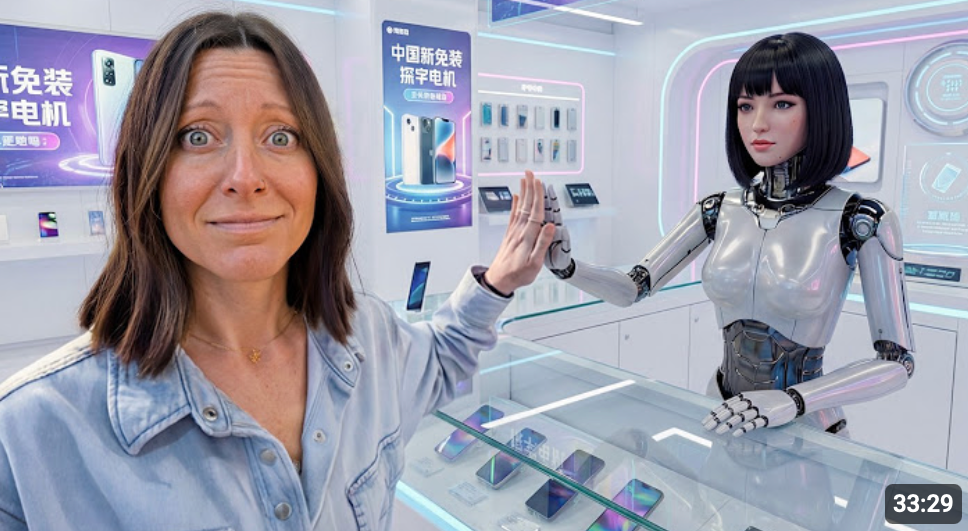
A meal order delivered by drone, dinner at a robot-themed restaurant and a ride in a driverless car, formed part of the itinerary for U.S. travel influencers Kara and Nate during a journey from Shanghai to Beijing. Their 33-minute YouTube video titled “China is Living in 2050” (available here) also featured robotic dogs and a shopping center filled with high-tech consumer products. It had racked up about 1.3 million views as of August 5, bringing experiences once associated with science fiction to the couple’s 4.5 million subscribers. The video is part of a growing trend on social media, turning China’s everyday technology into a major tourist attraction. Robotaxis, drone deliveries, humanoid robots and smart retail are now appearing alongside historical landmarks and natural scenic spots on foreign visitors’ itineraries. Travel operators say technology-focused trips, once aimed largely at overseas professionals and corporate delegations, are increasingly attracting more independent travelers, families and students. The shift is helping technology emerge as a calling card for Chinese tourism, built less around a single museum or theme park and more around experiencing how digital services and automation integrated into daily life.
In Hangzhou’s Yuhang district, Zhejiang province, itineraries for overseas visitors link the Liangzhu archaeological site, where digital tools help interpret ancient Chinese civilization, with an artificial intelligence (AI) town, robotics facilities and Alibaba’s digital industrial park. Visitors can interact with humanoid robots, test brain-computer interfaces, experiment with AI-generated content and see how digital platforms are used in transport, shopping and urban management. One of the companies included in Hangzhou’s newly launched technology study-tour is BrainCo, a developer of non-invasive brain-computer interface technology. Its demonstrations include an intelligent bionic hand that uses neural and muscle signals to interpret intended movements, along with wearable products designed for attention training, relaxation and sleep support, giving visitors a tangible look at how the technology is being developed for rehabilitation and consumer use. “Overseas interest has risen markedly since June last year,” said Gu Weiping, Director of the Study Tour Department of Hangzhou Shunjing Technology Cultural Tourism Development Co. “More independent travelers, families and overseas students began making reservations specifically for AI, robotics and smart-city experiences.” The number of overseas customers joining the company’s technology-themed program increased by more than 120% year-on-year, Gu said.
The expansion of the visa-free policy has made it easier for overseas visitors to turn online curiosity into real-world trips. China has expanded unilateral visa-free access to citizens of 50 countries, while nationals of 55 countries are eligible for its visa-free transit policy at 65 ports. Foreign nationals made a record 22.9 million entries into China in the first half, up 20.4% year-on-year, said the National Immigration Administration (NIA). Visa-free entries rose 30.6% to 17.8 million, accounting for 77.7% of the total. Wu Liyun, Professor at the China Academy of Culture and Tourism at Beijing International Studies University, said technology tourism is a global trend rather than a uniquely Chinese phenomenon. China’s advantage, she said, lies in the scale at which technology has moved beyond laboratories and exhibition halls to become seamlessly integrated into daily life. Foreign visitors can ride robotaxis, order goods delivered by drones, encounter service robots and use mobile phones for payments, transport and admission to attractions. The appeal comes less from any single invention than from seeing multiple technologies operating across the same city.
“China has a large number of technology companies, but the more distinctive feature is how AI and smart technologies have been applied to daily life and tourism,” Wu said. “That allows visitors to experience directly how technology changes ordinary life.” Technology is also effectively removing some of the practical barriers that have long affected inbound travel, Wu added. “Real-time translation, smart translation glasses, interactive screens, digital admission and mobile guides make it easier for foreign visitors to navigate attractions independently.”
Wu said the trend was broadening China’s inbound tourism. International itineraries were once concentrated in traditional destinations such as Beijing, Shanghai, Guilin and Xian, but more foreign visitors are extending their journeys to other emerging tech hubs. “Technology could bring more second and third-tier cities into the itineraries of overseas visitors,” she added. The rise of technology tourism is also creating an emerging commercial loop. More than 60% of the overseas groups handled by Gu’s company ask to add technology product demonstrations or shopping to their itineraries. Popular items include AI translation devices, small robots, drone equipment and consumer brain-computer products such as sleep-assistance devices. Young visitors typically spend CNY200 to CNY500 a day on technology experiences and products, Gu said. Hangzhou is now seeking to build shopping directly into its technology-tourism offering. On July 30, the city’s culture and tourism authorities unveiled 10 locally developed “new technology specialties”, 20 technology-tourism attractions and 20 themed study-tour routes, the China Daily reports.