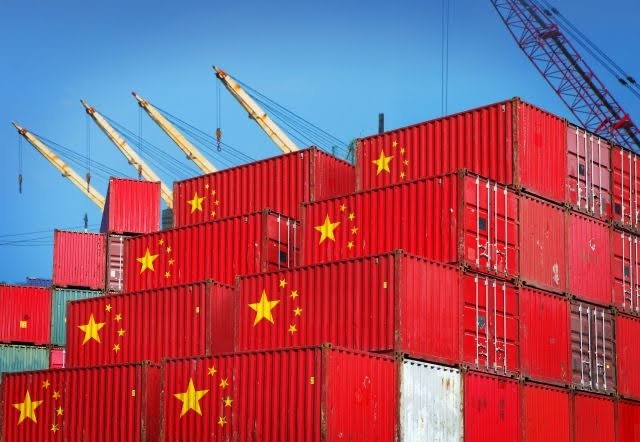
China’s trade momentum remained strong in October despite a strengthening of the yuan, sending its year-to-date trade surplus above USD1 trillion. China’s exports rose 35.2% to USD412.33 billion year-on-year in October, while imports grew by 41.6% to USD307.05 billion, the fastest growth recorded since May 2021, Customs data show. The faster growth in imports narrowed the monthly trade surplus to USD105.28 billion, from USD133.53 billion in September.
China’s cumulative trade surplus in the first 10 months reached USD1.04 trillion, up more than 8% from the same period last year, keeping the country on course for another annual record. Gary Ng, Senior Economist at Natixis, said export momentum remained strong, supported by demand related to artificial intelligence (AI) and emerging sectors such as electric vehicles and batteries. “While there is a recovery in imports, higher commodity prices clearly play a role, meaning it is too early to call it a sign of improving domestic demand,” he said. The ongoing AI boom was also driving imports of electronic components used to manufacture goods for export, he added. “In the future, the slowdown in AI investment and geopolitical tensions, such as the EU quota on electric vehicles, can pose headwinds for next year’s performance,” Ng said.
Despite this year’s strong export growth, domestic consumption has remained weak. Beijing has pledged to expand imports, particularly high-value imports, as part of efforts to promote more balanced trade. Zhang Zhiwei, President and Chief Economist at Pinpoint Asset Management, said exporters had been the driving force behind China’s economic growth this year and were likely to continue performing well. Strong investment in AI in the U.S. was supporting demand, Zhang said, while trade tensions between China and Europe remained persistent but had not escalated sharply. The yuan’s appreciation had also been gradual, he said. “I don’t think China’s macro policy stance will change significantly for the rest of this year,” he added.
Exports to the United States rose 32.9% year-on-year last month, while shipments to the European Union increased 24.4%. Exports to the Association of Southeast Asian Nations (ASEAN) surged 46.3%. At the end of September, President Xi Jinping met U.S. President Donald Trump in Washington, where the two sides agreed to cut tariffs on about USD30 billion worth of goods from each country, with most of the products covered by the agreement set to return to most-favored-nation rates, though the deal has yet to be implemented. By product category, exports of integrated circuits dropped 2.4% year- on-year in volume terms last month but surged by 137.1% in value terms, driven by higher prices amid a memory chip shortage fueled by the global artificial intelligence infrastructure buildout. China’s rare earth exports rose just 1% year-on-year by volume, as Beijing continued to tighten controls on shipments of the minerals, which are crucial inputs for a range of hi-tech industries.
Import growth was driven by higher spending on energy and commodities, with the year-on-year value of natural gas, coal and copper ore imports rising 50.2%, 60.0% and 23.1%, respectively. Imports of electronic products also rose sharply, with automatic data-processing equipment and related parts up 261% and integrated circuits up 78.3% in value terms. Crude oil imports dropped by 13.3% year-on-year by volume last month, while increasing by 41% in value terms. The People’s Bank of China (PBOC) announced earlier this month it would increase the foreign-exchange reserve requirement ratio (RRR) by 2 percentage points to 6% to curb the yuan’s appreciation, after the currency strengthened sharply in October, putting pressure on Chinese exporters.