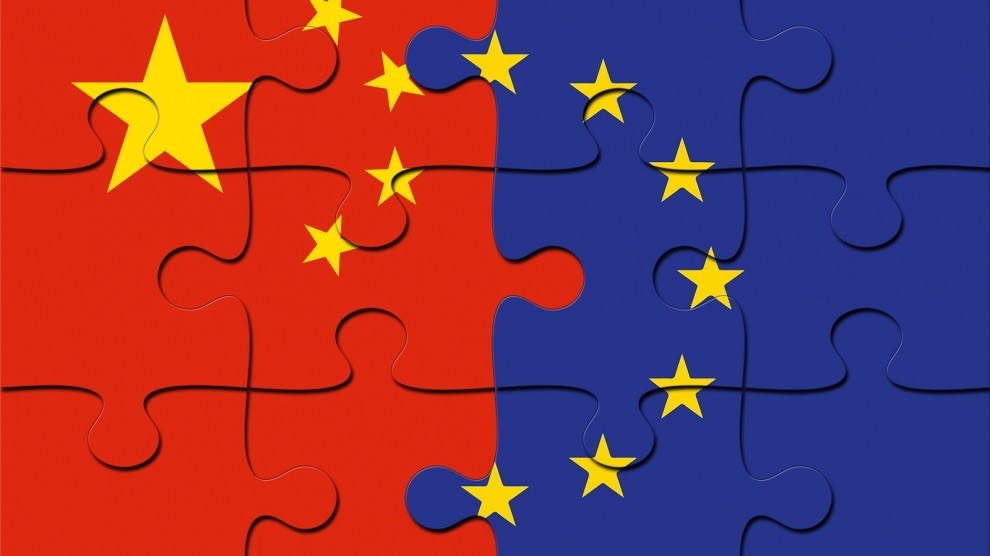
Chinese Commerce Minister Wang Wentao is set to visit Brussels in April, even as the European Union explores ways of “de-risking” its trade relations with Beijing. Wang is expected to meet with senior EU officials. He is also set to take in other European capitals, including Berlin. While China became the EU’s biggest trading partner in 2020, broad concerns have surfaced in Brussels and beyond about the bloc’s dependence on China for important commodities.
Member states consistently talk about the need to be “less naive” when it comes to the Asian power, and even as bilateral trade has soared in recent years, ties have frayed over Beijing’s relationship with Russia, its human rights record, and complaints over China’s economic model. Last week, European Commission President Ursula von der Leyen laid out a blueprint for a tougher China approach, focused on economic security, which will be followed up in policy form before the end of the year. The EU is considering restricting European companies from investing in some Chinese sectors such as robotics, artificial intelligence (AI), micro-electronics and quantum computing, she said. “We need to ensure that our companies’ capital, expertise, and knowledge are not used to enhance the military and intelligence capabilities of those who are also systemic rivals,” von der Leyen said. She insisted she was not seeking to decouple from China, but made clear that areas of cooperation were becoming few and far between. “There are some islands of opportunity that we can build on,” she said, before adding that the Comprehensive Agreement on Investment (CAI) agreed in 2020 and frozen due to sanctions needed to be “reassessed”, because it was now “outdated”, more than three years after an agreement was reached “in principle” and discussion of ratification was stalled in the EU parliament. “All companies in China, for example, are already obliged by law to assist state intelligence-gathering operations and to keep it secret,” she added, in a sign that Brussels would continue to squeeze Chinese firms over security concerns. Her wide-ranging address panned China on everything from human rights to economic coercion. China was “becoming more repressive at home and more assertive abroad”, she said.
The speech comes amid a broad effort from European leaders to engage diplomatically with China. Spanish Prime Minister Pedro Sanchez met President Xi last week, while the EU's Josep Borrell will stop off in Beijing on his way to the Group of Seven Foreign Ministers’ meeting in Japan in April. Chinese companies in Europe, meanwhile, are facing blowback over security concerns, particularly in the technology sector. Chinese-owned video app Tik Tok has been banned on work phones in EU institutions, with multiple national governments following suit. Huawei Technologies has also been frozen out of many EU member states' 5G infrastructures, the South China Morning Post reports.
On the occasion of the visit of French President Emmanuel Macron and Von der Leyen to China this week, the South China Morning Post remarks that ““Macron’s plan appears to clash with a tough-talking speech by von der Leyen in Brussels, in which she established herself as one of Europe’s most hawkish leaders on China. Analysts said that the odd-couple dynamic at the meeting with Xi could see von der Leyen play the “bad cop” to Macron’s “good cop”. Von der Leyen accused China of pursuing a “systemic change of the international order” with Beijing at its center. In response, she said, the EU needed to “de-risk” its economic ties and to do so, the Commission would propose a new “economic security strategy later this year”. As part of this, it will look into restricting European companies’ investments in China in sensitive sectors like robotics, quantum computing and artificial intelligence – a task some officials believe will be incredibly complex to administer.
On the same day as von der Leyen’s address, Spanish Prime Minister Pedro Sanchez spoke at the Boao Forum in Hainan and espoused a more dovish view on ties with China. “I firmly believe that relations between Europe and China – and, by extension, between Spain and China – do not have to be confrontational. There is a wide scope for mutually beneficial cooperation. We must remain partners, financially and beyond,” Sanchez said. One senior official noted the small levels of trade between Spain and China, saying that if von der Leyen “can’t even get the Spanish on board, what hope is there with France and Germany?”
Meanwhile, Fu Cong, China’s Ambassador to the EU, has called for more cooperation, including “in-depth exchanges” on economic and financial policies. He made the remarks in a meeting with Maarten Verwey, Director General for Economic and Financial Affairs at the European Commission, when the pair exchanged views on improving cooperation, according to a statement from China’s mission to the EU.
The EU has stepped up protectionism and its business environment has worsened in recent years, creating certain difficulties for many Chinese companies investing and operating in the EU, according a the report titled “Business Environment of the European Union 2022/2023” by the Academy of China Council for the Promotion of International Trade (CCPIT). Since 2022, the EU has developed a protectionist policy toolbox, making it more difficult for foreign enterprises to invest, do mergers and acquisitions, and participate in public procurement in the EU. According to the survey, some 33% of the respondents believe that the business environment in the EU has deteriorated, an increase of 5.86 percentage points from in 2021. The report noted four major challenges posed by the EU to foreign companies: increased market access barriers, the tendency to politicize economic issues, increased excessive regulations, and unfair treatment of Chinese companies. According to the report, 45.6% of the surveyed Chinese enterprises believe that the EU has raised its market access barriers, and 40% of the surveyed enterprises changed their investment plans because of the EU foreign investment review. Meanwhile, 61.4% of companies surveyed believe the EU and its member states have a tendency to politicize economic issues.
This overview is based on reports by the China Daily, the Global Times and the South China Morning Post.