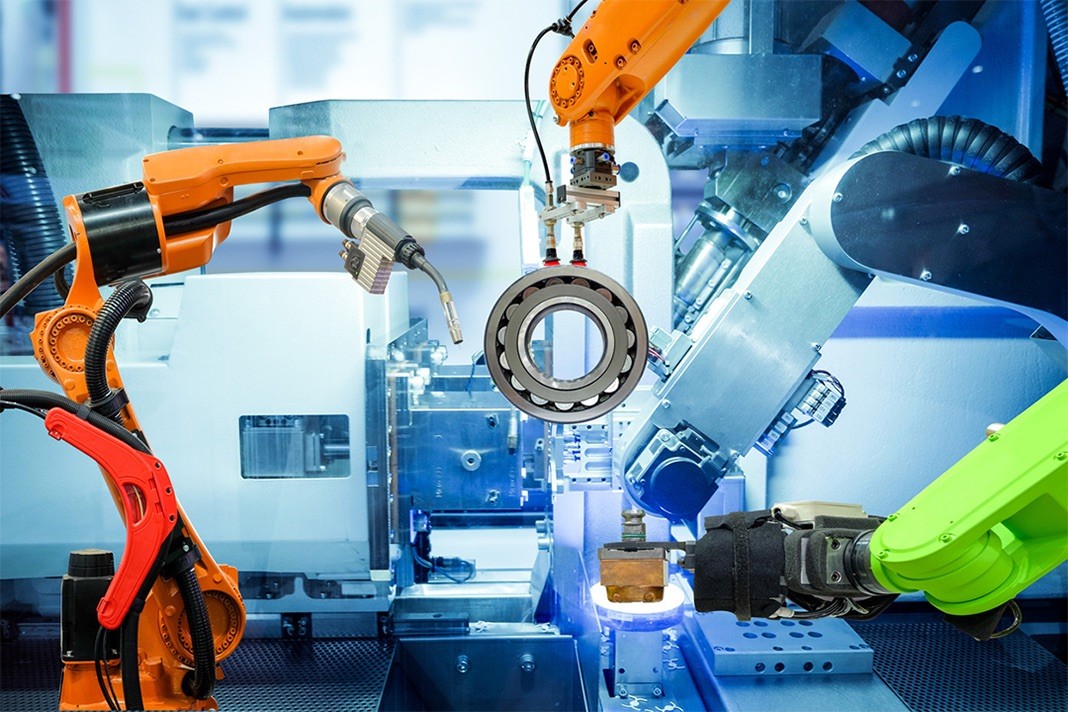
China should pool more resources into bolstering the application of cutting-edge intelligent technologies in advanced manufacturing, as part of its broader drive to build a modern industrial system backed by the real economy amid mounting external uncertainties, experts and company executives said. The country should double down on indigenous innovation to achieve breakthroughs in core technologies in key fields, they said. Heightened efforts are also needed to expand international cooperation on scientific and technological innovation, and to further encourage foreign investment in China’s high-tech manufacturing sector, they added, given that transforming and upgrading traditional industries has been high on China’s development agenda.
“Against the backdrop of potential risks like decoupling, it is of great significance to move the manufacturing sector toward higher-end, smarter and greener production through the adoption of new-generation information technologies, including artificial intelligence (AI), 5G and industrial internet, and nurture emerging industries with strategic importance,” said Luo Zhongwei, Researcher at the Chinese Academy of Social Sciences’ Institute of Industrial Economics.
Noting that the manufacturing industry is the foundation of the Chinese economy, Luo called for tackling bottlenecks in core technologies in fields such as basic materials and software, precision components and high-end equipment, in order to enhance the country’s independent innovative capacity and safeguard the security and stability of industrial and supply chains. “In the meantime, the country should continue to advance high-level opening-up, optimize the foreign investment structure and create a favorable business environment to attract more global stakeholders to invest in basic components and key parts of advanced manufacturing as well as high-tech industries,” Luo added.
China’s top leadership has attached great importance to manufacturing and emphasized the need to accelerate modernizing the industrial system, with the real economy as the pillar. President Xi Jinping said that manufacturing is an indispensable sector to China at all times and the country will strive to develop high-end manufacturing to realize all-around improvement. He made the remarks at a group deliberation during the annual sessions of the country’s top legislative and political advisory bodies in March. While presiding in May over the first meeting of the Commission for Financial and Economic Affairs, he called for speeding up the construction of the country’s modern industrial system backed by the real economy.
Xi said a modern industrial system is the material foundation of a modern country. He added that the focus of economic growth must be on the real economy to provide a solid material foundation for the nation to realize its second centenary goal – to turn China into a modern socialist country that is prosperous, strong, democratic, culturally advanced, harmonious and beautiful, by the time the People’s Republic of China celebrates its centenary in 2049. China has maintained its position as the world’s largest manufacturing hub for 13 straight years, accounting for nearly 30% of global manufacturing output in 2022, according to the Ministry of Industry and Information Technology (MIIT).
However, the country’s manufacturing sector shrank into contraction in May. According to the National Bureau of Statistics (NBS), the official purchasing managers index for the country’s manufacturing sector fell to 48.8 in May from 49.2 in April – below the 50-point mark that separates growth from contraction. “More efforts should be made to step up policy support, such as tax reduction, land use and electricity supply for advanced manufacturing enterprises to alleviate pressures, and guide capital to flow into the manufacturing sector,” said Bai Ming, Deputy Director of International Market Research at the Chinese Academy of International Trade and Economic Cooperation, as reported by the China Daily.