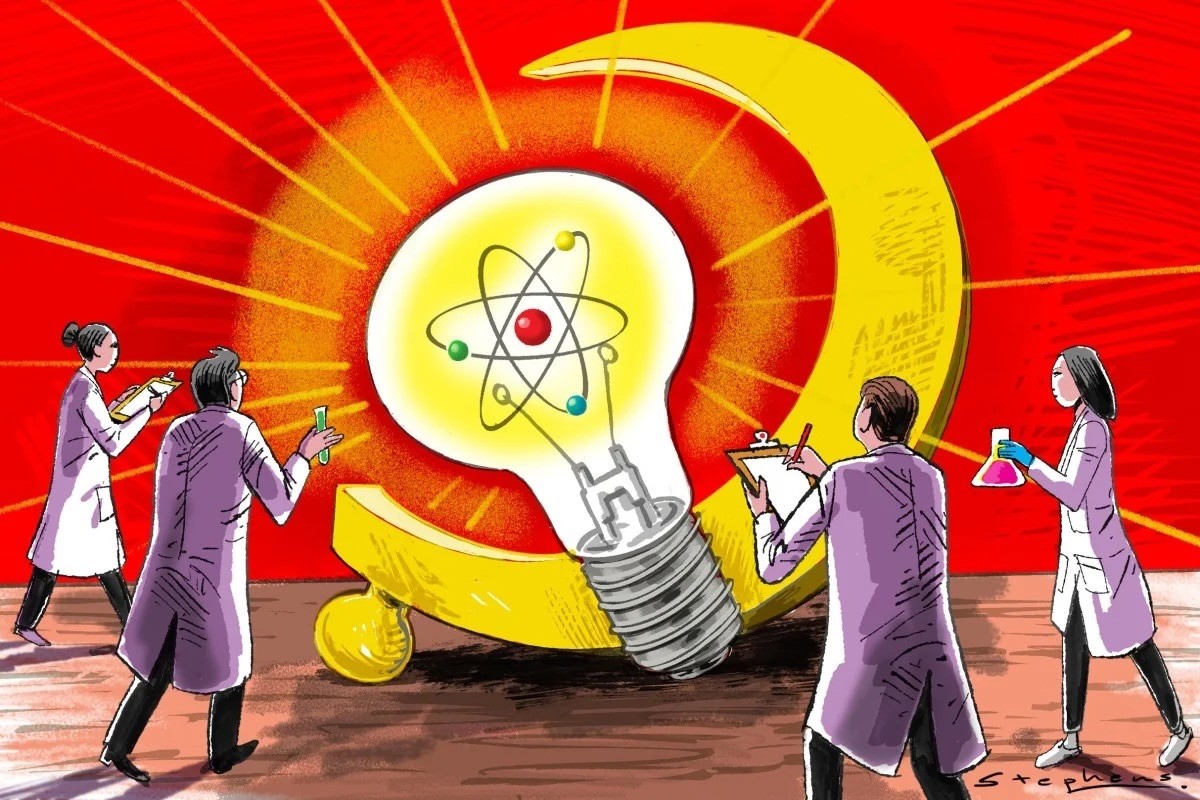
On April 30, President Xi Jinping convened China’s top scientific leadership in Shanghai for a symposium on strengthening basic research. On the surface, it seemed another high-level science policy meeting. In reality, it was a strategic declaration that China intends to compete not merely in manufacturing, commercialization or industrial deployment, but in foundational scientific discovery itself. The meeting’s significance may ultimately rival the “Made in China 2025” plan, write Tan Kong Yam, Professor of Economics at Nanyang Technological University and Clement Chan, Managing Director of a Hong Kong-based boutique fund, in the South China Morning Post.
Soon after the meeting, the Liberation Daily reported extensive responses from leading private-sector technologists and academics. It cited Peng Zhihui, Co-founder and Chief Technology Officer (CFO) of AgiBot; Xia Lixue, Co-founder and CEO of Infinigence AI; Li Lin, Academician of the Chinese Academy of Sciences (CAS); and Xu Tianheng, Researcher at the Shanghai Advanced Research Institute. Their remarks underscored Beijing’s growing emphasis on basic research, scientific self-reliance and original innovation as foundational pillars of national power, technological competitiveness and China’s long-term economic and strategic security.
For decades, China’s rise has been driven by its exceptional ability to absorb, refine and scale up existing technologies, making it arguably the world’s greatest “one to 100” civilization, to borrow from Peter Thiel’s framework. It excelled in commercializing and deploying technologies such as high-speed rail, electric vehicles, batteries, solar panels, drones and telecommunications through powerful manufacturing ecosystems and state coordination. But many foundational breakthroughs of the modern technological era – including semiconductors, the internet, quantum mechanics, the CRISPR gene-editing toolkit and machine deep learning – originated largely in Western, especially American, research systems. Beijing increasingly recognizes that true “zero to one” innovation requires breakthrough scientific discovery, intellectual freedom, experimentation, tolerance for failure and a long-term research culture.
China sees the shift from “one to 100” scaling to “zero to one” breakthrough innovation as essential for long-term national power, a view driven largely by U.S. technological containment and export controls. Beijing increasingly views basic research as a quest for “knowledge sovereignty” amid a deeper struggle over scientific and technological dominance. At the symposium, President Xi called for improvements in evaluating basic research and creating a more open, inclusive and failure-tolerant innovation environment, an implicit criticism of the key performance indicator-driven, bureaucratic research culture.
Modern Chinese governance excels at coordination, mobilization, disciplined execution and large-scale industrial deployment. Breakthrough science often depends on ambiguity, intellectual freedom, experimentation, dissent and tolerance for failure, qualities that can conflict with centralized, performance-driven governance. This tension may determine whether China can evolve from a manufacturing superpower into a true frontier innovation civilisation.
China’s challenge is increasingly cultural and cognitive rather than material. It already possesses vast scientific infrastructure, laboratories, universities, funding and engineering talent, with research and development (R&D) spending reaching CNY3.6 trillion in 2024. China also rivals or surpasses the U.S. in several scientific publication metrics.
But frontier innovation requires more than scale. China’s education and talent systems have historically emphasized discipline, standardization, examination performance and technical execution, while breakthrough discovery depends more heavily on curiosity, interdisciplinary thinking, risk-taking and tolerance for uncertainty. China needs not simply more scientists, but different kinds of scientists.
Over the past decade, the number of leading academicians in the Communist Party’s Central Committee has doubled. Instead of being purely advisers, scientists are increasingly being integrated directly into policymaking and industrial strategy, especially in sectors such as artificial intelligence, semiconductors, aerospace, robotics and advanced manufacturing. This reflects Xi’s broader emphasis on “new quality productive forces” as the foundation of China’s economic and geopolitical power.
The broader U.S.-China technological rivalry increasingly reflects a systemic competition between execution and invention, coordination and creativity, scale and originality. China excels at transforming technologies into civilizational-scale industrial systems, while the U.S. remains stronger at generating new technological paradigms. The central question is whether China can narrow the gap in original discovery without weakening the political structures that enabled its industrial rise. Xi’s symposium was more than a routine policy meeting. It signals a transition from an industrial civilization centered on manufacturing towards a scientific civilization seeking leadership in knowledge creation, technological standards and epistemic power, Tan and Chan conclude.