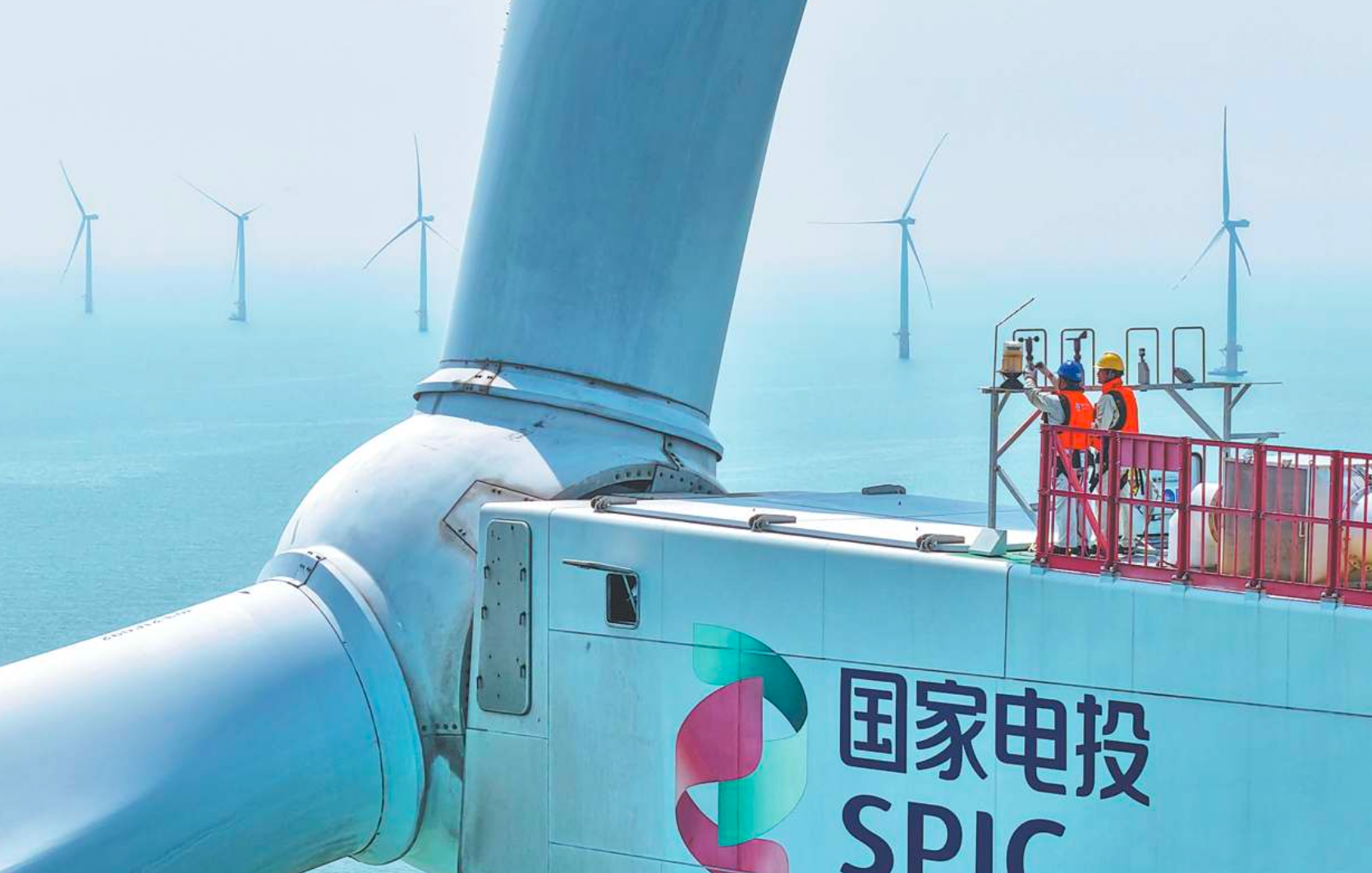
China has firmly solidified its position as the world’s largest manufacturer of clean energy equipment, supplying approximately 70% of the global market for wind power equipment and 80% for solar photovoltaic modules, according to the Report on China Energy Development 2026, published recently by the China Electric Power Planning and Engineering Institute (EPPEI). Driven by a more abundant and diversified domestic energy supply, China saw a landmark achievement in 2025, with the nation’s combined installed capacity for wind and solar power exceeding that of coal-fired thermal power for the first time in history. In 2025, China’s energy supply capacity improved significantly, playing a crucial role in enhancing the resilience of national energy security, according to the National Energy Administration (NEA).
China remains the world’s largest energy producer, accounting for over one-fifth of global energy production and roughly one-third of global power generation. In 2025, the country’s total primary energy production reached 5.13 billion metric tons of standard coal, a 3.6% year-on-year increase. As of the end of 2025, the nation’s cumulative installed power generation capacity surged by 16.1% year-on-year to reach 3.89 billion kilowatts, the report said. Despite the rapid expansion of renewables, traditional energy sources have continued to play a stabilizing role. Coal production capacity remained reasonably abundant, with output reaching 4.85 billion tons last year, a 1.4% increase from the previous year. The oil and gas sector also saw steady output increases, with crude oil production reaching 216 million tons and natural gas output hitting 262.06 billion cubic meters, marking the ninth consecutive year that natural gas production has grown by more than 10 billion cu m. China has expanded its crude oil import sources to around 40 countries.
At the same time, the domestic energy structure has experienced profound optimization. In 2025, the share of coal in China’s total energy consumption dropped to 51.4%, down 1.8 percentage points from the previous year. Conversely, the consumption share of clean energy – encompassing natural gas, hydropower, nuclear, wind and solar – increased 1.8 percentage points to 30.4%. Renewable energy now forms the undisputed backbone of China’s power grid. Accounting for over 60% of the nation’s total installed power capacity, renewables have become the dominant force. The combined installed capacity of wind and solar power reached 1.84 billion kW, officially surpassing thermal power to secure the top spot globally. Newly added electricity generation from wind, solar and biomass sources accounted for more than 90% of the total new electricity consumption across the country last year.
China’s overall electricity demand continues to rise robustly, driven heavily by advanced manufacturing, emerging high-tech sectors and widespread electrification. The green power generation trend is expected to drastically reduce the power sector’s overall carbon emissions, said Liu Zhiqiang, Deputy Director of the China Electricity Council’s Planning and Development Department. The report also detailed multiple technological breakthroughs. In the realm of long-duration energy storage, large-scale vanadium flow battery stations have entered operation, and the efficiency of compressed air energy storage systems has surpassed 70%. New business models such as virtual power plants (VPPs) and distributed energy have mushroomed. The number of electric vehicle charging stations reached 20.09 million in 2025, an increase of almost 50% year-on-year.
Beyond its borders, China’s unparalleled manufacturing scale has been a boon to global decarbonization, coupled with expansive direct investments. Figures released by the EPPEI reveal that over the past decade, Chinese overseas investments in thermal power exceeded 60 million kW of capacity with a total investment of over USD30 billion. From 2022 to 2025, China participated in more than 500 overseas new energy projects across 140 countries and regions, boasting an overseas solar photovoltaic capacity of over 100 million kW and wind power capacity of over 30 million kW, the EPPEI said.
The country’s cumulative solar PV module exports have exceeded USD180 billion, covering more than 200 countries and regions with an overseas installed capacity of over 1.2 billion kW. Chinese solar technology giant Longi recently signed a landmark agreement with Romanian developer Enexus for 50 megawatt-hours of liquid-cooled battery energy storage systems. The deal, marking one of Longi’s largest storage deployments in Europe, builds upon more than 200 megawatts of the company’s solar modules deployed across Enexus projects since 2025. It underscores a strategic shift for Chinese enterprises: moving from traditional module supply to providing comprehensive, utility-scale technology collaborations.
Meanwhile, the energy landscape is undergoing another seismic shift, driven by the explosive growth of artificial intelligence (AI). The report noted that AI and the energy sector are increasingly converging, with energy systems becoming a critical testbed for AI applications, while at the same time, the massive power demands of AI computing are reshaping energy infrastructure planning, the China Daily reports.