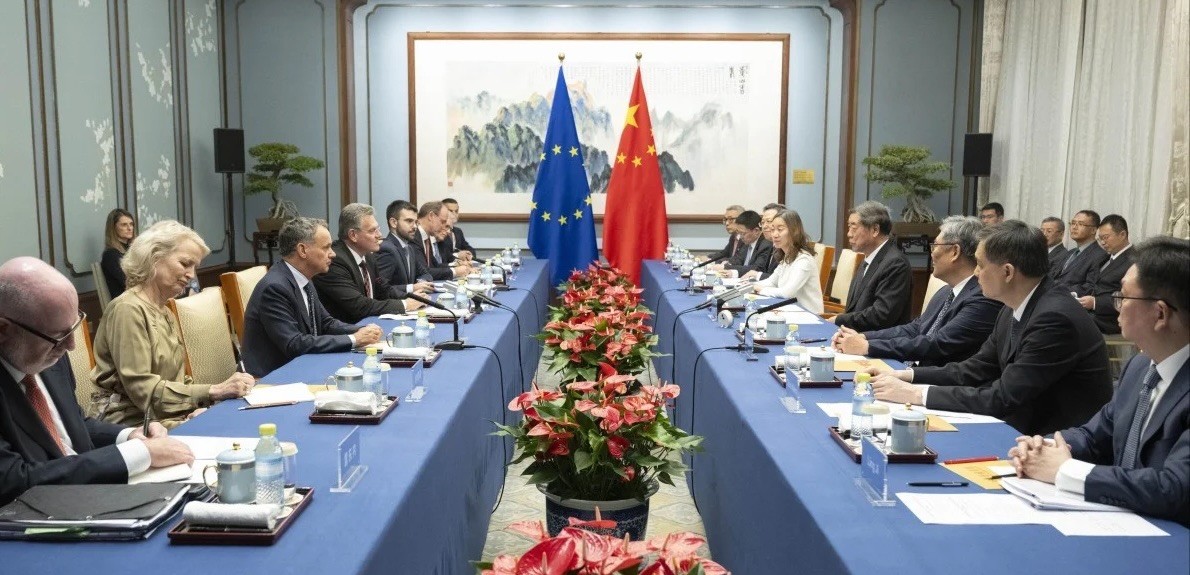
The European Union and China have “reached an understanding” that will cut Chinese hybrid car shipments by “more than a half”, in a temporary cooling of trade tensions that have threatened to boil over into a full-blown trade war. Speaking after marathon trade talks in Beijing, EU Trade Commissioner Maros Sefcovic said the deal would see China slash its hybrid car exports “by several million cars” over a four-year period. “This is the first time that China has accepted to moderate its exports without going through the phase of prior trade tensions, and I very much appreciate that,” Sefcovic told reporters in the Chinese capital. The sides also agreed to expedite EU applications for rare earth mineral export licenses and improve market access for goods including car parts, olive oil and textiles, which Sefcovic said could be worth “almost €4 billion” in current export value. EU national leaders are to decide this week whether China’s concessions are enough, but an all-out tariff war seems to be avoided.
“It’s very easy to declare a trade war or any war, but it’s very difficult to stop it,” Sefcovic said. “So therefore, I put so much emphasis on negotiations, and I’m glad that today I can present to you the outcome.” Sefcovic declined to share further details on the arrangement on hybrid cars – shipments of which have ballooned in recent months – but hinted that it could follow a recent import curb the bloc placed on Chinese steel. “There are different techniques,” he said. “If you look to recent months, I think you would find the answer.” EU was seeking a “proof of concept” deal in a single sector – hybrid cars – which would be seen as a test of whether Beijing was negotiating in good faith. A joint statement by the two sides, published following two days of negotiations, said that talks would continue over reducing tariffs and creating minimum price deals that would allow Chinese electric vehicles to enter the EU market at a lower duty rate.
The 16-point agreement listed a series of deliverables from the latest round of talks, with the two sides set to meet for further discussions in March next year. Most of these centered on long-standing trade disputes, including over medical equipment and power inverters. Commissioner Sefcovic met with Chinese Commerce Minister Wang Wentao and Vice Premier He Lifeng in Beijing. “We never had the level of intensity of our exchanges and contacts as we have had over the last three to four months with our Chinese counterparts,” Sefcovic said. But he cautioned that the outcomes laid out in the joint statement would not be enough by themselves to reduce tensions between the two sides. “It is a crucial first step, but only a first step in the process of rebalancing,” Sefcovic said. “As EU Commission President von der Leyen has said, dialogue needs results, and where the dialogue cannot deliver, the EU will use its tools to ensure rebalancing,” he added.
Chinese and European Union representatives also agreed to explore cooperation in areas including new energy and artificial intelligence (AI) during their just concluded trade talks, which Beijing described as “equal, professional and constructive”. Both parties “explored the possibility” of introducing mutual facilitation measures for the compliant trade of dual-use items between China and the EU. They agreed to strengthen policy communication, keep global supply chains stable, and support the “substantive launch” of a process for the “mutual delisting” of sanctioned firms under their respective legal frameworks.
The China Chamber of Commerce to the EU (CCCEU) welcomed the “pragmatic outcomes”, saying they showed both sides’ “willingness to handle trade frictions and stabilize bilateral trade relations through dialogue”. The European Automobile Manufacturers’ Association said “this announcement is a positive step in easing trade tensions between the two” sides, as reported by the South China Morning Post.
The China Daily added that China and the EU agreed on a package of measures to ease trade frictions, improve market access and strengthen the stability of industry and supply chains. The two sides also agreed to continue to explore the possibility of reducing tariffs on certain goods within the framework of World Trade Organization (WTO) rules. The progress was made during the second meeting of the China-EU trade and investment consultation mechanism. The third meeting will be held in March 2027, with a ministerial video meeting scheduled for January. China and the EU also agreed to continue dialogue on market access for medical devices, cosmetics and pharmaceuticals, as well as technical discussions concerning the EU’s Foreign Subsidies Regulation.
An editorial in the Global Times said that by continuously deepening their economic ties and shared interests, China and the EU can not only unleash the innovative potential of their respective markets but also reinforce each other's development and contribute to global economic recovery.
Meanwhile, in a resolution adopted by 454 votes in favor, 86 against, and 110 abstentions, the European Parliament demanded a “stronger and principled EU-China policy” that combines dialogue with more protection of European interests, calls for “economic reciprocity,” and what it calls a proportionate EU response if China “does not open its markets”.