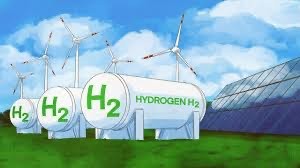
After becoming the main supplier of EVs, batteries and solar panels, China has set its sights on what it calls the energy of the future: green hydrogen. The array of scale models at the International Carbon Neutrality Expo in Shanghai gave an indication of China’s plan for the future of energy. At one such exhibit teeming with miniature airplanes, buses, solar and wind farms, and pylons, a marketing agent from China’s largest power producer Huaneng Group enthusiastically explained the company’s hydrogen plans to a group of government officials from Shanghai’s Qingpu district.
In another part of the 20,000 square meter hall, was a hydrogen-powered truck, aptly painted in blue, developed by Shaanxi Automobile Group and U.S. energy tech firm Accelera. Across the venue, which showcased the latest technologies and developments from local governments in the race for a green future, at least a dozen exhibits depicted a hydrogen-fueled future to visitors from across the world. “There were some hydrogen-related companies here last year, but most of them just talked about concepts,” said Lu Yufei, Vice President of Shanghai CEO Environmental Protection Technology, a maker of sewage and exhaust gas purification equipment that launched a pilot hydrogen production project in Shanghai in March. “This year it was different; they brought real world products and detailed solutions.”
There were dozens of hydrogen companies at the expo, from less than 10 last year. More than 20 of them are based in Shanghai’s Lingang district, which is known for U.S. carmaker Tesla’s Gigafactory. The event showcased China’s ambitions for its hydrogen industry. The world’s largest greenhouse gas emitter has looked into opportunities presented by the most abundant element in the universe. China wants to be a global leader in hydrogen to provide a pathway to carbon neutrality, and reduce its reliance on energy imports. It also sees hydrogen as a pillar of economic growth. Hydrogen, which does not emit carbon dioxide when burned, has been described as a “Swiss army knife” that can be used for power generation, heating and to decarbonize industries like steel and cement. To limit the global temperature rise to 1.5 degrees Celsius, the world will need at least 430 million tons a year of hydrogen by 2050, compared with 95 million tons in 2022, according to a forecast by the International Energy Agency (IEA). This could translate into many big business opportunities, creating millions of jobs worldwide in a hydrogen-fueled future.
In March, hydrogen appeared for the first time in the Chinese government’s annual work report, listed as a “cutting-edge” industry that will see accelerated deployment. This came after Beijing released its maiden national hydrogen strategy in 2022 up to 2035. The initiative called for at least 50,000 hydrogen-powered vehicles to be deployed and 100,000 to 200,000 tons of green hydrogen to be produced annually by 2025.
“China is probably one of the most active countries trying to popularize hydrogen and develop the hydrogen economy,” said Jenhao Han, Managing Director for Asia at Hy24, a Paris-based global investment firm exclusively focused on the hydrogen industry. At a forum in Beijing in April, Tsinghua University Professor Ouyang Minggao, said China has great advantages in taking the lead in manufacturing green hydrogen-related products and equipment such as electrolysers, fuel cells and fuel-cell vehicles, as well as ammonia and methanol, two carriers of hydrogen. He called hydrogen the “fourth pillar” of China’s economy, following the country’s success in solar panels, electric vehicles and lithium-ion batteries, which accounted for CNY1 trillion of exports last year and powered China’s 5.2% gross domestic product (GDP) growth.
Green hydrogen, produced using renewable energy, can also help ease China’s solar and wind overcapacity issue. Last year, China added a record 301 gigawatts (GW) of renewable capacity, nearly 60% of the global total. However, the country’s power infrastructure was unable to consume much of the generated power. “Green hydrogen projects can help absorb some of the renewable power produced in northwestern China, where most of the large-scale wind and solar projects are located and power demand is low,” said Yao Zhe, Beijing-based Global Policy Analyst at Greenpeace East Asia. China’s ambition to dominate the industry mirrors that of at least 40 countries and regions, including the U.S., the Middle East and the EU.
This decade will trigger a race for technology leadership in hydrogen, which has the potential to change the geopolitics of energy relations, according to the International Renewable Energy Agency. But every country has its own advantages and no single country is likely to dominate the entire chain. There is no guarantee of China’s success, but it has the potential to dominate the production of electrolysers and fuel cells, according to Li Jing, Partner at KPMG. “It’s not like the semiconductor and AI sectors,” he said. “There are not many technical bottlenecks in developing hydrogen-related equipment from R&D to manufacturing,” the South China Morning Post reports.