The city of Bengbu in Anhui province is home to over 200 companies active in smart sensing technology and is dubbed ‘China Sensor Valley’ by industry insiders. In an age of intelligent machines, sensors have become the invisible organs of modern technology, giving devices the power to see, hear, feel and respond. Increasingly, these sensors are being made not in Silicon Valley, but in Bengbu, a once-sleepy industrial city in Anhui province. At the heart of this transformation lie small, often invisible sensors called micro-electro-mechanical system (MEMS) sensors. No larger than a grain of rice, but performing an immensely powerful function, this component is enabling machines to perceive their environments with unprecedented precision, from facial recognition in smartphones to obstacle detection in autonomous vehicles.
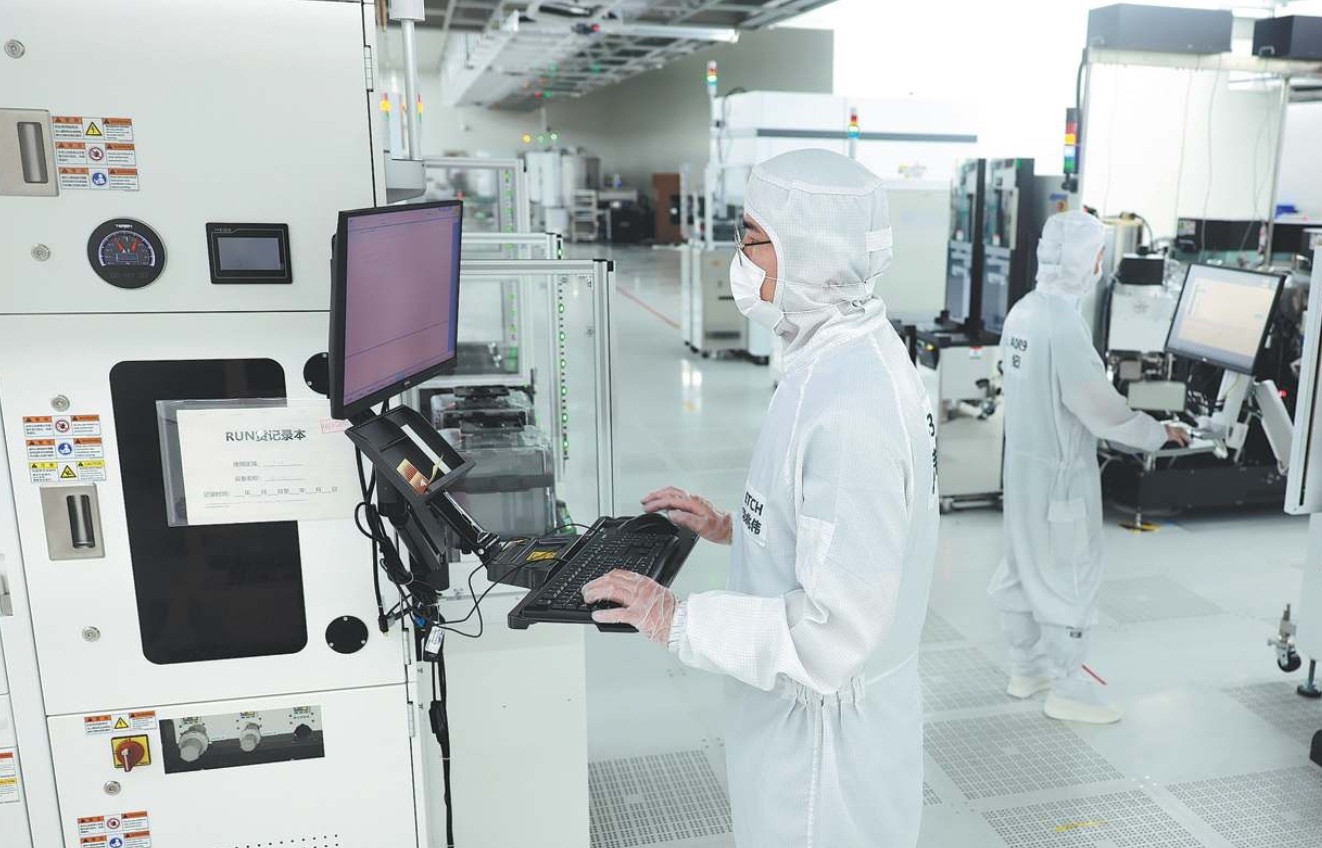
Huaxin Micro-Nano Integrated Circuit Co, a local chip leader, recently completed China’s first 8-inch MEMS fully automated production line. With 1,500 meters of overhead robotic tracks shuttling chip materials across 54 intersections, the line acts like a suspended, high-speed metro system for semiconductors. Each day, more than 3,000 transfer carts move through this aerial network, reducing costs by over CNY30 million annually. With 90% automation, it is expected to churn out 30,000 wafers per month by 2026, contributing CNY1.2 billion in annual output. Ding Jingxiu, Vice President of Huaxin, said: “These sensors aren’t just passive parts. They’re revolutionizing industries.” Ding said that they track gestures and orientation in smartphones; monitor tire pressure, fuel flow, and braking systems in automobiles; and mimic human movement and perception in humanoid robots. “We’re not just producing chips. We’re creating the sensors that allow machines to navigate the world,” he said.
The journey wasn’t completed in a day. Bengbu was once part of China’s old industrial belt, known more for its heavy manufacturing like glass, paper and tractors. But as the global economy pivoted toward digitization and China pressed forward with its new quality productive forces, the local government saw an opportunity to leap ahead. Tao Guangsheng, Director of the Management Committee of the Bengbu Economic and Technological Development Area, said: “Bengbu had the industrial bones, but it needed a new nervous system. We realized that smart sensors weren’t just components, they were the infrastructure of the next industrial revolution.” The rebranding of Bengbu as “China Sensor Valley” is more than just a slogan; it is also a vision anchored in reform and execution.
By 2027, the city’s sensor-related companies are expected to achieve over CNY30 billion in combined output, with an annual growth rate exceeding 50%. To seize the momentum, the city has launched a wave of policy support, which includes funding packages, factory space, talent recruitment and streamlined administrative approvals. Notably, a CNY7 billion industry fund was set up to back major projects and firms.
In 2024, eight provincial-level departments launched a set of special policies aimed at nurturing the sensor industry. These include investment subsidies, R&D incentives, IPO guidance and even global expansion support. To address the bottleneck between R&D and production, Bengbu also established dual-wafer lines: one for mass production, the other for pilot testing and customization. With such a flexible R&D and production environment, the city has already attracted 22 high-level research and innovation platforms, including a national MEMS engineering laboratory. That full-stack approach has turned Bengbu into one of the only cities in China with both 6-inch and 8-inch MEMS wafer lines, which are capable of handling everything from small-batch prototyping to industrial-scale production. More than 300 types of sensors are now produced in Bengbu, enabling next-generation products from autonomous driving and industrial automation to aerospace and consumer electronics.
Chen Binggen, Party Secretary and Chairman of Anhui North Microelectronics Research Institute Corp, a subsidiary of China North Industries Group Corp, said: “Sensor development used to be piecemeal in China, usually one firm doing R&D, another doing manufacturing. But here in Bengbu, we’ve built the full chain, from materials and chips to modules and systems.” The city is home to over 50 high-tech firms and 40 “little giant” companies, which refer to specialized, innovative, and fast-growing small enterprises supported by the Chinese government.
In some ways, Bengbu’s transformation also reflects broader changes sweeping across China’s manufacturing sector. No longer content with being the world’s factory, cities like Bengbu are embracing intelligent manufacturing, where software, hardware, AI and automation blend into a single ecosystem. Walking through Huaxin’s production floor feels like entering a sci-fi novel, the China Daily reports.