In the bustling manufacturing hubs of Zhejiang province, a quiet but profound revolution is underway as the traditional hum of manual assembly lines is being replaced by the precise, synchronized movements of robotic arms and automated guided vehicles. At the heart of this transformation is the integration of 5G networks and artificial intelligence (AI), spearheaded by China Mobile’s Zhejiang Branch, which is empowering local enterprises to leap from traditional to intelligent manufacturing. The robust computing power driving this industrial evolution is located in the China Mobile Yangtze River Delta (Jinhua) Data Center. As one of the largest data centers in East China, the facility spans 18.67 hectares and is built to national A-level standards, earning a diamond five-star internet data center certification. With over CNY3 billion already invested, it currently houses 13,000 racks with an IT capacity of 86 megawatts. Recognized by the Ministry of Industry and Information Technology (MIIT) as a 2025 national-level green computing facility, it maintains an advanced power usage effectiveness of 1.24, saving 34 million kilowatt-hours of electricity and reducing carbon emissions by 18,000 metric tons annually.
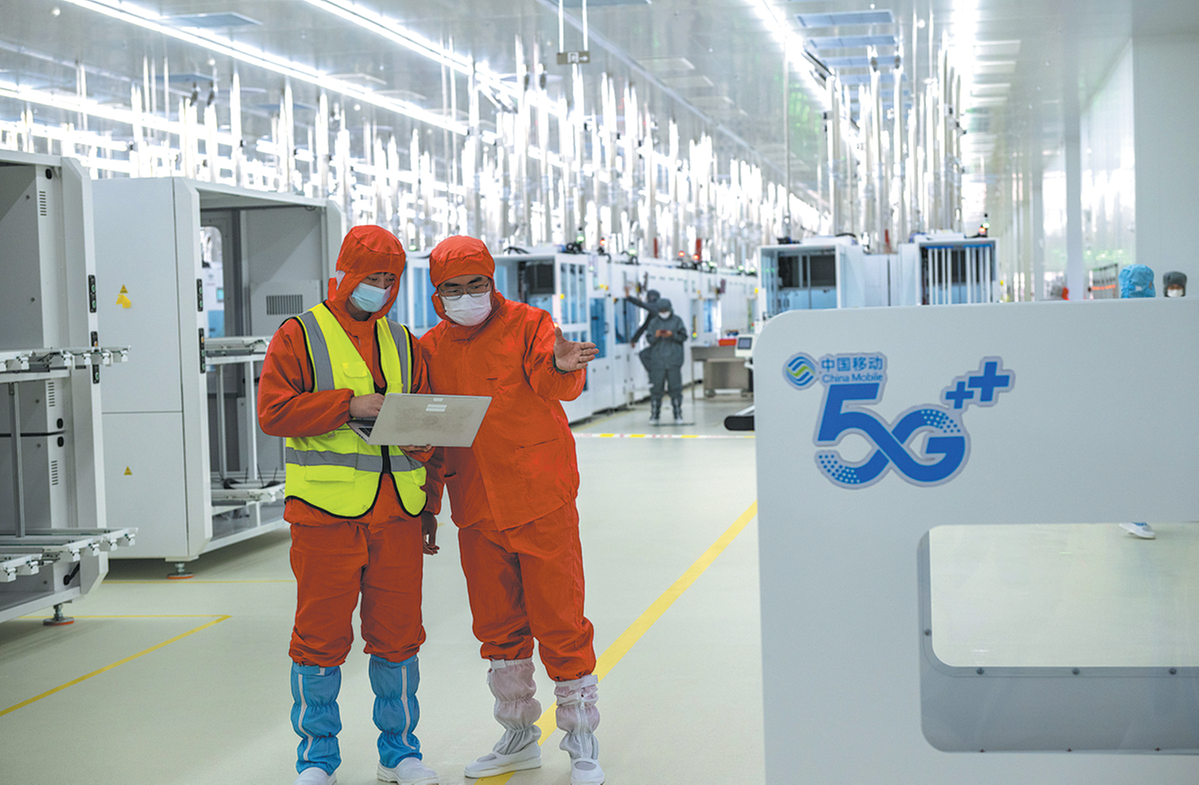
Nowhere is the application of this computing power more evident than at Ronma Solar Energy Group’s 5G smart factory in Jinhua, Zhejiang. As a state-level high-tech enterprise focusing on mono-crystalline silicon solar cells and photovoltaic modules, Ronma Solar Energy Group has become a benchmark enterprise for the deep integration of high-end equipment manufacturing and the digital economy. Walking into the factory’s massive workshop, one is greeted by a futuristic scene: hundreds of automated guided vehicles navigate autonomously without magnetic strips or QR codes, relying instead on 5G-enabled visual navigation and AI algorithms for real-time dynamic mapping.
Xiong Zhoushi, General Manager of China Mobile Jinhua Branch, highlighted the unprecedented scale and stability of this digital infrastructure. “Our factory spans 580 meters in length and 100 meters in width. We have over 800 devices, including 223 automated guided vehicles (AGVs), all connected via 5G. Since it began operating, there has not been a single network interruption,” Xiong said. He further explained the intricate automated workflow. “Our workshop has 14 process steps. For instance, after a battery cell completes the oxidation process, it is automatically loaded onto an AGV, which then follows programmed instructions to move seamlessly to the next production stage. Everything is unmanned and automatically controlled by our software systems. Our daily production capacity for battery cells is 3.78 million pieces, and actual output has reached 3.7 million. This 97% capacity utilization rate is currently the highest in the country’s photo-voltaic industry.”
The integration of AI has penetrated every facet of Ronma’s operations. The factory utilizes a digital twin platform that creates a precise 1:1 mapping of the physical production line. This allows for automatic roaming and first-person AI digital human inspections, which automatically pop up equipment ledgers as they pass by machines. This transparency even allows overseas clients to remotely check their order progress, reducing overseas client reception costs by 14%. He Liang, Dean of the Ronma Solar Research Institute, emphasized the transformative impact of these technologies on quality control and energy management. “We’ve integrated AI visual inspection to replace manual checks, effectively solving issues like missed inspections and false positives. Our accuracy rate for identifying various defects now exceeds 90%, which has significantly reduced our labor needs,” said He. “Furthermore, we’ve implemented an intelligent AI model for parameter tuning during high-temperature processes. This model dynamically analyzes massive amounts of data to optimize variables, lowering energy costs by 9%. We also use predictive maintenance algorithms to detect hotspot risks, attenuation abnormalities and electrical connection issues before they cause downtime,” added He.
Beyond the energy sector, China Mobile’s digital empowerment is catalyzing upgrades across diverse traditional industries. In the textile industry, Zhejiang Truelove Blanket Technology Co, known globally as the “World Blanket King”, has partnered with China Mobile to build the first cloud-based 5G textile intelligent inspection factory. Utilizing 5G’s low latency and high reliability, the system monitors the operational status of 8,000 yarns in real time. If a yarn breaks or skips, the system instantly identifies it and halts the machine. Now, a single worker can oversee 12 machines simultaneously.
In the traditional Chinese medicine sector, Zhejiang Shouxiangu Pharmaceutical Co has built the country’s first “50G PON + Wi-Fi 7” 10-gigabit pharmaceutical park. The company is now taking its AI integration a step further with its “AI Ancient Formula” project. By utilizing a dual-model strategy of “Tongyi Qianwen + DeepSeek”, the system digitizes ancient texts to automatically generate prescription plans. To support this, their computing resources are expanding from dual A100 GPUs to an 8-card A100 setup. Soon, an AI Q&A agent will allow managers to ask conversational questions and receive instant, data-driven answers, the China Daily reports.