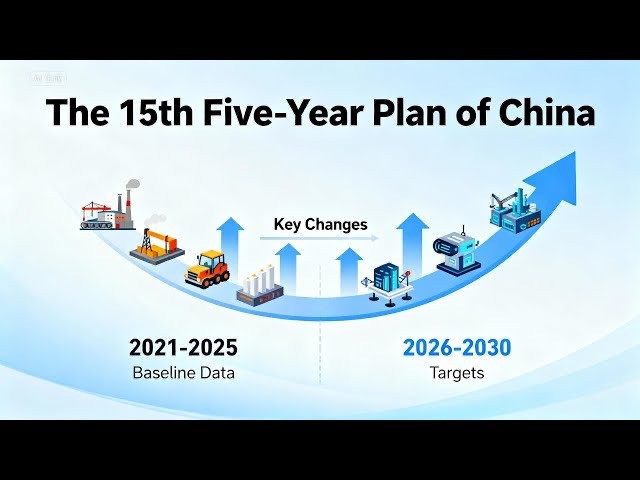
The draft of the 15th Five Year Plan (2026-2030) has been distributed to the NPC and CPPCC delegates for review en deliberation, after which a final version will become available at the conclusion of the “two sessions” on March 11. To address social and environmental challenges, the plan introduces seven metrics focused on people’s livelihood, including employment, healthcare, and support for children and the elderly. It also mandates a 17% reduction in carbon intensity per unit of GDP to drive the green transition. China’s 15th Five Year Plan outline sets the goal of keeping gross domestic product (GDP) growth within a “reasonable” range during the 2026-2030 period, with specific annual targets to be determined in light of prevailing conditions each year. It aims to lay a solid foundation for doubling per capita GDP from its 2020 level by 2035, bringing the country to the threshold of moderately developed nations. China’s per capita GDP stood at around USD10,504 in 2020. China has set a target for achieving an annual total grain production capacity of around 725 billion kg during the 15th Five Year Plan period and an annual comprehensive energy production capacity of 5.8 billion tons of standard coal equivalent. The Plan prioritizes high-level technological self-reliance, focusing on innovation and breakthroughs in key and core technologies. It aims for the added value from core digital industries to reach 12.5% of China’s GDP during the five year period.
The plan outline indicates that China is preparing for extreme contingencies, including potential external shocks or disruptions to coastal regions. The push to set up strategic hinterlands and backups for key industries in interior regions is expected to continue, while food self-sufficiency and stable energy production are needed to prepare for extreme scenarios. China aims to play a bigger role in setting global standards for AI governance, the digital economy, and outer space activities. This includes establishing a global organization for artificial intelligence (AI) cooperation, along with AI collaboration platforms and technology application centers under the Belt and Road Initiative (BRI) and within the Global South. Beijing also aims to foster an open-source ecosystem for technological development and innovation. Controllable nuclear fusion is to become a cornerstone of China’s future energy supply and security. Plans include speeding up the development of its “artificial sun” program, with fusion positioned as pivotal to achieving long-term energy independence.
The Plan also seeks to strengthen research and application of quantum technology and computing power. It envisions building an integrated space-to-ground quantum communication network and expanding a nationwide computing grid to support cutting-edge scientific research. On energy security, in addition to building oil and gas pipelines and expanding wind and solar power bases, China aims to deepen global cooperation to safeguard the security of “strategic corridors”. The Plan includes a road map to becoming a global magnet for the world’s best minds, including an incentive framework to attract hi-tech talent from abroad. To advance its goal of becoming a global science hub, China will encourage leading overseas science and engineering universities to set up joint educational programs in the country. It also plans to allow cross-border transfers of research funds, making it easier for international teams to work on Chinese soil. It also pledges to better protect private companies, curb profit-driven law enforcement, and improve legal mechanisms to safeguard China’s expanding overseas assets and investments. China will also intensify efforts in deep-sea exploration, polar research, outer space and next-generation nuclear energy – areas it identifies as future sources of scientific innovation and long-term strategic advantage.
The plans to advance deep sea exploration include the development of a new generation of submersibles and setting up a deep sea research station. It also seeks to expand its presence in the Arctic and Antarctic, positioning them as global frontiers for scientific advancement, the South China Morning Post reports.
President Xi Jinping also stressed that the 15th Five Year Plan (2026-30) period will be crucial for building a Healthy China by 2035. The nation aims to raise average life expectancy to 80 years by 2030. The Healthy China Initiative must give priority to key areas, particularly those that benefit broad segments of the population and have far-reaching impact.
This overview is based on reports by the China Daily, Global Times, and South China Morning Post.